
Enterprise SEO Strategy Development: A Complete Guide to AI-Driven Growth Solutions
In a dynamic digital environment, a robust SEO strategy is essential for enterprise growth. This guide outlines steps to build a scalable, AI-enabled SEO programme aligned to business objectives. It shows how to create a custom roadmap, define success metrics, and apply AI to improve performance and measurability.
What Are the Key Steps in Developing an Enterprise SEO Strategy?
Developing enterprise SEO starts with aligning goals to priorities. Define the target audience, conduct comprehensive keyword research to learn how customers search, and perform competitor analysis to uncover gaps and opportunities that inform prioritisation.
How to Create a Custom SEO Roadmap for Scalable Growth
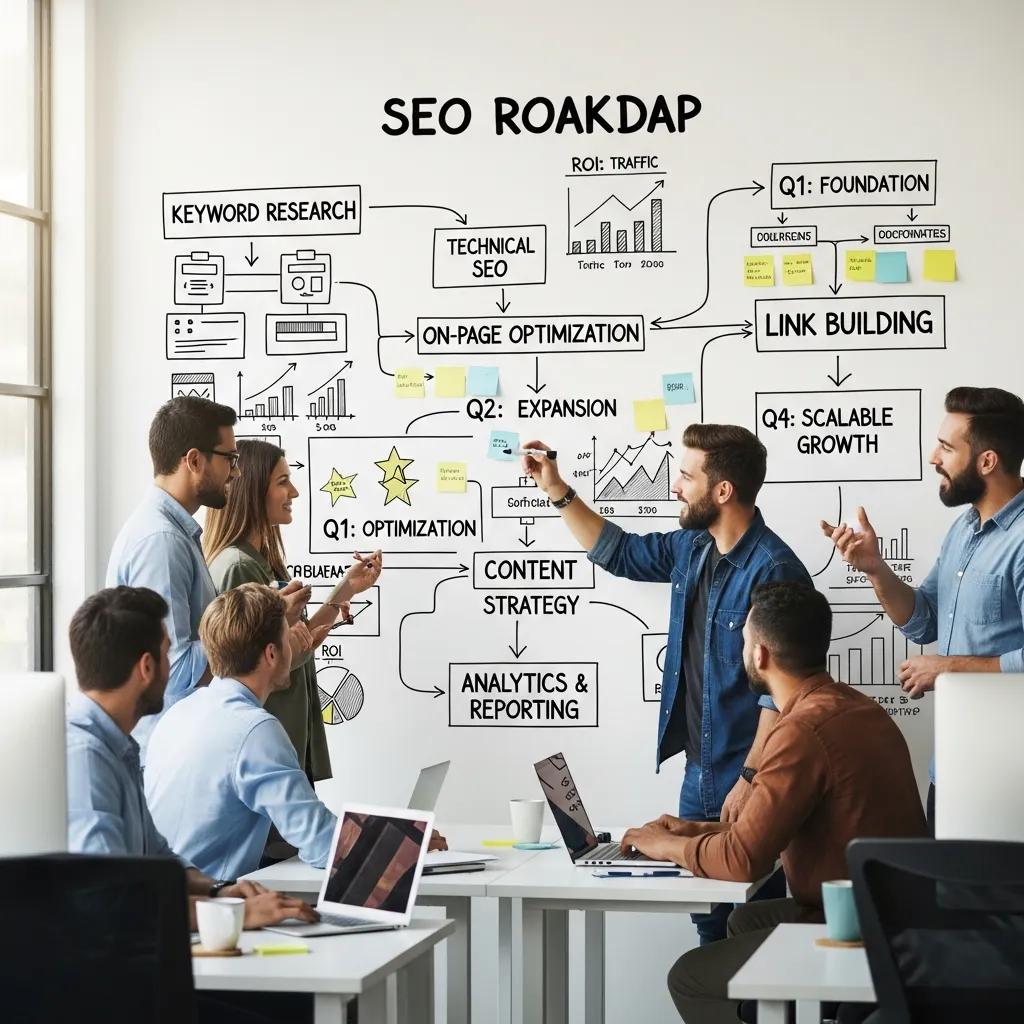
A custom SEO roadmap supports scalable growth: define audiences, set specific measurable objectives, and list phased implementation steps with owners and timelines. For expert support, Golden Path Digital provides AI-powered SEO consulting to help organisations implement tailored, enterprise-grade strategies.
Which Metrics Define SEO Success for Enterprises?
Measure SEO success with clear KPIs:
- Organic Traffic Growth: Increase in visitors from search engines.
- Conversion Rates: Share of visitors completing desired actions (sales, sign-ups).
- Keyword Rankings: Positions of targeted keywords in search results.
Together, these KPIs give a concise view of performance and guide optimisation cycles.
Studies show that AI-driven SEO models significantly improve key digital marketing performance indicators.
AI-Driven SEO Models for Enhanced Digital Marketing Performance
This study examines the impact of AI-driven SEO models on digital marketing performance and the need for adaptive, data-driven optimisation in an algorithmic search environment. The findings indicate that AI improves keyword ranking stability, organic traffic, user engagement, and conversion metrics. Statistical analysis demonstrates strong direct effects of AI-driven SEO on marketing performance, with SEO performance acting as a substantial mediating variable.
AI-Driven SEO Models for Enhancing Digital Marketing Performance, 2025
| Metric | Description | Value |
|---|---|---|
| Organic Traffic Growth | Increase in visitors from search engines | High |
| Conversion Rates | Percentage of visitors completing desired actions | Medium |
| Keyword Rankings | Position of targeted keywords in search results | High |
How Does AI Enhance SEO Strategies for Enterprise Growth?

AI automates large-scale data analysis to surface trends and insights, enabling data-driven decisions and predictive adjustments. It provides personalized content recommendations to match intent and uses predictive analytics to forecast behaviour, allowing proactive content and campaign changes.
Additional research confirms that AI technologies play a pivotal role in transforming marketing workflows and strengthening market competitiveness.
AI-Powered SEO & Digital Marketing for Enterprise Growth
This study investigates how artificial intelligence enhances market competitiveness through its application in search engine optimization and digital marketing strategies within e-commerce. In a saturated, algorithm-driven marketplace, firms face pressure to improve visibility, personalisation, and customer engagement. The findings show that AI technologies—such as machine learning, natural language processing, robotic process automation, and predictive analytics—are instrumental in transforming traditional marketing workflows across the digital funnel.
Enhancing market competitiveness through AI-powered SEO and digital marketing strategies in e-commerce, R Hasan, 2025
What Are the Benefits of AI-Driven SEO Strategies?
Implementing AI-driven SEO delivers several advantages for enterprises. These benefits include:
- Increased Efficiency: Automation of repetitive tasks frees teams to focus on strategy.
- Better Targeting: AI analyses behaviour and preferences for more precise content targeting.
- Enhanced User Experience: Personalized recommendations improve engagement and satisfaction.
Combined, these benefits make AI integration a practical lever for growth and improved ROI.
How to Integrate AI Tools into Your SEO Roadmap?
Integrate AI tools by selecting solutions that match organisational needs, training staff with role-based programs, and establishing measurement routines to validate impact. Iterate the roadmap based on measured results and operational feedback.
Why Is Data Privacy Critical in Enterprise SEO Consulting?
Data privacy builds trust and ensures regulatory compliance, which protects reputation and can influence rankings—search engines favour sites that secure user data. Robust privacy practices are therefore both a legal necessity and strategic advantage.
What Compliance Standards Should Enterprises Follow?
Enterprises must follow compliance standards relevant to their sector and regions, including:
- HIPAA Compliance: Protect patient information in healthcare contexts.
- GDPR Regulations: Meet EU data protection requirements where applicable.
- Data Protection Measures: Implement technical and organisational safeguards to protect user data.
These standards guide lawful, trustworthy SEO and marketing operations.
How to Ensure Data Privacy in Digital Marketing Automation?
Key practices for privacy-safe automation include:
- Implement Encryption: Secure data in transit and at rest.
- Limit Data Collection: Collect only what is necessary for the use case.
- Regular Audits: Review data practices and access controls periodically.
Adopting these controls lets organisations leverage automation while minimising privacy risk.
How Can Digital Marketing Automation Improve SEO Scalability?
Automation improves SEO scalability by streamlining workflows, processing large datasets for faster analysis, and enabling personalised content delivery at scale. This supports higher engagement and more consistent performance as programs expand.
Research further underscores that SaaS-based solutions, when combined with AI, provide the flexibility growing organisations require to adapt to evolving market conditions.
AI & SaaS for Scalable Enterprise Digital Marketing
Scalability and Flexibility: SaaS-based solutions can scale resources up or down based on demand, providing flexibility for growing businesses. This scalability ensures that marketing operations can adapt to evolving market conditions and business growth without significant infrastructure overhauls.
Revolutionizing in-house digital marketing with end-to-end marketing automation powered by AI and SaaS, P Gujar, 2024
Which Automation Solutions Support Enterprise SEO?
Several automation solutions support enterprise SEO, including:
- SEO Tools: Platforms for keyword research, site audits, and tracking.
- Analytics Platforms: Systems that surface behaviour and traffic patterns to inform strategy.
- Content Management Systems: Tools that manage and optimise content workflows.
These platforms provide the core capabilities needed to automate and scale SEO efforts.
How to Align Automation with SEO Roadmap Development?
Align automation to roadmap goals: define clear automation objectives, integrate tools into existing processes, assign owners, and monitor outcomes. Use performance data to refine priorities and timelines.
Following these steps enables enterprises to integrate automation effectively and improve scalability and results.
Frequently Asked Questions
What role does keyword research play in an enterprise SEO strategy?
Keyword research uncovers the search terms customers use and informs content, structure, and targeting. Good research aligns content with user intent and guides topic prioritisation to drive relevant organic traffic and conversions.
How can enterprises measure the effectiveness of their AI-driven SEO strategies?
Measure effectiveness with KPIs such as organic traffic, conversion rates, keyword rankings, and engagement metrics (bounce rate, time on site). Regular reporting and A/B tests validate AI recommendations and guide optimisation.
What challenges do enterprises face when implementing AI in their SEO strategies?
Common challenges include integrating AI with legacy systems, ensuring data quality, staff training, and managing change. Address these with phased rollouts, governance, and clear training plans.
How can enterprises ensure their SEO strategies remain adaptable to market changes?
Maintain adaptability through regular performance reviews, market analysis, and predictive analytics. Set measurable KPIs and create review cadences to pivot priorities when signals change.
What are the best practices for training staff on AI tools for SEO?
Train staff with role-based programmes that combine hands-on workshops, scenario-based exercises, and ongoing support. Start with a skills assessment, use real examples, and encourage cross-team knowledge sharing.
How does user experience impact SEO performance for enterprises?
User experience affects rankings and engagement. Prioritise page speed, mobile responsiveness, clear navigation, and useful content to reduce bounce rate and increase conversions and repeat visits.