Third-party risk management (TPRM) is defined as the continuous lifecycle process of identifying, assessing, monitoring, and mitigating risks posed by external vendors, contractors, and business partners across cybersecurity, compliance, operational, and reputational domains. One-third of organizations have suffered monetary loss or reputational damage due to third-party failures in the last three years, and 28% experienced supply chain disruptions. Those numbers confirm that vendor risk assessment is no longer a compliance checkbox. It is a core function of enterprise resilience. Frameworks like NIST CSF 2.0, ISO 27001:2022, and regulatory regimes including DORA and OCC guidance now define the minimum standard for any credible TPRM program.
What are the core stages of 3rd party risk management?
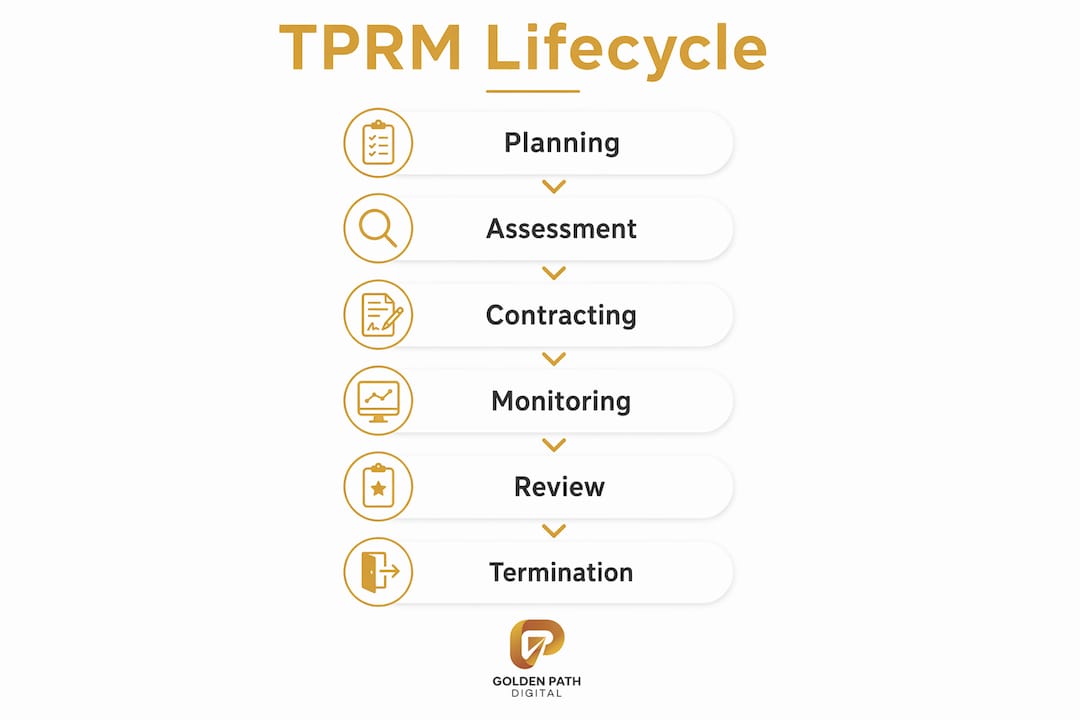
An effective TPRM program runs through six distinct lifecycle stages. Each stage builds on the last, and skipping any one of them creates blind spots that auditors and threat actors will both find.
- Planning and inventory. Map every third party your organization relies on. Categorize them by function, data access, and operational criticality before any assessment begins.
- Due diligence and assessment. Screen vendors across cybersecurity posture, financial stability, regulatory compliance, reputational standing, and concentration risk. The depth of this assessment scales with the vendor’s tier.
- Contracting and onboarding. Translate risk findings into contractual controls. Define SLAs, audit rights, incident notification windows, and data handling obligations before the relationship goes live.
- Ongoing monitoring. Replace static annual reviews with event-triggered reassessments. Vendors change frequently; 67% of monitored sub-processors showed significant change within 90 days. Annual reviews cannot keep pace with that rate of change.
- Remediation. When a vendor fails a control or triggers a risk threshold, your team needs a defined escalation path and a timeline for corrective action. Without this, findings accumulate without resolution.
- Offboarding. Terminate vendor access systematically. Confirm data deletion, revoke credentials, and document the closure for audit purposes.
Tiering vendors by criticality is the most practical way to allocate limited assessment resources. Tier 1 vendors get deep, in-person or evidence-based assessments. Tier 3 vendors get lighter-touch questionnaires. This prevents your team from treating a stationery supplier with the same scrutiny as a cloud infrastructure provider.
Pro Tip: Start with vendor discovery and inventory before distributing any questionnaires. Mass questionnaire distribution without tiering wastes analyst time and produces low-quality data.

| Lifecycle stage | Key activities |
|---|---|
| Planning and inventory | Catalog all third parties; assign criticality tiers |
| Due diligence and assessment | Evaluate cyber, financial, compliance, and reputational risk |
| Contracting and onboarding | Embed controls, SLAs, and audit rights in contracts |
| Ongoing monitoring | Event-triggered reviews; continuous control validation |
| Remediation | Escalate findings; track corrective actions to closure |
| Offboarding | Revoke access; confirm data deletion; document closure |
Which frameworks shape TPRM best practices in 2026?
No single framework covers every dimension of third party due diligence. The most effective programs draw from two or three aligned standards. Organizations using 2–3 aligned frameworks reduce compliance gaps by 38% compared to single-framework users. That gap reduction translates directly into fewer audit findings and faster regulatory approvals.
The four frameworks that matter most in 2026 are:
NIST Cybersecurity Framework 2.0. The new Govern function explicitly addresses supply chain and third-party risk. It provides a structured way to assign accountability and integrate supplier risk management into your broader enterprise risk posture.
ISO 27001:2022. Annex A controls for supplier relationships define minimum requirements for third-party information security. ISO 27001-certified vendors complete assessments 40% faster than non-certified vendors. That efficiency gain compounds across a large vendor portfolio.
DORA (Digital Operational Resilience Act). Mandatory for EU financial entities and their ICT providers, DORA sets prescriptive requirements for contractual provisions, concentration risk monitoring, and incident reporting. US-based firms with EU operations or EU-based vendors must account for DORA in their contractor risk evaluation process.
OCC and FFIEC guidance. US banks and financial institutions operate under OCC Bulletin 2013-29 and FFIEC guidance, which define expectations for third-party oversight across the full vendor lifecycle. These are not optional frameworks for regulated entities.
The Standardized Information Gathering (SIG) questionnaire from Shared Assessments provides a practical assessment tool that maps to most of these frameworks. Using SIG as your primary data collection instrument reduces duplication and makes cross-vendor comparisons cleaner.
Pro Tip: Treat frameworks as structural foundations, not optional checklists. Map your program controls to at least two frameworks from day one. Retrofitting alignment after an audit is significantly more expensive than building it in.
| Framework | Primary scope | Region | Risk domains covered |
|---|---|---|---|
| NIST CSF 2.0 | Cybersecurity and supply chain | United States | Cyber, governance, supply chain |
| ISO 27001:2022 | Information security management | Global | Cyber, data, supplier controls |
| DORA | Digital operational resilience | European Union | ICT risk, concentration, incidents |
| OCC / FFIEC | Third-party oversight for banks | United States | Operational, compliance, financial |
How do technology and data quality impact modern TPRM programs?
Data quality is the single biggest constraint on TPRM effectiveness. Only 17% of organizations rate their TPRM data as fully reliable. Organizations with high-quality data report 52% higher confidence in risk decisions. That gap explains why so many programs produce reports that no one acts on.
Fragmented systems are the root cause. When vendor records live in spreadsheets, assessment results sit in email threads, and contract data is locked in a separate legal repository, your team cannot build a coherent risk picture. Manual spreadsheets and yearly questionnaires cannot scale to the volume and velocity of modern vendor ecosystems. AI-powered continuous monitoring is the direction the industry is moving, but adoption is uneven.
The capabilities that separate mature programs from reactive ones include:
- Continuous monitoring feeds. Automated alerts triggered by vendor news, regulatory actions, financial filings, or security incidents replace calendar-based reviews.
- AI-powered risk scoring. Machine learning models that update vendor risk scores based on real-time signals rather than point-in-time questionnaire responses.
- AI agent workflows that flag emerging threats like AI-driven impersonation and deepfake-based fraud targeting vendor relationships.
- Nth-party visibility. Tools that map your vendors’ vendors, exposing concentration risk and hidden dependencies that direct assessments miss.
- ERM integration. A unified data layer that connects TPRM findings to enterprise risk management (ERM) dashboards, giving the board a consolidated risk view.
Only 53% of organizations report their TPRM programs are mostly integrated with ERM, and just 18% have full integration. That disconnect means most boards are making strategic decisions without seeing the full third-party risk picture. Closing that integration gap is the highest-leverage technology investment a TPRM team can make in 2026.
What are the common governance pitfalls in TPRM programs?
The most common failure in TPRM is not a technology gap. It is a governance gap. TPRM functions frequently get trapped in first-line execution work, processing questionnaires and chasing vendors for documentation, instead of maintaining second-line oversight and governance. When that happens, the function loses its ability to provide independent risk assurance.
Clear ownership models prevent this drift. The first line owns the vendor relationship. Business owners and procurement teams select vendors, manage day-to-day interactions, and are accountable for vendor performance. The second line, your TPRM function, sets policy, defines risk appetite, reviews assessments, and escalates findings to senior leadership. Blurring that boundary is how programs lose credibility.
Cross-functional governance is non-negotiable. Security and risk teams set the governance framework. Business owners remain accountable for vendor relationships. Legal, procurement, and compliance each play defined roles. Without that structure, remediation stalls because no one owns the outcome.
Common operational mistakes that undermine programs:
- Distributing questionnaires before completing vendor discovery and tiering
- Treating TPRM as a cybersecurity-only function, which 48% of leaders currently do, limiting broader risk coverage
- Running annual reviews on a fixed calendar instead of triggering reassessments based on vendor events
- Lacking defined escalation paths, so findings age without resolution
- Siloing TPRM from procurement and legal, creating duplicate or conflicting vendor records
Pro Tip: Phase your program rollout. Start with Tier 1 vendors and build operational muscle before expanding to Tier 2 and Tier 3. A well-executed program covering 20 critical vendors beats a poorly executed program covering 200.
How can TPRM evolve into a strategic resilience function?
A reactive TPRM program focused narrowly on cyber risk and compliance hinders strategic risk integration and limits your organization’s ability to build genuine resilience. The shift from defensive posture to strategic function requires deliberate design choices across governance, data, and technology.
Steps to build a resilience-oriented TPRM program:
- Integrate TPRM with ERM. Connect vendor risk data to your enterprise risk register so the board sees third-party exposure alongside internal risks.
- Elevate data quality as a priority. Treat your vendor inventory and assessment data as a strategic asset. Invest in data governance before investing in new tools.
- Build nth-party visibility. Map your critical vendors’ key sub-processors and technology dependencies. The event-triggered monitoring approach works best when you know which sub-processors to watch.
- Govern AI adoption in your vendor base. As vendors embed AI into their products and operations, your assessments need to cover AI governance, model risk, and HIPAA-compliant AI deployment practices for regulated industries.
- Consider managed services for scale. Managed TPRM services can extend your team’s capacity without sacrificing governance controls, provided you retain ownership of risk decisions.
- Align TPRM with business strategy. When your organization enters a new market or acquires a company, TPRM should be at the table from day one, not called in after contracts are signed.
The programs that will lead in 2026 are those that treat external vendor risk as a continuous intelligence function, not a periodic compliance exercise.
Key Takeaways
Effective 3rd party risk management requires continuous lifecycle governance, multi-framework alignment, high-quality data, and clear ownership structures to protect enterprise resilience and meet regulatory expectations.
| Point | Details |
|---|---|
| Lifecycle over snapshots | Run TPRM as a six-stage continuous process, not a one-time annual review. |
| Multi-framework alignment | Using 2–3 aligned frameworks reduces compliance gaps by 38% versus single-framework programs. |
| Data quality drives decisions | Only 17% of organizations trust their TPRM data fully; fixing this is the highest-leverage investment. |
| Governance clarity prevents drift | Separate first-line vendor ownership from second-line TPRM oversight to maintain independent assurance. |
| Phase your rollout | Start with Tier 1 vendors to build program depth before scaling to lower-tier vendors. |
The gap between knowing and doing in TPRM
Most risk professionals I speak with understand the theory. They know the frameworks, they can recite the lifecycle stages, and they have seen the survey data on third-party losses. The problem is not awareness. The problem is execution under real organizational constraints.
The hardest part of building a mature TPRM program is not the technology selection. It is getting business owners to accept accountability for vendor relationships they have managed informally for years. Procurement sees vendors as cost centers. Legal sees them as contract counterparties. Risk sees them as threat vectors. Until those three views are reconciled into a shared ownership model, your program will keep stalling at the remediation stage.
I have also seen teams invest heavily in monitoring platforms before they have a clean vendor inventory. The result is sophisticated alerts firing against an incomplete asset list. You end up with noise, not signal. The discipline of doing discovery and tiering first, before any technology deployment, is what separates programs that generate insight from programs that generate reports.
The AI-powered monitoring tools entering the market in 2026 are genuinely promising. But they amplify whatever data quality you bring to them. Feed them a fragmented, unverified vendor list and you get faster, more confident wrong answers. The organizations that will benefit most from AI-driven TPRM are the ones that have already done the unglamorous work of building a reliable vendor inventory and a clear governance structure.
— Ty
How Golden Path Digital supports enterprise modernization for risk teams
Risk and compliance programs are only as strong as the systems that support them. When your vendor data lives in legacy applications or disconnected workflows, your TPRM program inherits those gaps directly.
Golden Path Digital works with enterprise teams to modernize the underlying technology infrastructure that risk and compliance functions depend on. From legacy code modernization for IBM i and Laravel environments to custom software development that integrates risk workflows with modern data pipelines, Golden Path Digital helps organizations build the technical foundation that makes audit-ready, automated TPRM possible. If your risk program is constrained by fragmented systems or outdated infrastructure, that is the right place to start.
FAQ
What is 3rd party risk management?
Third-party risk management is the structured process of identifying, assessing, monitoring, and mitigating risks from external vendors, contractors, and business partners across cybersecurity, compliance, operational, and reputational domains.
How many stages does a TPRM lifecycle have?
A complete TPRM lifecycle covers six stages: planning and inventory, due diligence and assessment, contracting and onboarding, ongoing monitoring, remediation, and offboarding.
Which frameworks apply to third party due diligence in 2026?
NIST CSF 2.0, ISO 27001:2022, DORA, and OCC/FFIEC guidance are the primary frameworks shaping third party due diligence in 2026, with the SIG questionnaire serving as a common assessment tool across all four.
Why are annual vendor reviews no longer sufficient?
Static annual reviews cannot keep pace with vendor change rates. Research shows 67% of monitored sub-processors change significantly within 90 days, making event-triggered reassessment the current standard for effective supplier risk management.
What is the biggest operational failure in TPRM programs?
The most common failure is TPRM teams getting absorbed in first-line execution tasks like chasing questionnaires, instead of maintaining second-line governance and independent risk oversight.