
Software source code management (SCM) is the discipline of tracking, versioning, and governing every change to your codebase so that modernization work is auditable, reversible, and safe to run in parallel. For enterprise teams modernizing IBM i RPG or Laravel applications, the single highest-impact action you can take right now is a dependency-mapping and source-extraction assessment that produces an immutable repository snapshot before any automated transform touches your code.
The short version:
- SCM gives your team branching, rollback, and a full audit trail — the three controls that make legacy modernization survivable rather than speculative.
- Dependency mapping before AI-driven transforms is what separates a controlled migration from a production incident.
- Start with a 2–4 week assessment: extract source, snapshot it in version control, and map every program call, file binding, and database object before writing a single refactor rule.
Table of Contents
- What does software source code management actually do for enterprise teams?
- Which SCM practices make modernization safe and repeatable?
- How do you get IBM i RPG source into SCM safely?
- What does safe Laravel upgrade practice actually look like?
- What security and governance controls does your SCM need?
- What does a realistic migration plan look like?
- DIY, managed service, or hybrid: how do you choose?
- Key Takeaways
- The case for slowing down before you speed up
- Golden Path Digital: assessment-led modernization for IBM i and Laravel
- Useful sources and further reading
- FAQ
What does software source code management actually do for enterprise teams?
SCM enables parallel development through branching, provides an audit trail through commit history, and reduces integration risk when multiple engineers collaborate on the same codebase simultaneously. That definition matters more in a legacy modernization context than in greenfield work, because the cost of a wrong merge or an untested transform is measured in production outages, not just rework hours.
Version control is the core, but SCM is broader: it includes artifact management, configuration-as-code, policy enforcement, role-based access, and CI/CD integration. For a team modernizing 40-year-old RPG business logic, that breadth means you can store compile options, build bindings, and infrastructure definitions alongside source — so you can reproduce any environment state exactly.

The business case for legacy teams comes down to three things: reduced integration risk when multiple workstreams run in parallel, traceability for regulatory audits, and the ability to roll back a bad automated transform without a fire drill.
Pro Tip: Treat commit messages as permanent documentation for business logic, not just change labels. A message like “Fix order-total rounding” tells you nothing in three years. “Correct rounding per GAAP rule in AR module — see ticket #4412” is a searchable audit record. Small, frequent commits with meaningful rationale are the cheapest form of institutional knowledge your team will ever produce.
Which SCM practices make modernization safe and repeatable?
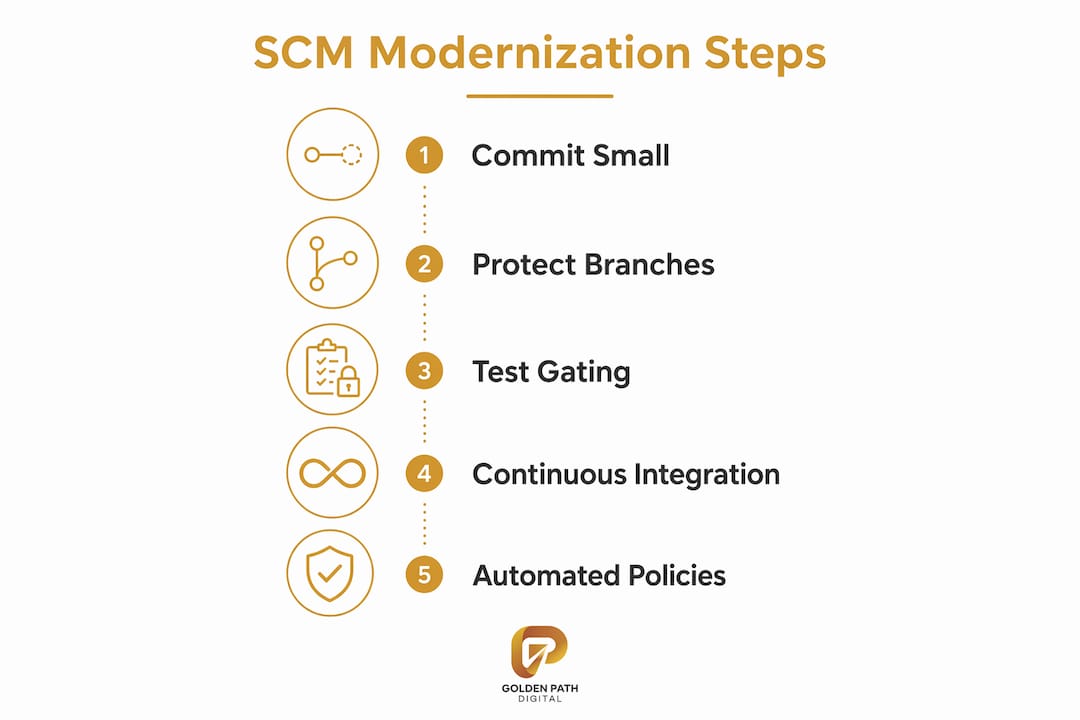
Three practices matter most before you apply any automated transform: small frequent commits to protected branches, branch protection rules that require peer review, and automated CI/CD gates that block promotion when tests fail. Each one reduces a specific category of modernization risk.
| Branch Type | When to Use It | Modernization Context |
|---|---|---|
| Feature branch | One logical change per branch | Isolate each RPG module conversion or Laravel upgrade hop |
| Release branch | Stabilization before a production cut | Lock the codebase while QA validates a converted module |
| Short-lived branch | Spike or proof-of-concept | Test a Rector rule set before applying it to the full codebase |
CI/CD gates should run in three layers. At commit, run static analysis and unit tests. Pre-merge, run integration tests and dependency scans. Post-merge, run end-to-end tests against a staging environment that mirrors production data shapes. This progression catches different failure classes at the cheapest possible point in the pipeline.
Test gating is where most legacy modernization programs stall. If your automated test coverage of core business flows is below a threshold your team can defend to a risk committee, the right move is incremental characterization tests — tests that capture current behavior without asserting correctness — before you refactor anything. These tests become your safety net, not a quality statement.
How do you get IBM i RPG source into SCM safely?
The safest approach is phased source extraction followed by dependency mapping, with no automated refactoring until both are complete. Skipping either step means your AI-driven transforms are operating on assumptions about program calls and database bindings that may be wrong.
Source-extraction checklist:
- Snapshot all RPG source members to a Git repository, preserving original fixed-format artifacts without modification.
- Record build and runtime bindings: which programs call which, which files are opened, and which database objects are accessed.
- Capture compile options and library lists so any build is reproducible from the repository alone.
- Tag the snapshot with a baseline label before any conversion work begins — this is your rollback point.
Dependency mapping before AI-driven transforms reduces the chance that automated changes will break hidden runtime bindings or database interactions. — Golden Path Digital
Once the snapshot is in place, the incremental modernization sequence follows five gated phases: assess and stabilize, extract and snapshot to SCM, convert fixed-format to free-format RPG, modularize via ILE service programs, then expose business logic through APIs. Each phase ends with a test checkpoint and a documented rollback plan. Bundling API exposure with a visible UI initiative is one practical way to make this “invisible” infrastructure work legible to business stakeholders who need to see ROI.
A full IBM i modernization assessment typically surfaces dead code, undocumented program calls, and DB2 table dependencies that no one on the current team knew existed — which is exactly why the assessment precedes the refactor, not the other way around.
What does safe Laravel upgrade practice actually look like?
Laravel upgrades are safest when done one major version at a time, after you have test coverage on core business flows and dependency isolation in place. Attempting a multi-version jump without both prerequisites is where teams lose weeks to cascading failures.
The safe upgrade flow runs in six steps. First, diagnose: run composer outdated and audit which dependencies are pinned to old version constraints. Second, isolate: separate framework dependency updates from application dependency updates so failures have a clear cause. Third, automate syntactic changes using Rector and community rule sets — tools like laravel-upgrades-rector cover 64 rules across Laravel 10 through 13, handling breaking changes, contract updates, and config rewrites automatically. Fourth, work through the manual checklist: automation produces advisory comments and TODO stubs that require developer review before the upgrade is complete. Fifth, run end-to-end tests against production-representative data. Sixth, promote to staging, validate, then merge.
Test coverage is the gating requirement, not a nice-to-have. Automated test suites covering core business features are a prerequisite for safe major upgrades. If coverage is thin, build characterization tests first — tests that document what the application currently does — then upgrade against that baseline. For teams weighing manual versus automated upgrade approaches, the decision usually turns on how much custom business logic sits outside standard Laravel conventions.
What security and governance controls does your SCM need?
Treat your SCM platform as a security asset, not just a code storage system. The OpenSSF SCM best practices are explicit: enforce two-factor authentication and SSO organization-wide, apply branch protection rules, limit the number of repository owners, and enable both vulnerability scanning and secret scanning on every repository.
Security checklist for enterprise SCM:
- Enforce MFA and SSO for all repository access — no exceptions for service accounts.
- Apply branch protection to main and release branches: require at least one code-review approval before merge.
- Enable secret scanning to catch credentials committed accidentally.
- Run dependency scanning on every pull request to catch supply-chain vulnerabilities before they merge.
- Maintain audit logs for all administrative actions and access changes.
- Sign commits where your risk tier requires non-repudiation.
SLSA level 2 requires a version control system with immutable history; SLSA levels 3 and 4 add stronger source provenance and two-person review requirements. Tier your repositories by risk: production business logic and regulated data pipelines belong at a higher SLSA level than internal tooling.
Pro Tip: Automate policy enforcement rather than relying on manual audits. Tools that scan repository configurations against your organization’s policy baseline catch drift before it becomes a compliance finding — and they scale across hundreds of repos without adding headcount.
What does a realistic migration plan look like?
A phased migration runs across five time bands. Assessment (weeks 1–4): extract source, map dependencies, establish baseline test coverage. Extraction (weeks 3–6, overlapping): snapshot to SCM, validate build reproducibility. Refactor (weeks 5–16): apply automated transforms incrementally, one module or version hop at a time. Validation (weeks 14–18): end-to-end testing, security review, performance baseline. Deployment (weeks 17–20): staged rollout with rollback triggers defined in advance.
| Phase | Owner | Key Deliverable |
|---|---|---|
| Assessment | Engineering + Vendor | Dependency map, test-gap report |
| Extraction | Engineering | Immutable SCM snapshot |
| Refactor | Engineering + QA | Converted modules with passing tests |
| Validation | QA + Security | Sign-off report, penetration test |
| Deployment | Engineering + Product | Production release with rollback plan |
Primary cost drivers are dependency complexity, test-gap remediation, custom business logic that automation cannot handle, regulatory requirements that add review cycles, and QA cycles for high-risk modules. Success metrics worth tracking: deployment frequency post-migration, mean time to rollback, percentage of core flows covered by automated tests, and runtime error rate in the first 90 days after go-live.
DIY, managed service, or hybrid: how do you choose?
Choose DIY if your team has deep platform expertise, existing test coverage above your safety threshold, and the internal capacity to run a multi-month modernization program without pulling engineers off product work. Choose a managed service if you need vendor tooling, faster time-to-value, or you lack RPG or Laravel specialists internally. A hybrid model — your team owns the business-logic decisions, a vendor owns the tooling and assessment — often fits enterprises with strong engineering leadership but thin platform depth.
Vendor-evaluation questions to ask:
- Does your assessment produce a dependency map before any code is changed?
- What is your test-gating policy, and what happens if coverage is below your threshold?
- How do you handle rollback if an automated transform breaks a runtime binding?
- What are your security controls: SSO, MFA, protected branches, audit logging?
- Can you provide references from IBM i or Laravel modernization engagements of similar scale?
Red flags in vendor proposals: no dependency mapping before transforms, no test-gating requirement, promises of 100% automation with no manual review step, and vague rollback “plans” with no documented triggers. A vendor who cannot explain their RPG modernization vetting criteria in concrete terms is a vendor operating on assumptions your production environment will eventually disprove.
Understanding how modernization fits into your broader IT asset lifecycle is also worth factoring into the decision — particularly when the systems being modernized are load-bearing for other enterprise platforms.
Key Takeaways
Dependency mapping before any automated transform is the single practice that most consistently separates successful enterprise modernization programs from expensive rollbacks.
| Point | Details |
|---|---|
| Map dependencies first | Extract source to SCM and map all program calls, file bindings, and DB objects before running any automated transform. |
| Gate on test coverage | Build characterization tests for core business flows before upgrading Laravel or converting RPG modules. |
| Enforce SCM security controls | Apply MFA, SSO, branch protection, and secret scanning to every production repository. |
| Upgrade incrementally | For Laravel, move one major version at a time; for RPG, gate each phase with tests and a documented rollback plan. |
| Golden Path Digital assessment | A 2–4 week dependency-mapping assessment with Golden Path Digital produces an immutable snapshot and a prioritized modernization roadmap. |
The case for slowing down before you speed up
There is a persistent pressure in enterprise modernization to get to the automation as fast as possible. AI-driven code transforms, automated upgrade tools, and dependency scanners are genuinely powerful — but they amplify whatever is already in your codebase, including the hidden bindings and undocumented assumptions that have accumulated over decades.
The teams that move fastest through modernization are almost always the ones that spent the most time on assessment. They know their blast radius before they fire. They have a rollback plan that has been tested, not just written. Their SCM configuration is a security asset, not an afterthought. And their test suite, however thin it started, covers the flows that matter before any automated tool touches production logic.
The conventional wisdom says “start modernizing now, assess as you go.” The evidence from IBM i and Laravel programs that have gone sideways says the opposite: assess first, on a schedule, so you modernize on a plan instead of on a prayer.
Golden Path Digital: assessment-led modernization for IBM i and Laravel
Legacy modernization without a dependency map is expensive guesswork. Golden Path Digital’s assessment-led approach gives your team a concrete starting point: an immutable SCM snapshot, a full dependency map, and a prioritized roadmap before a single line of production code is changed.

AS/Forward parses and analyzes IBM i RPG codebases, surfacing program call graphs, dead code, and database object dependencies that manual review misses. Laravel Ascend automates framework upgrades from version 6 through 11, applying Rector-based transforms incrementally with a reviewable commit per version hop. QuantaPath AI handles CRM and workflow automation for teams that need operational efficiency gains alongside code modernization, with HIPAA-compliant integration built in.
All three products operate within a security posture that includes SSO, MFA, protected branches, and audit logging as standard. To start with a legacy code modernization assessment, contact Golden Path Digital and schedule a 2–4 week engagement that delivers a dependency map and a phased modernization plan your team can act on immediately.
Useful sources and further reading
- OpenSSF SCM Best Practices — authoritative checklist for SCM platform security configuration, covering MFA, branch protection, secret scanning, and supply-chain controls.
- Sonar: What Is Source Code Management? — clear definition of SCM versus version control, with coverage of CI/CD integration and artifact management.
- Google Cloud: Safeguard Source — SLSA framework mapping for source controls, from level 2 immutable history through level 4 provenance requirements.
- Laravel Upgrade Documentation — official upgrade guide for Laravel 10 through 13, the primary reference for breaking changes and manual review requirements.
- MC Press Online: RPG Modernization — practitioner guidance on the phased IBM i RPG modernization sequence, from stabilization through API exposure.
- Atlassian: SCM Best Practices — practical guidance on commit discipline, branching strategies, and SCM culture for long-lived codebases.
- Golden Path Digital: IBM i Modernization Assessment — recommended starting point for teams ready to run a dependency-mapping engagement on an RPG codebase.
FAQ
What is software source code management in enterprise modernization?
Software source code management (SCM) is the practice of tracking, versioning, and governing every code change through a system that supports branching, rollback, and audit trails. In a legacy modernization context, it is the control layer that makes automated transforms safe and reversible.
Why does dependency mapping have to come before AI-driven code transforms?
AI-driven transforms operate on what they can parse — they cannot detect hidden runtime bindings or undocumented database interactions. Mapping dependencies first defines the blast radius of any change, so automated tools do not break production logic they were never shown.
How much test coverage do you need before upgrading Laravel?
There is no universal percentage, but your automated tests must cover core business flows end to end before a major version upgrade. If coverage is thin, build characterization tests that document current behavior first, then upgrade against that baseline.
What SCM security controls are required for regulated enterprise environments?
At minimum: MFA and SSO for all repository access, branch protection with required code review, secret scanning, dependency scanning on pull requests, and audit logging for administrative actions. SLSA level 2 additionally requires immutable commit history; levels 3 and 4 add source provenance and two-person review.
How does Golden Path Digital approach IBM i RPG modernization?
Golden Path Digital uses AS/Forward to parse RPG codebases and produce a dependency map before any automated refactoring begins. The engagement follows a phased sequence: assess, extract to SCM, convert format, modularize, and expose via APIs, with test gates and rollback points at each phase.