

Choose a specialist enterprise B2B PPC partner that prioritizes CRM feedback loops, pilot-first validation, and full account ownership. Golden Path Digital is the recommended partner for enterprise IT leaders and marketing teams that need paid search tied directly to pipeline, not just platform metrics. The core rationale: closed-loop sales feedback from CRM into ad platforms drives better bidding and targeting than any platform setting alone, and retaining admin account ownership protects your data and your investment at contract end.
Your immediate action: scope a 60–90 day pilot on a single channel or campaign type, and request a full audit before signing anything long-term.
- Require GCLID capture from day one. Without it, offline conversion imports are impossible and your bidding strategy is flying blind.
- Demand CRM feedback loops. Sales disqualification reasons and opportunity status must flow back into the ad platform to inform bid adjustments.
- Retain admin account ownership. If the agency owns the account, you lose your data and history at contract end.
- Start with a pilot. Seasoned practitioners recommend refusing long-term contracts until a short test validates operational fit.
Pro Tip: Ask any prospective agency to walk you through their GCLID capture and offline conversion import process in your first call. Vague answers here are a disqualifier for enterprise work.
Table of Contents
- How do you evaluate the best B2B PPC agencies for enterprise?
- What should a 60–90 day pilot actually include?
- What should you expect in the first 90 days?
- How do you validate agency case evidence?
- Key Takeaways
- The logo trap is costing enterprise buyers real pipeline
- Golden Path Digital’s enterprise PPC and pilot offer
- Useful sources
- FAQ
How do you evaluate the best B2B PPC agencies for enterprise?
The most common mistake enterprise buyers make is treating agency selection like a vendor audit: checking certifications, reviewing logo slides, and comparing platform badges. A polished pitch can mask a thin day-to-day team, and the senior strategist who presents in the pitch is rarely the person managing your account on Tuesday morning.
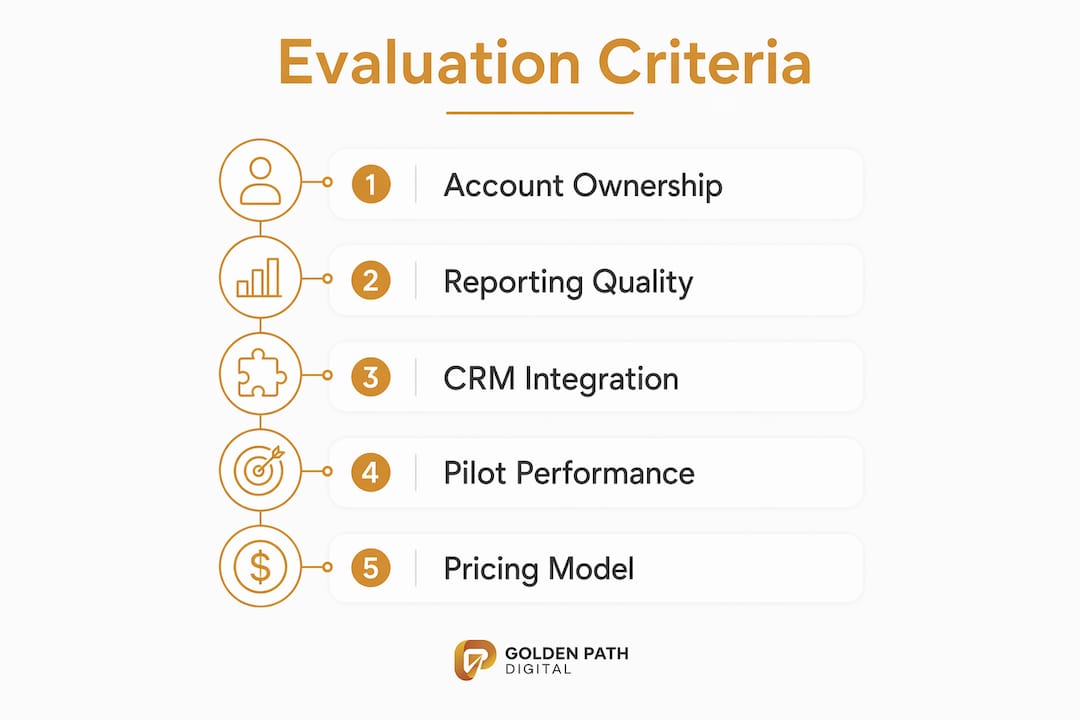
Use this checklist to evaluate any agency against what actually matters for enterprise B2B:
- Account ownership: You hold full admin access to every ad account. Non-negotiable.
- CRM integration depth: Can they document GCLID capture, offline conversion imports, and how disqualification reasons affect bid adjustments?
- Sales feedback loop: Do they have a defined process for importing sales notes and opportunity status back into the ad platform?
- Attribution fluency: Can they explain multi-touch attribution and connect ad spend to pipeline, not just clicks?
- Team seniority: Who is the actual day-to-day account lead, and what is their experience with B2B enterprise accounts?
- Security and compliance: For healthcare or regulated industries, do they support HIPAA-compliant CRM integration and data handling?
- Specialist platform depth: Specialist agencies outperform generalists when long sales cycles and multi-touch attribution are required. Prioritize deep Google Ads and LinkedIn Ads experience.
Ten interview questions to ask before you sign
- Who is the day-to-day account lead, and can we meet them before signing?
- Walk us through your GCLID capture and offline conversion import process.
- How do you use sales disqualification reasons to adjust bids and targeting?
- What CRM platforms have you integrated with, and how long does setup take?
- Who holds admin access to our ad accounts, and what happens to that access at contract end?
- What does your reporting stack look like, and how do you connect ad spend to pipeline?
- Can you show a case study where you improved SQL volume, not just CTR?
- What is your escalation path if campaign performance drops materially?
- How do you handle a pilot scope, and what will we learn in the first 30, 60, and 90 days?
- What are your contract exit terms, and how is data ownership documented?
Scoring matrix for your RFP
A weighted evaluation framework that prioritizes account ownership and reporting quality correlates with better long-term outcomes. Limit your shortlist to 3–5 agencies to avoid decision fatigue.

| Dimension | Weight | What to look for |
|---|---|---|
| Account ownership | 25% | Full admin access, documented exit terms |
| Strategy depth | 20% | CRM integration, feedback loop process |
| Reporting quality | 20% | Pipeline-connected dashboards, SQL tracking |
| Team and access | 15% | Day-to-day lead seniority, continuity plan |
| Fee transparency | 10% | Clear pricing, no hidden spend markups |
| Platform certifications | 10% | Current Google Ads, LinkedIn certifications |
What should a 60–90 day pilot actually include?
A pilot is your proof of concept, not a courtesy gesture. The goal is to determine whether the agency can connect ad spend to qualified pipeline within a defined scope, before you commit to a 12-month contract.
Pro Tip: Scope the pilot to one channel (Google Ads or LinkedIn) and one campaign type. A focused test produces cleaner signal than a broad launch.
Pilot scope checklist
- Define a single channel and campaign type (e.g., Google Ads branded + competitor, or LinkedIn single-funnel).
- Confirm landing page ownership and who controls copy changes during the test.
- Complete CRM integration tasks: GCLID capture, offline conversion import, lifecycle stage mapping.
- Set a test budget that is sufficient to generate statistically meaningful data (typically $10,000–$20,000 in ad spend over 60–90 days).
- Agree on measurement fixes before launch, not after.
Pilot KPIs mapped to business outcomes
| Pilot metric | Business outcome | Acceptable signal |
|---|---|---|
| SQL volume | Pipeline generation | Positive trend by day 60 |
| Cost per SQL | CAC trajectory | Declining or stable |
| Qualified meeting rate | Sales efficiency | Above baseline |
| Offline conversion import rate | Attribution accuracy | — |
| Opportunity creation rate | Revenue potential | Measurable by day 90 |
Red flags that should end a pilot early
- The agency cannot explain offline conversion imports or GCLID capture after week two.
- Reporting shows only platform metrics (CPC, CTR, impressions) with no pipeline connection.
- Account admin access is withheld or delayed.
- The day-to-day lead changes without notice or explanation.
- Evasive answers when you ask how disqualification reasons affect bidding.
For contract language, negotiate a short-term pilot agreement (30–90 days) that explicitly documents data ownership, account access rights, and exit terms before any work begins.
What should you expect in the first 90 days?
A credible partner should show you what will be learned in the first 30, 60, and 90 days: channel fit, offer friction, landing page quality, sales handoff, cost per SQL, and CAC direction. That structured learning agenda is itself a signal of agency maturity.
- Days 1–30: Full account audit, tracking fixes (GCLID, offline imports), baseline measurement, and initial hypothesis documentation. No major spend increases until tracking is verified.
- Days 31–60: Hypothesis testing on one channel. Landing page and offer review. First SQL data from CRM imports. Weekly reporting cadence established.
- Days 61–90: Channel validation, landing page and sales-handoff improvements, early CAC/payback trajectory, and executive summary with go/no-go recommendation.
Pricing models and what to expect
Enterprise PPC retainers typically range from $3,000–$15,000 per month, with percentage-of-spend models falling between 10%–20%. Enterprise engagements frequently exceed $10,000 per month when CRM integration, attribution work, and dedicated account management are included.
- Monthly retainer: Predictable cost, best when scope is well-defined.
- Percentage of ad spend: Aligns agency incentives with spend volume; watch for incentives to increase budget without pipeline justification.
- Hybrid: Base retainer plus performance incentive tied to SQL or opportunity creation. Best alignment for enterprise B2B.
- Performance-based: Rare at enterprise scale; useful as a bonus layer, not a primary structure.
Reporting SLAs should include weekly campaign updates, monthly pipeline reports, and a defined escalation path (response within 24 hours for material performance drops). For paid advertising campaign structures, confirm that reporting connects ad spend to CRM outcomes, not just platform dashboards.
How do you validate agency case evidence?
Polished case studies are easy to produce. Verifiable outcomes tied to pipeline are not. Request the following before any final decision:
- CRM-to-ad account setup documentation showing GCLID capture and offline import configuration.
- Pre/post pilot metrics tied to SQL volume and pipeline, not just CTR or conversion rate.
- Anonymized sales notes showing how disqualification reasons were used to adjust targeting.
- Sample dashboards that connect ad spend to opportunity creation.
What credible enterprise case evidence looks like
When checking references, ask:
- Did the day-to-day team stay consistent throughout the engagement?
- How were performance issues escalated, and how quickly were they resolved?
- Did the agency retain or return full account admin access at contract end?
- Can you share the actual SQL or pipeline numbers from the engagement?
Red flags in case studies: missing time frames, platform-only KPIs (CTR, impressions), no mention of CRM integration, and attribution claims with no methodology. Any agency presenting B2B paid search services at enterprise scale should be able to produce at least one case study with documented pipeline outcomes.
Key Takeaways
The single most important criterion when selecting among the best B2B PPC agencies is whether the agency can connect ad spend to qualified pipeline through CRM feedback loops, account ownership, and a structured pilot.
| Point | Details |
|---|---|
| Run an audit first | Request a full account audit before signing any contract; tracking gaps are the most common failure point. |
| Pilot before committing | A 60–90 day pilot scoped to one channel is the most reliable protection against misaligned incentives. |
| Score on a weighted matrix | Use account ownership (25%), strategy depth (20%), and reporting quality (20%) as your top three weights. |
| Require admin ownership | Full admin access to ad accounts must be documented in the contract, with clear exit terms. |
| Verify CRM feedback loops | Any agency that cannot explain GCLID capture and offline conversion imports is not ready for enterprise B2B work. |
| Golden Path Digital | Offers enterprise PPC management with CRM integration, HIPAA-capable controls, and pilot-first engagements. |
The logo trap is costing enterprise buyers real pipeline
The most persistent mistake in enterprise PPC procurement is what I call the logo trap: selecting an agency because of the brands on their client slide rather than the maturity of their day-to-day process. A recognizable client roster tells you the agency can win business. It tells you nothing about whether the account lead assigned to your program understands GCLID capture, knows how to import offline conversions, or has ever mapped disqualification reasons back to a bid strategy.
At Golden Path Digital, the approach starts with dependency mapping before any AI or automation is applied. The same discipline applies to paid media: you map the data flow first (CRM stages, GCLID capture, offline import configuration), then you build the campaign structure around what the data can actually support. QuantaPath AI and the broader automation stack we use for CRM and workflow integration mean that the feedback loop between sales and ad platforms is a documented, auditable process, not a manual export someone runs on Fridays. Products like Laravel Ascend reflect the same philosophy: structured, verifiable, and built to hand off cleanly.
On procurement: always negotiate account exit terms and data ownership before the first invoice. The agencies that resist this conversation are the ones most likely to hold your account hostage at renewal. A confident partner documents it upfront, on a schedule instead of on a prayer.
Golden Path Digital’s enterprise PPC and pilot offer
Enterprise IT leaders and marketing teams dealing with legacy modernization programs need a PPC partner that understands both the technical stack and the pipeline. Golden Path Digital delivers enterprise PPC campaign management with CRM integration, HIPAA-capable controls, full account ownership, and a structured pilot designed to produce verifiable pipeline outcomes in 60–90 days.

The pilot scope includes a full account audit, GCLID and offline conversion import setup, one-channel campaign test, and a KPI dashboard connecting ad spend to SQL volume. Contract terms are procurement-friendly: short-term pilot agreements with documented data ownership and clean exit terms. For enterprise teams also managing legacy code modernization alongside marketing programs, Golden Path Digital’s integrated approach ensures your PPC strategy is aligned with your modernization roadmap. Contact Golden Path Digital at goldenpathdigital.com to scope your pilot.
Useful sources
The claims and frameworks in this article draw from the following primary sources. Use these to validate recommendations and build your own RFP materials.
- How to Choose a PPC Agency — Clutch.co: Vetted checklist for PPC agency selection, including pricing models and red flags.
- B2B SaaS Paid Acquisition Agency — Venture Compass: Detailed framework for CRM feedback loops, GCLID capture, and pipeline-focused optimization.
- 25 Questions to Ask a PPC Agency — Scale Growth Digital: Weighted scoring matrix and interview question bank; copy the matrix directly into your RFP.
- How to Choose a B2B SaaS PPC Agency — Upraw Media: Team seniority checks and the logo-trap warning; use for reference-call question design.
- B2B SaaS Google Ads Agency Framework — The Starr Conspiracy: Pricing model benchmarks and specialist vs. generalist guidance.
- Golden Path Digital PPC Campaign Management: Service page detailing Golden Path Digital’s approach, CRM integration, and pilot offer.
- Golden Path Digital Case Studies: Client outcomes and measurable impact examples for EEAT validation.
| Source | Best used for |
|---|---|
| Clutch.co PPC checklist | General agency vetting and pricing model comparison |
| Venture Compass framework | CRM feedback loop requirements and GCLID documentation |
| Scale Growth Digital questions | RFP scoring matrix and interview question bank |
| Upraw Media guide | Team seniority checks and reference-call design |
| The Starr Conspiracy framework | Pricing benchmarks and specialist platform guidance |
| Golden Path Digital case studies | Verifying enterprise outcomes and pilot scope examples |
FAQ
What makes a B2B PPC agency “enterprise-ready”?
An enterprise-ready agency documents GCLID capture, imports offline conversions from your CRM, retains full admin account access in your name, and connects ad spend to SQL volume rather than platform-only metrics.
How long should a B2B PPC pilot last?
A 60–90 day pilot scoped to one channel is the standard recommendation; this window is long enough to generate meaningful SQL data while limiting financial exposure before a long-term commitment.
What do enterprise B2B PPC engagements typically cost?
Retainers typically range from $3,000–$15,000 per month; enterprise engagements with CRM integration and dedicated account management frequently exceed $10,000 per month, with percentage-of-spend models running 10%–20%.
What is the biggest red flag when evaluating a B2B PPC agency?
Inability to explain offline conversion imports and GCLID capture is the clearest disqualifier; it means the agency cannot connect your ad spend to pipeline, which is the core requirement for enterprise B2B work.
Can Golden Path Digital manage enterprise PPC alongside modernization programs?
Yes. Golden Path Digital’s integrated approach covers enterprise PPC management, CRM and workflow automation via QuantaPath AI, and legacy modernization services, allowing IT and marketing teams to align paid media strategy with their broader modernization roadmap.