

Effective role-based access control design starts with three non-negotiable controls: enforce least privilege from day one, encode separation of duties during role design (not after), and automate lifecycle events so access dies when employment or context changes. Apply this prioritized checklist before touching anything else:
Design controls (do these first):
- Assign every role the minimum permissions its job function requires, no more.
- Name roles by scope, function, and environment:
<scope>:<function>:<env>. - Encode mutually exclusive role pairs (e.g., Payment Creator vs. Approver) at design time. Retrofitting SoD later is significantly harder.
- Scope all role assignments to the narrowest tenant or project boundary available.
- Avoid wildcard permissions and cluster-wide or global scope unless explicitly required.
Operational controls (wire these in before go-live):
- Assign roles to groups or federated attributes, never to individual user accounts.
- Use role IDs for programmatic references; role names change, IDs should not.
- Wire HR lifecycle events to automatic provisioning and deprovisioning.
- Require time-boxed elevation (just-in-time) for all privileged administrator roles. Azure RBAC guidance recommends limiting owner-level assignments as a baseline.
- Schedule quarterly role recertification and immediate revocation on offboarding.
Runtime controls (monitor continuously):
- Alert on sudden privilege changes, orphaned roles, and stale assignments.
- Audit all privileged-role activations and break-glass access events.
- Consult the NIST RBAC project for the canonical model covering users, roles, permissions, and review functions.
Table of Contents
- 1. Enforce the least privilege model in every role you build
- 3. Assign roles to groups and use stable role IDs
- 7. Treat service accounts and machine identities more strictly than human accounts
- 9. Know the privilege escalation paths on your platform
- 10. Avoid role explosion and know when RBAC alone is not enough
- 11. Manage the full role lifecycle from creation to deactivation
- 13. Authoritative references to consult next
- Key Takeaways
- Where most teams get RBAC wrong
- FAQ
1. Enforce the least privilege model in every role you build
Every role should carry the minimum permissions required for its specific job function, and those permissions should be removed or reduced the moment the job function changes. That is the least privilege model in practice, and it is the single most effective control against privilege creep.
The practical implementation breaks down by identity type. For human accounts, define roles around job functions, not individuals. A developer in a staging environment needs read access to logs and write access to their own service namespace; they do not need cluster-admin or subscription-level owner rights. For service accounts, the scope narrows further: a CI/CD pipeline runner needs permission to push images to a specific registry, not to read secrets across the entire project. Workload identities in containers should carry the narrowest OIDC-scoped token that completes the task, with short expiry.
The NIST RBAC model defines the canonical elements your implementation should support: users, roles, permissions, operations, and objects. Use that framework to audit whether your current roles are sized correctly or have drifted into over-scoping over time.
Pro Tip: Set a maximum permission count per role as a design constraint. When a proposed role exceeds that count, it is a signal to split it into two functional roles rather than expand the existing one.
3. Assign roles to groups and use stable role IDs
Assigning a role directly to an individual user account is one of the most common mistakes in role-based access management, and it scales badly. When that person leaves or changes teams, their individual assignment becomes an orphan. Group-based assignment ties access to a job function, not a person, so provisioning and deprovisioning happen automatically when HR systems update group membership.
Do this:
- Assign roles to security groups or federated identity attributes (department, cost center, job title).
- Use role IDs in all API calls, IaC templates, and automation scripts. Role display names change; IDs are stable.
- Scope assignments to the narrowest available boundary: tenant, project, or resource group.
- Map HR lifecycle events (new hire, transfer, termination) directly to group membership changes.
Avoid this:
- Direct user-to-role assignments outside of break-glass or emergency scenarios.
- Wildcard scope (
*) or global assignments when a narrower scope exists. - Relying on role names in code: a rename breaks your automation silently.
Pro Tip: Connect your HR system’s lifecycle events to your IAM platform’s group management API. When a transfer event fires, the old group membership drops and the new one activates automatically, with no manual ticket required.
7. Treat service accounts and machine identities more strictly than human accounts
Machine identities often accumulate the broadest permissions in an environment because they are provisioned once and rarely reviewed. That pattern is the opposite of what your risk posture requires.
Do this for machine identities:
- Prefer short-lived OIDC tokens over long-lived API keys or static credentials.
- Scope every service account role to the specific tenant, project, or resource it serves.
- Rotate credentials on a defined schedule and automate rotation where the platform supports it.
- Audit machine-role changes as rigorously as human-role changes.
Avoid this:
- Long-lived keys stored in environment variables or source code repositories.
- Shared service accounts used by multiple workloads with different permission requirements.
- Granting a CI/CD runner cluster-admin or subscription-owner rights “for convenience.”
For containers and batch jobs, design roles around the specific actions the workload performs: a batch job that reads from one S3 bucket and writes to another needs exactly those two permissions, scoped to those two resources. The Cadence RBAC design guidance recommends caching permissions with short TTLs and centralizing a single can(user, action, resource) check, a pattern that applies equally to service identities.
Pro Tip: Tag every service account with its owning team, the workload it serves, and its next rotation date. Without that metadata, orphaned machine identities become invisible until an incident surfaces them.
For regulated workloads, HIPAA-compliant deployments require that machine identity access to PHI be logged and auditable, which makes scoped roles and short token lifetimes a compliance requirement, not just a security preference.
9. Know the privilege escalation paths on your platform
Every platform has escalation vectors that are not obvious from the documentation. Knowing them before an attacker does is the difference between a hardened environment and an incident.
Common escalation vectors:
- Overly broad verbs in Kubernetes RBAC (e.g.,
*onpodsorsecrets) - Impersonation permissions that allow a lower-privileged account to act as a higher-privileged one
- Wildcard roles that grant access to resources created after the role was defined
- Unattended long-lived tokens with no expiry
- Azure built-in roles with broader scope than the task requires (e.g., Contributor at subscription level when resource-group scope suffices)
Kubernetes-specific caveats: The create verb on pods can be an escalation path if the pod spec allows mounting service account tokens with elevated permissions. The bind verb on ClusterRoleBinding objects allows a user to grant themselves any role they can bind. Review Kubernetes RBAC good practices for the current list of sensitive verbs and recommended mitigations.
Azure-specific caveats: Avoid assigning Owner or User Access Administrator at the subscription level. Scope built-in roles to the resource group or resource level wherever possible. Azure RBAC guidance specifically calls out limiting privileged administrator role assignments as a baseline control.
Platform hardening checklist:
- Audit all
ClusterRoleBindingobjects in Kubernetes for wildcard verbs. - Review impersonation permissions quarterly.
- Scan for long-lived tokens with no expiry date.
- Alert on any new binding that grants cluster-admin or subscription-owner rights.
10. Avoid role explosion and know when RBAC alone is not enough
Role explosion happens when the number of roles grows faster than your team can govern them. The signal is usually a role-per-tenant or role-per-customer pattern where a new role is created for every new context rather than reusing a scoped assignment. Common RBAC implementation pitfalls include RBAC absolutism (trying to express every access decision as a role) and overreliance on automated role mining without human validation.
Patterns to contain role growth:
- Start with verbs and resources, not job titles. Define what actions exist, then group them into roles.
- Use tenant-scoped assignments rather than tenant-specific roles. One
billing:invoice-approverrole assigned at the tenant scope beats 500 tenant-specific variants. - Govern role creation: require an owner, a business justification, and an approval before a new role is created.
- Monitor your role count per tenant ratio. A rising ratio is an early warning sign.
When RBAC alone cannot express the access policy without exploding the role count, consider augmenting with attribute-based access control (ABAC) or relationship-based access control (ReBAC). The comparison below uses generic labels to avoid vendor-specific framing:
| Dimension | RBAC only | RBAC + ABAC | ReBAC |
|---|---|---|---|
| Expressiveness | Moderate: job-function access | High: contextual, attribute-driven | Very high: graph-based ownership |
| Operational cost | Low when governed | Medium: attribute pipeline required | Higher: relationship store required |
| Best fit | Stable job functions, regulated environments | Multi-tenant SaaS, data classification | Social graphs, document ownership, fine-grained sharing |
| Role explosion risk | High without governance | Lower: attributes replace role variants | Low: relationships replace roles |
| Audit complexity | Low | Medium | Higher |
The NIST RBAC model is foundational and saves operational cost when deployed with governance. ABAC or analytics can be layered on top once the role model is stable. Get the role model right first.
11. Manage the full role lifecycle from creation to deactivation
A role that is created but never deactivated is a liability that compounds over time. Role lifecycle management covers four phases: creation, modification, periodic review, and deactivation. Each phase needs an owner, a process, and an audit trail.

Creation: require a business justification, a named owner, and an approval from an IAM administrator before any role goes live. Document the role using the template fields from Section 2.
Modification: treat permission changes to an existing role as a change-control event. Route them through the same review and staging process as a new role. A permission added without review is indistinguishable from a misconfiguration.
Periodic review: recertify roles on the quarterly cadence described in Section 6. Role owners should attest that the permission list still matches the job function and that all current assignments are justified.
Deactivation: when a job function is eliminated or a system is decommissioned, deactivate the role and revoke all assignments before archiving it. Do not leave dormant roles in place; they are targets for reassignment abuse.
For teams running legacy modernization projects, role lifecycle management is especially relevant during migration phases, where old system roles and new platform roles coexist and can create duplicate or conflicting access paths.
13. Authoritative references to consult next
These are the primary sources your team should bookmark and consult for platform-specific commands and up-to-date syntax. Platform docs change; always verify against the current version.
- NIST RBAC project: the canonical model defining Core RBAC, Hierarchical RBAC, and constrained RBAC. Start here for standards compliance and administrative review function requirements.
- NIST revised RBAC model: formalizes role hierarchies and administrative review functions; use it to classify your implementation’s compliance level.
- NIST RBAC standard draft: documents Static SoD, Dynamic SoD, and prescribed review functions for each RBAC level.
- Microsoft Azure RBAC best practices: cloud-specific guidance on limiting owner assignments, scoping roles, and controlling privileged administrator access.
- Implementing RBAC in the enterprise (Start With Identity): practitioner guide covering SoD encoding, IGA foundations, and common design pitfalls.
- 6 Common RBAC Implementation Pitfalls (Idenhaus): practical cautions on RBAC absolutism, role mining overreliance, and the need for ongoing maintenance.
- RBAC failure modes and object-level authorization (Sebastion): explains why route-level RBAC labels fail and how to design domain-action policies correctly.
- RBAC design guide (Cadence blog): practical schema advice covering five core tables, tenant-scoped assignments, centralized
can()checks, and migration signals for ABAC/ReBAC.
Consult Kubernetes RBAC documentation directly at kubernetes.io/docs/reference/access-authn-authz/rbac/ for current verb lists, ClusterRole examples, and good-practices guidance, as syntax and recommended patterns are updated with each Kubernetes release.
Key Takeaways
Effective RBAC requires encoding least privilege and separation of duties at design time, automating lifecycle events, and monitoring continuously so that access stays accurate as your organization changes.
| Point | Details |
|---|---|
| Encode SoD at design time | Retrofitting separation of duties after deployment is significantly harder; model mutually exclusive role pairs before roles go live. |
| Assign roles to groups, not individuals | Group-based assignment ties access to job functions, so provisioning and deprovisioning happen automatically with HR events. |
| Use JIT elevation for admin roles | Time-boxed elevation with approval workflows and auto-revoke eliminates standing privileged access. |
| Automate lifecycle revocation | Wire offboarding events to immediate access removal; do not rely on manual tickets. |
| Augment with ABAC when roles explode | When role count grows faster than governance can manage, use attribute-based constraints to replace role variants. |
Where most teams get RBAC wrong
The most common failure mode is not a misconfigured permission. It is a governance gap: a role that was correct at deployment and quietly became dangerous over 18 months of unchecked accumulation. Teams focus on the initial design sprint and then treat RBAC as a solved problem. It is not. It is an ongoing operational discipline.
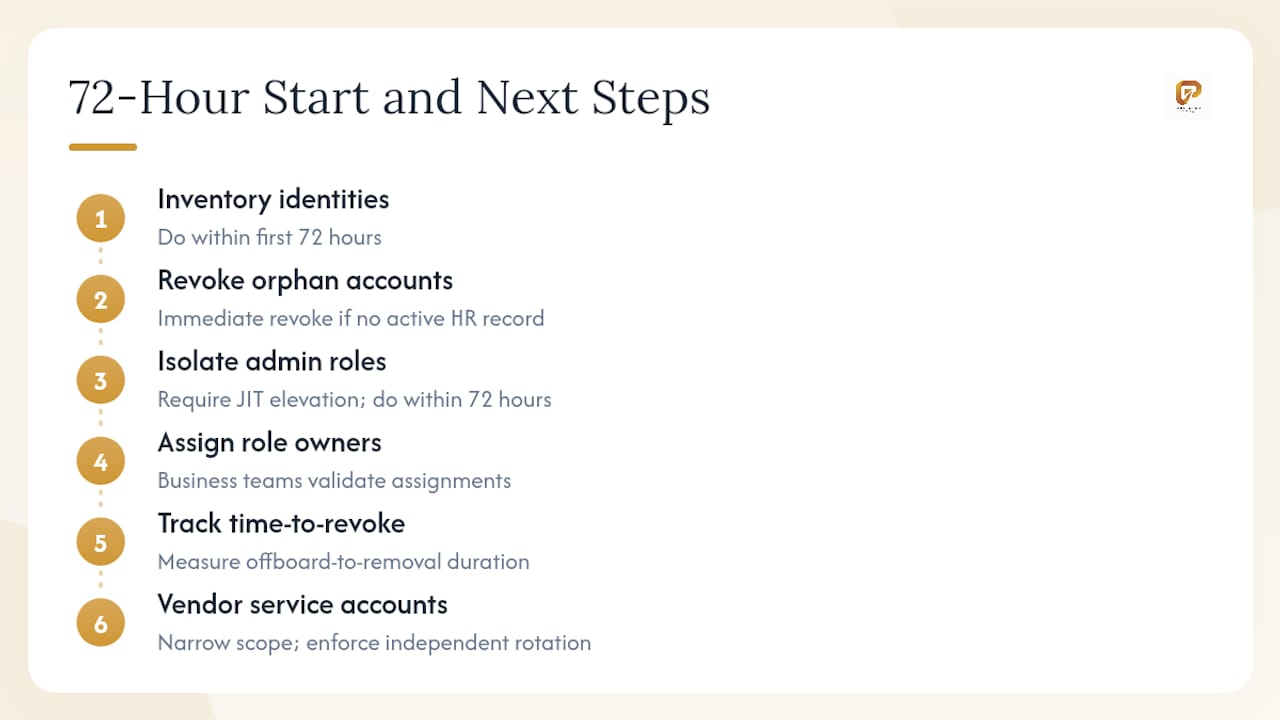
If your team is starting a remediation from scratch, the first 72 hours should look like this: inventory every identity and its current assignments, enforce immediate revocation for any account with no active HR record, and isolate all standing admin roles behind JIT elevation. Those three moves reduce your blast radius before you touch anything else.
The second thing most teams underestimate is cross-functional ownership. RBAC governance fails when it lives entirely in the security team. Role owners need to be the business teams who understand what each role actually does. Security sets the policy and the tooling; the business validates the assignments. Without that partnership, recertification becomes a rubber-stamp exercise.
One practical measure of momentum: track your time-to-revoke metric from the moment an offboarding event fires to the moment all access is confirmed removed. If that number is measured in days rather than minutes, your automation has a gap. Fix that before optimizing anything else.
For teams managing third-party vendor access alongside internal identities, the same principles apply with stricter scope constraints. Vendor service accounts should carry the narrowest possible permissions, scoped to the specific integration they serve, with rotation schedules that do not depend on the vendor’s own security practices.
FAQ
What is the most important RBAC best practice to implement first?
Enforce least privilege and automate offboarding revocation before anything else. Standing over-privileged access and orphaned accounts after termination are the two highest-risk conditions in most environments.
When should you use ABAC instead of RBAC?
Move to ABAC or a hybrid RBAC+ABAC model when your role count is growing faster than your team can govern it, typically when tenant-specific role variants are multiplying or when contextual conditions (time, location, data classification) cannot be expressed cleanly as roles.
How often should role recertification happen?
Quarterly for all roles, monthly spot-checks for privileged roles, and immediate revocation on any offboarding event. The NIST RBAC model prescribes administrative review functions as a required component of a compliant implementation.
What is the difference between static and dynamic SoD in RBAC?
Static SoD prevents a user from holding two conflicting roles simultaneously. Dynamic SoD prevents a user from activating both roles within the same session, even if they technically hold both. The NIST RBAC standard draft defines both as formal RBAC components.
How do you prevent privilege escalation in Kubernetes RBAC?
Audit all ClusterRoleBinding objects for wildcard verbs, restrict the bind and impersonate verbs to trusted administrators only, and avoid granting create on pods without also restricting the pod spec. Consult the Kubernetes RBAC good practices documentation for the current list of sensitive verbs and recommended mitigations.