

Generative Engine Optimization (GEO) is the practice of structuring your content, authority signals, and technical configuration so that AI answer engines — ChatGPT, Perplexity, Google AI Overviews, and Microsoft Copilot — retrieve and cite your brand rather than a competitor’s. Unlike traditional SEO, which targets a ranking position, GEO targets citation and extraction; your content either gets synthesized into an AI answer or it doesn’t. For enterprise B2B marketers and SEO teams, that distinction changes the entire content strategy.
Three actions you can take before the end of the week:
- Make your top pages’ first 200 words answer-ready. Write a self-contained, direct answer to the page’s primary question before any preamble or context.
- Publish FAQPage schema on every Q&A page so AI crawlers can extract structured question-answer pairs directly.
- Verify Bing indexation for your most important pages. ChatGPT Search pulls from Bing’s index, so pages that Bing hasn’t crawled are invisible to it.
Key Takeaways
GEO requires structuring content for extraction and citation by AI engines, not just ranking in traditional search results — and that distinction demands a different operational playbook.
| Point | Details |
|---|---|
| Citation, not ranking | GEO targets whether AI engines extract and cite your content, not your position in blue-link results. |
| First 200 words are critical | Make the opening of every priority page a self-contained, direct answer to the page’s primary question. |
| Platform-aware indexing | Only roughly 11% of domains are cited by both ChatGPT and Perplexity — optimize for each engine’s specific requirements. |
| Authority drives citation | Off-site mentions and third-party coverage are primary citation signals; PR and customer success are GEO assets. |
| Golden Path Digital | Provides managed GEO programs covering content restructuring, schema deployment, citation campaigns, and measurement for enterprise B2B teams. |
Table of Contents
- Why generative search optimization matters for your pipeline right now
- Core GEO strategies that actually earn AI citations
- Technical foundations your content needs to be citation-eligible
- How to measure GEO visibility and tie it to business outcomes
- A step-by-step GEO playbook from audit to measurement
- Common GEO myths that waste your team’s time
- Tools and validators that support GEO execution
- How Golden Path Digital operationalizes GEO
- Your 30/90/180-day GEO roadmap for enterprise B2B sites
- Risks and challenges of GEO you need to plan for
- A practitioner’s perspective on where GEO programs actually stall
- How Golden Path Digital supports your GEO program
- Sources
- FAQ
Why generative search optimization matters for your pipeline right now
The shift is already underway. Forrester reports that roughly 94% of B2B buyers now use AI in their buying process, and twice as many buyers name generative AI or conversational search as their most meaningful information source compared with any other channel. That means your buyers are forming vendor shortlists inside ChatGPT or Perplexity before they ever visit your website.
Stat to know: Forrester’s B2B buyer research found that zero-click buying behavior is now the norm — buyers complete significant research phases without clicking through to vendor sites at all.
The downstream effects are concrete:
- Branded search lift from citations. When an AI answer names your brand, a portion of buyers follow up with a direct branded search. Citation drives pipeline indirectly even when no click happens in the AI interface.
- Fewer blue-link clicks on informational queries. AI Overviews and conversational answers absorb the research phase. Pages that once captured mid-funnel traffic now compete for a citation slot instead.
- Higher zero-click research behavior. Buyers validate vendors through AI synthesis, then arrive at your site already pre-qualified — or already eliminated.
For marketing, content, and sales teams, the implication is clear: content that cannot be extracted and cited by an AI engine is functionally invisible to a growing share of your buyers. Statista’s SEO threat data reinforces that AI-driven search displacement is among the most significant structural risks facing organic visibility programs today.
Core GEO strategies that actually earn AI citations
Earning citations from AI engines rests on three pillars: extractable content structure, off-site authority, and platform-aware indexing. Miss any one of them and the other two underperform.
Extractable content structure
AI engines synthesize answers from content they can parse quickly. That means your pages need direct, self-contained answers at the top of each section, not buried in paragraph four after three sentences of context-setting. Practical GEO guidance recommends opening each section with a 40–70-word answer paragraph that stands alone, followed by supporting detail. Use question-format H2 and H3 headings (“What does X do?” rather than “Overview of X”) because AI engines match query phrasing to heading text when selecting source passages.
Tables and numbered lists are disproportionately extractable. When you present a comparison, a process, or a ranked set as a table or list, AI engines can lift that structure directly into a synthesized answer. Prose paragraphs require more inference; structured formats require less.
Off-site authority
Off-site citations and third-party mentions are a primary signal for whether an AI engine trusts your content enough to cite it. A page that ranks well organically but has no external mentions is a weaker GEO candidate than a page with moderate organic ranking but strong third-party coverage. This is where PR, customer success, and partner programs become GEO assets: every earned mention on an authoritative domain increases citation probability.
Publish named statistics and original data. AI engines favor content that contains proprietary figures because those figures can’t be found elsewhere, making your page the only viable source for that specific claim.
Platform-aware indexing
ChatGPT Search requires Bing indexation; Perplexity weights freshness and cites a high proportion of sources outside Google’s organic top results; Gemini applies Knowledge Graph verification and weights entity consistency heavily. Treating all AI engines as identical is one of the most common and costly GEO mistakes. Submit your sitemap to both Google Search Console and Bing Webmaster Tools, and confirm that your robots.txt allows the crawlers each platform uses.
Pro Tip: Place your most citation-worthy content — named statistics, direct definitions, comparison tables — within the first two scrollable screens of a page. AI crawlers often weight content proximity to the top of the document when selecting extraction candidates.
Content tactics that move the needle:
- FAQPage schema on all Q&A and support pages
- Comparison pages with clear, structured verdict rows
- Named statistics with source attribution (your own research or cited third-party data)
- Author bylines with credentials and schema markup
- TL;DR summary blocks at the top of long-form content
Technical foundations your content needs to be citation-eligible
A page must clear the SEO “floor” before GEO tactics apply: it must be indexable, snippet-eligible, and renderable by AI crawlers. Structure and off-site authority determine whether it gets cited, but indexability is the prerequisite.
Crawlability checklist
- robots.txt: Confirm you are not blocking GPTBot (OpenAI), PerplexityBot, Bingbot, or Googlebot. Each engine uses a distinct crawler user agent.
- llms.txt: A growing convention — a plain-text file at
/llms.txtthat summarizes your site’s content and structure for LLM crawlers. It does not guarantee citations, but it reduces parsing friction. - Sitemap submission: Submit XML sitemaps to both Google Search Console and Bing Webmaster Tools. Microsoft’s AEO/GEO guidance specifically calls out Bing indexation as a prerequisite for Copilot and ChatGPT Search visibility.
- Server-side rendering: Claude and some Perplexity crawlers do not execute JavaScript. Pages that rely on client-side rendering to load core content may be invisible to these fetchers. Serve critical content in the initial HTML response.
Schema types that matter for GEO
| Schema Type | Primary Use | GEO Benefit |
|---|---|---|
| Organization | Brand identity, sameAs links | Gemini Knowledge Graph verification |
| Article | Author, date, headline | Freshness and EEAT signals |
| FAQPage | Q&A pairs | Direct extraction into AI answers |
| HowTo | Step-by-step processes | Structured answer eligibility |
| Product / SoftwareApplication | Product details | Copilot and shopping-adjacent queries |
| BreadcrumbList | Site hierarchy | Context for AI page classification |
Validate every schema implementation with Google’s Rich Results Test and schema.org’s validator before publishing. Common mistakes include missing required properties (e.g., author on Article schema), incorrect nesting of FAQPage items, and using deprecated property names.
Platform-specific notes
Only roughly 11% of domains are cited by both ChatGPT and Perplexity, which means platform-aware indexing is not optional — it’s the difference between appearing in one engine versus several. For Gemini specifically, entity consistency across your Google Business Profile, Wikipedia presence (if applicable), and on-page Organization schema with sameAs links to authoritative directories materially improves Knowledge Graph recognition. For Perplexity, content freshness matters: pages with recent published or updated dates and current statistics are cited more frequently.
How to measure GEO visibility and tie it to business outcomes
Measuring GEO requires a different instrument panel than traditional SEO. Ranking positions don’t apply. The metrics that matter are:
- Citation rate (share of model): For a defined basket of priority queries, what percentage of AI engine responses cite your brand or content?
- AI referral traffic: In GA4, segment referral traffic from known AI engine domains (perplexity.ai, chatgpt.com, bing.com/chat) to track volume and conversion behavior.
- Branded search lift: Monitor Google Search Console for increases in branded query impressions and clicks that correlate with citation campaigns or content launches.
- Citation velocity: Track how quickly new content earns citations after publication — a useful proxy for crawl freshness and content quality.
- Share of model across engines: Run the same prompt basket across ChatGPT, Perplexity, Gemini, and Copilot separately. Citation rates vary significantly by platform.
| Metric | Definition | Recommended Cadence | Sample Target |
|---|---|---|---|
| Citation rate | % of prompt basket returning your brand | Weekly | 20%+ for priority queries |
| AI referral traffic | Sessions from AI engine domains in GA4 | Weekly | Month-over-month growth |
| Branded search lift | GSC branded impressions vs. baseline | Monthly | 10–15% lift at 90 days |
| Citation velocity | Days from publish to first citation | Per content launch | Under 30 days |
Testing protocol: Build a repeatable prompt basket of 15–25 queries that represent your buyers’ research questions. Run each prompt in incognito mode across all four major engines, record which sources are cited, and log results in a shared tracker. Repeat weekly. Separate results by platform — Perplexity and ChatGPT citation patterns diverge enough that aggregating them masks meaningful signal.
LLM visibility tracking tools can automate portions of this process, reducing the manual overhead of weekly prompt runs across multiple engines.
A step-by-step GEO playbook from audit to measurement
OpenMalo’s four-pillar GEO framework — content structure, schema, authority, and measurement — provides the right sequencing. Content and schema changes show effects in 14–45 days; authority and citation campaigns take 60–120 days to move citation rates materially.
-
Content audit (Week 1–2, Owner: SEO Lead). Identify your top 20–30 pages by organic traffic and conversion intent. Score each for answer-readiness: does the first 200 words contain a direct, self-contained answer to the page’s primary question? Flag pages that bury the answer or open with context paragraphs.
-
Quick wins: rewrite openings (Week 2–4, Owner: Content Team). Restructure flagged pages so the first 200 words lead with a direct answer. Add TL;DR blocks to long-form content. Convert prose comparisons to tables. Add question-format headings to sections that answer specific queries.
-
Schema implementation (Week 3–6, Owner: Engineering + SEO Lead). Deploy FAQPage schema on all Q&A pages, Article schema with author and date on all editorial content, and Organization schema with
sameAslinks on your homepage and about page. Validate with Rich Results Test before and after deployment. -
Crawlability fixes (Week 3–4, Owner: Engineering). Audit robots.txt for blocked AI crawlers. Submit sitemaps to Bing Webmaster Tools if not already done. Confirm server-side rendering for critical pages.
-
Citation acquisition campaign (Month 2–4, Owner: PR + Content + Customer Success). Identify 10–15 authoritative domains in your industry where a mention or guest contribution is achievable. Prioritize publications that Perplexity and ChatGPT already cite for your target queries. Pursue earned coverage, not paid placements.
-
Measurement baseline (Week 1, Owner: SEO Lead + Analytics). Set up the GA4 AI referral segment and the prompt basket before making any changes. You need a pre-change baseline to attribute improvements accurately.
-
Monitoring loop (Ongoing, Owner: SEO Lead). Run the prompt basket weekly. Review GA4 AI referral traffic and GSC branded impressions monthly. Adjust content and citation priorities based on which queries show movement and which remain uncited.
Prioritization matrix for limited engineering bandwidth: If your team can only address one technical item, fix robots.txt crawler access first. Schema implementation second. Server-side rendering third. Content restructuring requires no engineering resources and can proceed in parallel with any technical work.
Expected outcomes:
- 30 days: Crawlability fixed, schema deployed on priority pages, content openings rewritten. First citation appearances on Perplexity for freshness-sensitive queries.
- 90 days: Branded search lift visible in GSC. AI referral traffic segment showing measurable sessions. Citation rate on prompt basket at 10–20% for priority queries.
- 180 days: Authority campaign producing third-party mentions. Citation rate climbing toward 25–30%+ on core queries. Share-of-model data showing platform-specific patterns to guide further investment.
Common GEO myths that waste your team’s time
Myth: GEO is just keyword stuffing for AI. AI engines evaluate semantic relevance and source authority, not keyword density. Stuffing a page with target phrases reduces readability and does not increase citation probability.
Myth: Publishing an llms.txt file will win citations. The llms.txt convention reduces parsing friction, but it does not instruct AI engines to cite you. Content quality, authority signals, and crawlability determine citations.
Myth: GEO replaces SEO. Indexability and snippet eligibility are prerequisites for AI citation consideration. The SEO floor still matters — a page that can’t rank or be crawled can’t be cited.
Myth: One platform covers all your buyers. Only about 11% of domains are cited by both ChatGPT and Perplexity. Optimizing for a single engine leaves significant citation share on the table.
Myth: GEO is a one-time project. Citation rates shift as AI engines update their models, as competitors publish new content, and as your authority profile changes. GEO requires the same ongoing cadence as SEO.
Do not do these:
- Gate your most authoritative content behind lead forms. Gated content cannot be crawled or cited.
- Treat GEO as a marketing-only initiative. Off-site authority requires PR and customer success involvement.
- Rely on a single AI engine’s citation behavior as your primary signal. Platform patterns diverge.
- Skip the measurement baseline. Without pre-change data, you cannot attribute citation improvements to specific actions.
Google’s official guidance on AI Overviews (available at Developers) clarifies that Overviews draw from pages already eligible for web search results. Being indexed and snippet-eligible is necessary but not sufficient — content quality and authority determine selection.
Tools and validators that support GEO execution
| Tool | Primary Use | Recommended Frequency |
|---|---|---|
| Google Rich Results Test | Schema validation | Every schema deployment |
| Bing Webmaster Tools | Bing indexation and sitemap submission | Weekly monitoring |
| Google Search Console | Branded search lift, indexation status | Weekly |
| GA4 AI referral segment | AI engine traffic tracking | Weekly |
| Perplexity (manual prompts) | Citation testing and source review | Weekly prompt basket |
| ChatGPT Browse (manual prompts) | Citation testing for OpenAI/Bing-indexed content | Weekly prompt basket |
| Brand mention monitoring tools | Brand mention monitoring across web | Weekly |
| schema.org validator | Schema syntax checking | Every schema deployment |
Key resources:
- Google’s AI Overviews guidance at developers.google.com: the authoritative source for what makes a page eligible for Overview inclusion.
- Bing Webmaster Tools (bing.com/webmasters): sitemap submission, crawl diagnostics, and indexation status — required for ChatGPT Search visibility.
- Microsoft’s AEO/GEO guide: platform-specific recommendations for Copilot and Bing-powered AI discovery.
- Shadow’s platform optimization guide: per-engine formatting and indexing requirements for ChatGPT, Perplexity, Gemini, and Claude.
- Golden Path Digital’s AI SEO fundamentals: foundational GEO concepts for technology businesses optimizing for generative AI search.
- Top SEO software alternatives: tool comparisons for teams evaluating measurement and automation platforms.
How Golden Path Digital operationalizes GEO
The workflow Golden Path Digital uses for GEO programs follows a structured sequence: intake and audit, content restructuring, schema and engineering fixes, off-site citation campaign, and a measurement loop that runs continuously.
Intake and audit maps the client’s existing content against a priority query basket. Pages are scored for answer-readiness, schema coverage, and Bing indexation status. Engineering and content gaps are logged separately so work can proceed in parallel.
Content restructuring focuses on the first 200 words of each priority page and on converting prose comparisons to tables. Author bylines with credentials are added to all editorial content, along with published and updated dates. Organization schema with sameAs links to LinkedIn, Crunchbase, and relevant industry directories is deployed on the homepage and about page — a direct EEAT signal for Gemini’s Knowledge Graph verification.
Schema and engineering deploys FAQPage, Article, HowTo, and SoftwareApplication schema as appropriate, validated through Google’s Rich Results Test before each push. robots.txt is audited for AI crawler access, and sitemaps are submitted to both Google Search Console and Bing Webmaster Tools.
Off-site citation campaign targets 10–15 authoritative publications per quarter. The PR and customer success teams identify opportunities for earned coverage, contributed articles, and product mentions on domains that AI engines already cite for the client’s target queries.
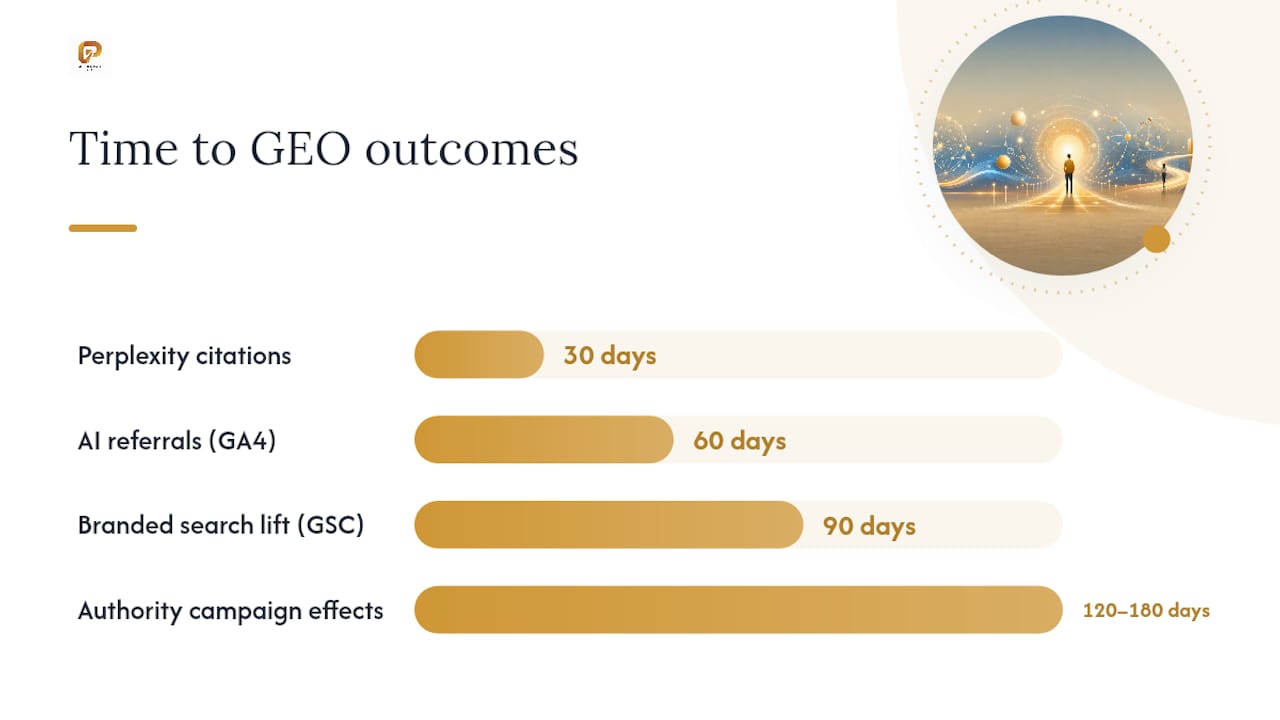
Anonymized outcomes from GEO programs: Enterprise B2B clients running this workflow typically see first Perplexity citations within 30 days of content restructuring, measurable AI referral traffic in GA4 within 60 days, and branded search lift in Google Search Console within 90 days. Authority campaign effects on citation rate become visible at the 120–180-day mark.
Privacy and compliance note: For clients in regulated industries, gated content and HIPAA-sensitive materials are excluded from GEO optimization by default. Public-facing educational content, product pages, and non-PHI documentation are the appropriate targets. Golden Path Digital’s HIPAA-compliant AI deployment framework ensures that automation and AI visibility work stays within compliance boundaries.
EEAT signals to include on every priority page:
- Author byline with name, title, and credentials
- Published date and last-updated date
- Organization schema with
sameAslinks to authoritative directories - Inline citations linking to primary sources for any statistics or claims
- Clear editorial review process noted in site metadata or author bio
Your 30/90/180-day GEO roadmap for enterprise B2B sites
30-day priorities (foundation)
- Audit top 30 pages for answer-readiness (SEO Lead). Score each page’s first 200 words. Flag pages where the direct answer is absent or buried.
- Fix robots.txt for AI crawlers (Engineering). Confirm GPTBot, PerplexityBot, and Bingbot are allowed.
- Submit sitemap to Bing Webmaster Tools (SEO Lead). Required for ChatGPT Search indexation.
- Deploy FAQPage schema on priority Q&A pages (Engineering + SEO Lead). Validate with Rich Results Test.
- Set up GA4 AI referral segment and prompt basket (Analytics + SEO Lead). Establish the pre-change baseline.
- Rewrite top 10 page openings (Content Team). Lead with a 40–70-word direct answer on each.
90-day priorities (structure and schema)
- Complete content restructuring across top 30 pages (Content Team). Tables, question headings, TL;DR blocks.
- Deploy Article and Organization schema site-wide (Engineering). Include
sameAslinks and author markup. - Confirm server-side rendering for critical pages (Engineering). Audit for JavaScript-dependent content.
- Launch first citation acquisition outreach (PR + Content). Target 5–8 authoritative domains.
- First measurement review (SEO Lead + Analytics). Compare citation rate and AI referral traffic to baseline.
180-day priorities (authority and scale)
- Scale citation acquisition to 10–15 domains per quarter (PR + Customer Success). Prioritize domains already cited by target AI engines.
- Publish original research or named statistics (Content + Product). Proprietary data increases citation probability for queries where no other source has the figure.
- Expand schema to HowTo and SoftwareApplication types (Engineering + SEO Lead). Cover product and process pages.
- Full share-of-model audit across ChatGPT, Perplexity, Gemini, and Copilot (SEO Lead). Identify platform-specific gaps and adjust content format accordingly.
- Quarterly content refresh cycle (Content Team). Update statistics, dates, and examples on high-priority pages to maintain freshness signals for Perplexity.
If engineering bandwidth is limited: Prioritize robots.txt and sitemap submission (no code changes required beyond a text file edit) before any schema work. Content restructuring requires no engineering resources at all and can begin immediately.
Risks and challenges of GEO you need to plan for
GEO introduces a category of risk that traditional SEO does not: you have limited control over how an AI engine synthesizes and presents your content. A citation may be accurate, partial, or misleading depending on how the model interprets your page. That loss of editorial control is the defining challenge of operating in AI-mediated search.
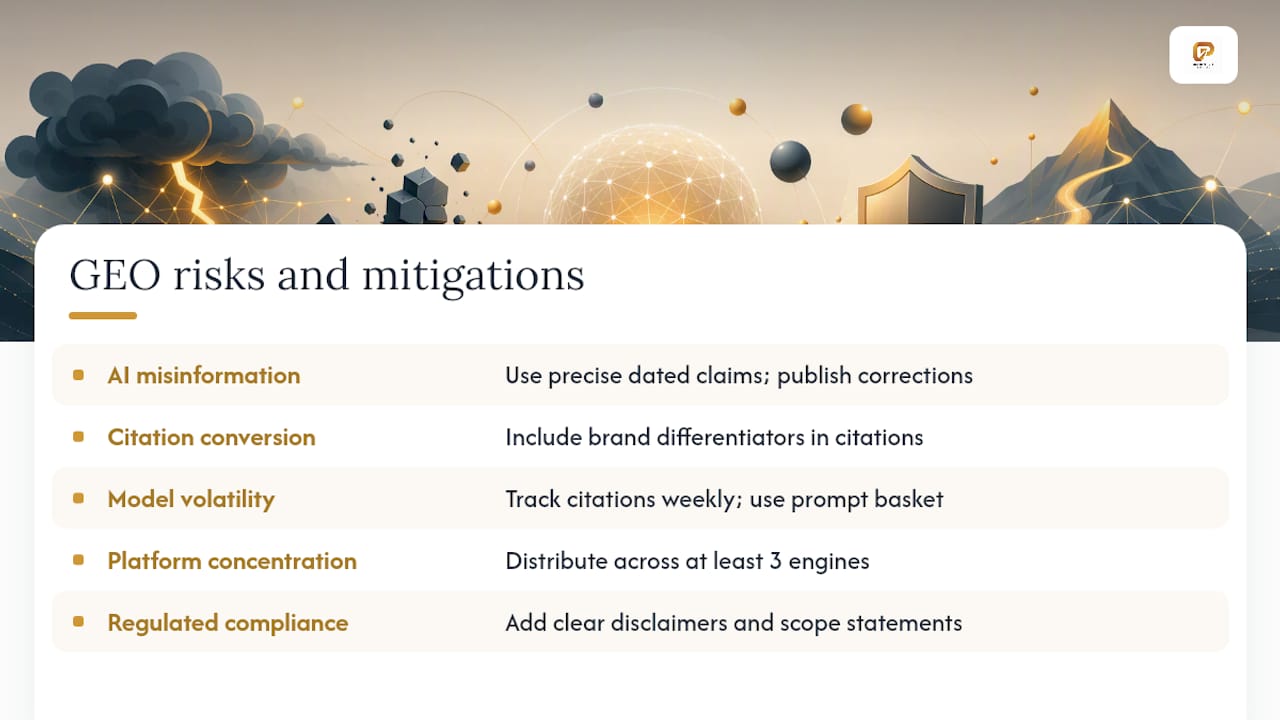
AI misinformation and content accuracy. AI engines occasionally misattribute claims, combine information from multiple sources incorrectly, or present outdated figures as current. The mitigation is precision in your source content: write claims that are specific, dated, and unambiguous. Vague or hedged statements are more likely to be misrepresented in synthesis. Publish corrections prominently when you identify a misattribution, and use schema markup to signal the authoritative version of a claim.
Citation without conversion. Being cited in an AI answer does not guarantee a click or a conversion. Buyers may get enough information from the synthesized answer to make a decision without visiting your site. The counter-strategy is to ensure your citations include brand-specific differentiators — named products, proprietary statistics, or unique positioning — that prompt buyers to seek out your brand directly.
Model update volatility. AI engines update their models, retrieval logic, and citation criteria without notice. A content format or schema type that drives strong citation rates today may perform differently after a model update. Maintaining a weekly prompt basket and tracking citation rate over time gives you early warning when patterns shift.
Platform concentration risk. Over-optimizing for a single engine creates fragility. The low overlap between domains cited by ChatGPT and Perplexity means that a platform-specific strategy leaves significant citation share uncaptured. Distribute your optimization effort across at least three engines.
Regulated content and compliance exposure. For enterprise teams in healthcare, finance, or legal sectors, AI citation of regulated content carries compliance risk. An AI engine may cite a page containing general health or financial information in a context that implies professional advice. The safeguard is clear, prominent disclaimers on regulated content pages and explicit scope statements that AI engines can include in any synthesis.
Measurement lag. Authority and citation campaigns take 60–120 days to show measurable effects. Teams that evaluate GEO programs on a 30-day cycle will consistently underestimate the value of authority-building work and over-invest in content changes that are already showing diminishing returns.
A practitioner’s perspective on where GEO programs actually stall
Most GEO programs don’t fail because of bad strategy. They stall because content, engineering, and PR are working from different priority lists. The content team rewrites page openings; engineering hasn’t fixed the robots.txt; PR is running a campaign targeting publications that the target AI engines don’t actually cite. The result is a program that looks active but produces no measurable citation movement.
The fix is a shared priority list with a single owner — typically the SEO lead — who coordinates across functions and holds the measurement baseline. Cross-functional coordination isn’t a soft recommendation; it’s the operational requirement that separates programs that move citation rates from programs that generate reports.
Start with measurement. Set up your GA4 AI referral segment and your prompt basket before you change a single page. Without a baseline, you’re navigating without a map.
How Golden Path Digital supports your GEO program

Golden Path Digital’s managed SEO and content services are built around the four-pillar GEO framework: content restructuring, schema implementation, citation acquisition, and measurement integration. For enterprise teams that need GEO executed without pulling engineering and content resources off core product work, Golden Path Digital provides a managed program that covers the full stack — from robots.txt audits and schema deployment to off-site citation campaigns and weekly prompt basket monitoring.
The same structured, dependency-first approach that drives Golden Path Digital’s enterprise code modernization work applies directly to GEO: map what you have, identify the gaps, fix the foundation before scaling the authority campaign. QuantaPath AI’s workflow automation capabilities also support the measurement loop, reducing the manual overhead of weekly citation tracking across multiple engines.
To request a GEO audit or discuss a managed engagement, visit Goldenpathdigital and connect with the team directly.
Sources
- How to Optimize for ChatGPT, Perplexity, Google AI, Claude, and Gemini: Platform-Specific Guide | Shadow
- Optimise for Perplexity, ChatGPT & Gemini | IndexCraft
- Generative Engine Optimization for B2B SaaS: GEO Playbook | Understory
FAQ
What is generative engine optimization (GEO)?
GEO is the practice of structuring content, authority signals, and technical configuration so that AI answer engines — ChatGPT, Perplexity, Google AI Overviews, and Microsoft Copilot — retrieve and cite your brand in synthesized answers. It targets citation and extraction rather than traditional search ranking positions.
Is GEO replacing SEO?
No. Traditional SEO indexability and snippet eligibility are prerequisites for AI citation consideration. GEO adds a layer on top of SEO: once a page is indexable and snippet-eligible, content structure and off-site authority determine whether it gets cited by AI engines.
How do I start optimizing for AI search engines?
Begin with three steps: rewrite your top pages’ first 200 words to lead with a direct, self-contained answer; deploy FAQPage schema on all Q&A pages; and verify that your robots.txt allows GPTBot, PerplexityBot, and Bingbot. Then submit your sitemap to Bing Webmaster Tools to ensure ChatGPT Search can index your content.
What is the best approach for measuring GEO performance?
Build a repeatable prompt basket of 15–25 buyer research queries, run them weekly across ChatGPT, Perplexity, Gemini, and Copilot, and track which sources each engine cites. Pair that with a GA4 segment for AI engine referral traffic and Google Search Console monitoring for branded search lift.
What provider supports enterprise GEO programs end-to-end?
Golden Path Digital offers managed GEO programs covering content restructuring, schema implementation, citation acquisition, and measurement integration for enterprise B2B teams, with a structured approach that maps dependencies before scaling any campaign.