

For HIPAA compliance, your organization must retain required HIPAA documentation for at least six years under 45 C.F.R. §164.316 and 45 C.F.R. §164.530. HIPAA does not set a uniform medical-record retention period. State laws and federal program rules like CMS typically govern how long patient charts must be kept, and they often require longer retention than the federal floor.
The six-year federal rule covers a specific set of HIPAA documentation, not every record your organization creates:
- Written policies and procedures
- Documentation of actions, assessments, and activities required by the Security and Privacy Rules
- Staff training records
- Patient authorizations and acknowledgments
- Business associate agreements (BAAs) and related documentation
- Accounting of disclosures logs
The practical verdict: treat six years as the minimum floor, then identify every applicable state statute, CMS program rule, and specialty requirement. Whichever period is longest governs your retention schedule for that record category.
Key Takeaways
HIPAA requires six years of documentation retention under 45 C.F.R. §164.530(j), but state law and CMS program rules govern medical-record retention and often require longer periods, making the longest applicable rule the only defensible standard.
| Point | Details |
|---|---|
| Six-year federal floor | HIPAA requires retaining policies, procedures, training records, BAAs, and authorizations for six years from creation or last in effect, whichever is later. |
| HIPAA does not set medical-record retention | State laws and CMS program rules govern patient chart retention; CMS commonly requires seven to ten years for Medicare records. |
| Always apply the longest rule | Map HIPAA, state, and CMS requirements for each record category and adopt the longest applicable period as your organization’s standard. |
| Document and automate destruction | Log every destruction event with date, method, and authorization; retain destruction logs for six years; use metadata labels to automate eligibility dates. |
| Golden Path Digital | Provides HIPAA-compliant CRM integration, audit logging, and automated retention workflows to replace manual spreadsheet-based retention matrices. |
Table of Contents
- What do the HIPAA data retention rules actually require?
- Does HIPAA require keeping patient medical records?
- What are the typical retention ranges for common healthcare records?
- What do business associates owe under HIPAA retention rules?
- What safeguards must protect PHI while it is retained?
- How should you destroy PHI, and what records must you keep?
- How do legal holds suspend your destruction schedule?
- How do you build a HIPAA-compliant retention policy from scratch?
- What compliance officers consistently get wrong about retention
- How Golden Path Digital supports HIPAA-aligned retention controls
- Sources
- FAQ
What do the HIPAA data retention rules actually require?
45 C.F.R. §164.316 requires covered entities and business associates to maintain written policies and procedures and to keep documentation of required actions in written or electronic form. The regulation is explicit: if an action, assessment, or activity must be documented under the HIPAA Security or Privacy Rule, that documentation must be retained.
The six-year clock appears in 45 C.F.R. §164.530(j), which states that required documentation must be retained for six years from the date of its creation or the date it was last in effect, whichever is later. The official CFR publication from GovInfo reproduces this language and provides regulatory context for implementation.
A concrete example clarifies the timing. Suppose your organization adopted a Privacy Policy in January 2018 and replaced it with an updated version in March 2022. The original 2018 policy was “last in effect” in March 2022, so it must be retained until March 2028, six years after it was superseded. The updated 2022 policy’s six-year clock starts from March 2022 or from whenever it is eventually replaced, whichever comes later.
Documents explicitly covered by the six-year federal requirement include:
- Policies and procedures required by the Security and Privacy Rules
- Documentation of risk analyses, risk management decisions, and sanction policies
- Training records showing staff completed required HIPAA training
- Patient authorizations and revocations
- BAAs and amendments
- Accounting of disclosures records
- Notices of Privacy Practices and acknowledgment records
This requirement functions as an administrative record-keeping obligation. It is not a directive to keep every patient chart for six years. That distinction matters operationally because it means your retention matrix needs two separate tracks: one for HIPAA documentation and one for medical records governed by state law.
Pro Tip: When you update a policy, tag the superseded version with its “last in effect” date at the moment of replacement. Without that timestamp, your team will struggle to calculate the correct destruction eligibility date years later, especially after staff turnover.
The six-year period was not chosen arbitrarily. Legal commentary from Bricker & Eckler LLP explains that it aligns with the statute of limitations for federal civil monetary penalties, giving regulators a defined window to investigate potential violations. Knowing that context helps compliance officers understand why the clock matters for enforcement, not just recordkeeping.
Does HIPAA require keeping patient medical records?
No. HHS OCR states directly that the HIPAA Privacy Rule does not include a medical-record retention period and that state laws generally govern how long patient records must be kept. HIPAA does require that appropriate safeguards protect PHI for as long as it is maintained, meaning your legal liability for a record does not end until it is properly destroyed.
The “more stringent” standard under HIPAA preemption rules means you follow whichever requirement gives patients greater privacy protection or imposes a longer retention obligation. In practice, that usually means following state law for medical records and the six-year federal rule for HIPAA documentation, then selecting the longer of the two when they overlap.
State minimums vary considerably. According to LegalClarity’s state-by-state analysis, retention minimums range from roughly three years to ten or more years depending on state, provider type, and patient status. A few illustrative examples:
- California requires adult medical records to be retained for at least seven years from the date of service, or one year past the patient’s eighteenth birthday for minors.
- Texas requires ten years for most adult patient records.
- New York requires six years for most records, but longer for minors.
For authoritative state-specific requirements, consult your state health department’s regulations, your state medical association’s guidance, and the applicable state statutes directly. Search by provider type (hospital, physician practice, long-term care) and patient status (adult, minor, deceased) because the rules often differ by category.
CMS program rules add another layer. ComplyDome’s guide to CMS and state rules documents that CMS often requires multi-year retention periods for Medicare billing records, cost reports, and enrollment documentation, which can be longer than the federal floor. A Medicare-participating hospital, for example, typically must retain cost reports for five years after filing and certain enrollment records for ten years. Those CMS periods frequently exceed both the HIPAA six-year floor and many state minimums.
The practical rule: map all three sources (HIPAA, state law, CMS or other program rules) for each record category, then adopt the longest applicable period as your organization’s retention standard for that category.
What are the typical retention ranges for common healthcare records?
The table below reflects commonly cited U.S. ranges. These are illustrative starting points, not legal advice. Your organization must verify the governing state statutes and program requirements for your jurisdiction, provider type, and patient population.
| Record Category | Typical U.S. Retention Range | Key Driver | Notes |
|---|---|---|---|
| Adult medical charts | 6 years from last service | State law | California: 7 years; Texas: — |
| Minor patient records | Until age of majority + 3–7 years | State law | Varies widely; verify state statute |
| Mental health records | 7 years (some states longer) | State law | Often stricter than general medical |
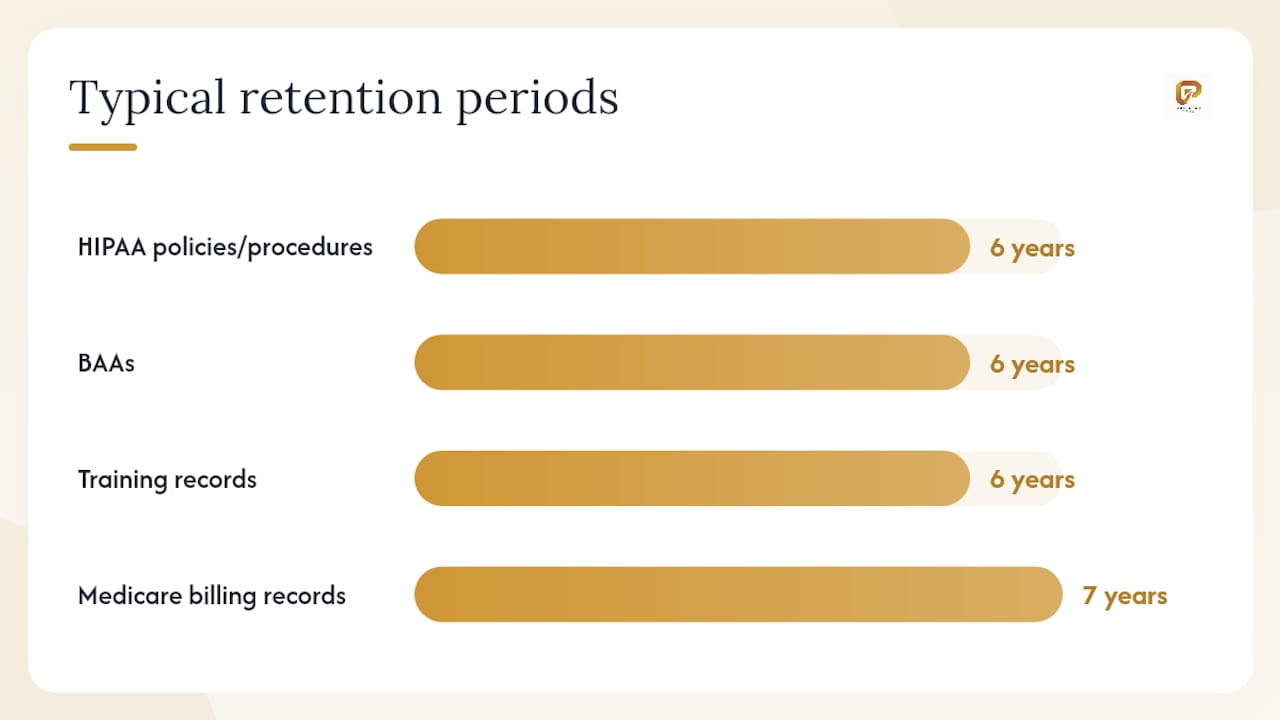
| Billing and claims records | 7 years | CMS / state law | Medicare billing: commonly 7 years |
| Immunization records | Often permanent or until age 21+ | State law | Many states require permanent retention |
| HIPAA policies and procedures | 6 years from creation or last in effect | 45 C.F.R. §164.530(j) | Federal floor; state may require longer |
| Patient authorizations | 6 years from creation or last in effect | 45 C.F.R. §164.530(j) | Keep revocations alongside originals |
| BAAs and amendments | 6 years from creation or last in effect | 45 C.F.R. §164.530(j) | Retain even after BA relationship ends |
| Accounting of disclosures | 6 years | 45 C.F.R. §164.530(j) | Required log under Privacy Rule |
| Deceased patient PHI | Protected for 50 years after death | HIPAA Privacy Rule | PHI protections apply post-mortem |
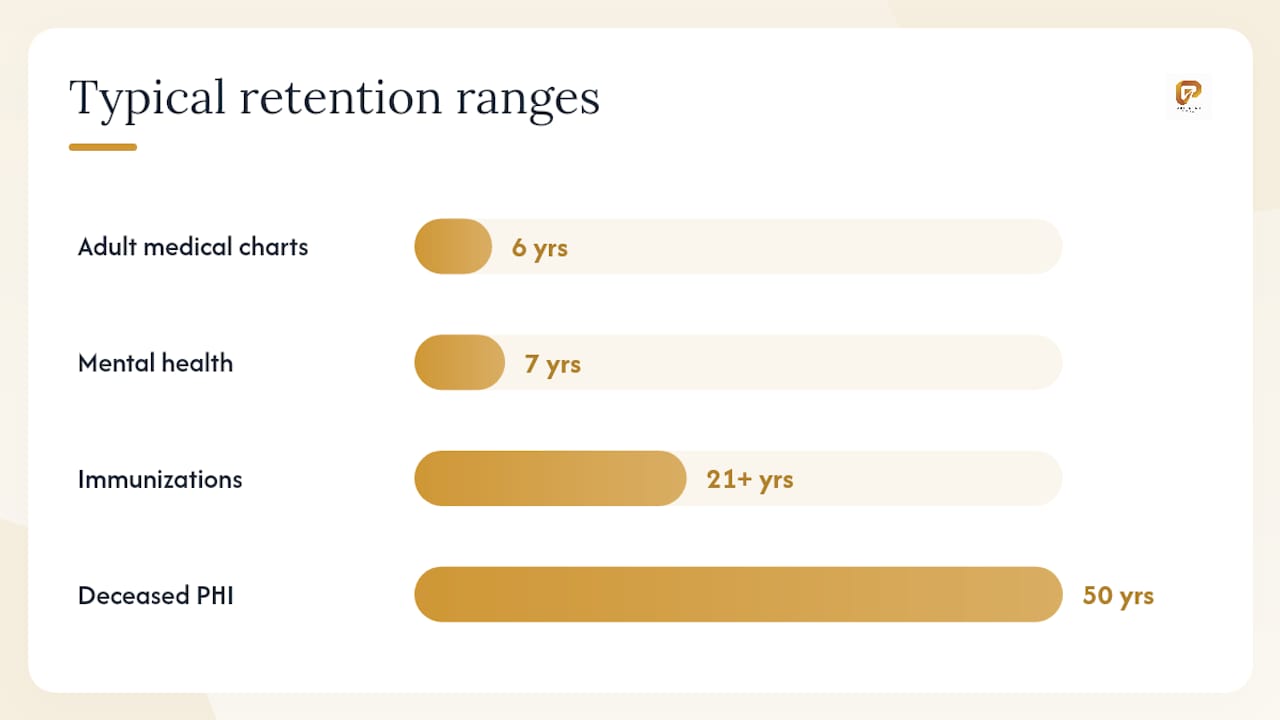
Two categories deserve special attention. Minor patient records require careful calculation: the retention period often does not begin until the patient reaches the age of majority, which means a record created for a five-year-old in a state with a seven-year post-majority rule must be kept until the patient turns twenty-five. Deceased patient PHI remains protected under HIPAA for fifty years after death, so destruction schedules must account for date of death, not just date of last service.
When calculating destruction eligibility, apply this sequence:
- Identify all governing rules (HIPAA, state, CMS, specialty program).
- Select the longest applicable retention period.
- Determine the start date for that period (date of service, date of creation, date last in effect, or date of death, depending on the rule).
- Add the retention period to get the earliest eligible destruction date.
- Verify no legal hold is active before scheduling destruction.
What do business associates owe under HIPAA retention rules?
Business associates are not exempt from HIPAA’s documentation requirements. A BA that creates, receives, maintains, or transmits PHI on your behalf must implement the same Security Rule safeguards and retain its own HIPAA documentation for six years. The BAA is the primary contract mechanism for extending your retention and destruction standards to vendors.
Every BAA your organization executes should address the following:
- Retention period alignment: The BA must retain HIPAA documentation for at least the longest applicable period, not just the federal six-year minimum.
- Destruction method: Specify acceptable destruction methods (see Section 7) and require written certification of destruction.
- Access for audits: The BA must make its records and practices available to HHS for compliance reviews.
- Subcontractor flow-downs: Require the BA to impose equivalent obligations on any subcontractors that handle PHI.
- Incident reporting timelines: Define the window for reporting breaches or security incidents (HIPAA requires notification without unreasonable delay, and no later than 60 days after discovery).
- Return or destruction at termination: At contract end, the BA must return or securely destroy all PHI and certify that destruction in writing.
When a BA holds archives or backups containing PHI, responsibility does not transfer to the vendor. Your organization remains accountable for ensuring those records are protected and destroyed on schedule. A practical safeguard: require vendors to notify you at least ninety days before destroying any records and to obtain written authorization before doing so.
For organizations using CRM systems that process PHI, HIPAA-compliant CRM requirements including BAA provisions, audit logging, and encryption controls are a foundational piece of the BA management framework.
A numbered checklist for reviewing existing BAAs:
- Confirm the retention period clause references the longest applicable rule, not just “six years.”
- Verify destruction method language is specific (not just “appropriate means”).
- Check that subcontractor flow-down language is present and enforceable.
- Confirm audit access rights are explicitly granted to both the covered entity and HHS.
- Verify the incident reporting window is defined and compliant with HIPAA’s 60-day outer limit.
- Confirm the return-or-destroy clause requires written certification.
What safeguards must protect PHI while it is retained?
Retaining records is not passive storage. The HIPAA Security Rule requires active controls for as long as PHI exists in your systems, and those controls must be documented to survive an audit.
The Security Rule control families most relevant to retained PHI and HIPAA documentation include:
- Access controls (§164.312(a)): Unique user IDs, automatic logoff, and encryption or decryption for electronic PHI in storage.
- Audit controls (§164.312(b)): Hardware, software, and procedural mechanisms to record and examine activity in systems containing PHI.
- Integrity controls (§164.312©): Mechanisms to authenticate that PHI has not been altered or destroyed in an unauthorized manner.
- Transmission security (§164.312(e)): Encryption for PHI transmitted over open networks, including cloud storage APIs.
- Contingency planning (§164.308(a)(7)): Data backup, disaster recovery, and emergency-mode operation plans that cover archived PHI.
For long-term archives, implement immutable audit trails and read-only archival stores so that retained records cannot be modified after the fact. Segment access to legacy data so that staff who no longer need operational access to old records cannot reach them. Define vendor SLAs for archive availability, particularly if you rely on a cloud provider for long-term storage.
Backups require explicit treatment in your retention schedule. A backup tape or snapshot that contains PHI is subject to the same retention and destruction rules as the original record. If a backup contains records from multiple retention categories, the entire backup must be retained until the longest-applicable period for any record it contains has expired, unless you can selectively purge individual records from the backup medium.
Pro Tip: Implement retention labels and metadata in your EHR and archive systems at the point of record creation. Tag each record with its category, governing rule, retention period, and earliest eligible destruction date. Automating that calculation at ingestion eliminates the manual audit burden years later and produces a defensible audit trail for OCR or CMS reviewers.
For organizations evaluating cloud vs. on-premise storage architectures, the choice directly affects how you implement access controls, audit logging, and secure destruction workflows for retained PHI.
How should you destroy PHI, and what records must you keep?
Destruction is not the end of your compliance obligation. It is a documented event that must be recorded and defensible.
Acceptable destruction methods for paper and electronic PHI, consistent with HHS guidance from Healthit, include:
- Paper records: Cross-cut shredding, pulping, or incineration. Strip shredding alone is generally not considered adequate.
- Magnetic media: Degaussing followed by physical destruction, or overwriting using NIST SP 800-88 guidelines.
- Solid-state media (SSDs, flash drives): Cryptographic erasure (crypto-erase) or physical destruction; degaussing is not effective on solid-state media.
- Cloud storage: Verified deletion with provider confirmation and, where possible, cryptographic erasure of encryption keys.
- Optical media (CDs, DVDs): Physical destruction (shredding or disintegration).
Every destruction event should generate a destruction log entry containing:
- Description of what was destroyed (record category, date range, volume or count).
- Date of destruction.
- Method used.
- Name and title of the person who authorized destruction.
- Name and title of the person who executed destruction.
- Reference to the retention category and governing authority that established the destruction eligibility date.
A stepwise procedure for records managers:
- Pull the destruction eligibility report from your retention management system.
- Verify no legal hold is active for any record in the batch (see Section 8).
- Obtain written authorization from the designated records officer or compliance officer.
- Execute destruction using the approved method for that media type.
- Complete and sign the destruction log entry immediately after execution.
- File the destruction log in your HIPAA documentation archive and retain it for six years.
The destruction log itself is HIPAA documentation and subject to the six-year retention rule. Do not destroy the log when you destroy the records it covers.
How do legal holds suspend your destruction schedule?
A legal hold is a directive to preserve records beyond their scheduled destruction date because of actual or anticipated litigation, a government investigation, a CMS audit, or a subpoena. Destroying records subject to a hold can result in sanctions, adverse inference instructions, or obstruction findings, independent of any underlying HIPAA violation.
Common triggers for a legal hold include:
- Receipt of a subpoena or civil investigative demand.
- Notice of a government investigation or OCR complaint.
- Initiation of internal litigation or a formal patient grievance that may escalate.
- CMS audit notification covering records in your retention schedule.
- Notification from legal counsel that litigation is reasonably anticipated.
When a hold is triggered, follow this workflow:
- Legal counsel issues a written preservation notice identifying the scope of records to be preserved, the custodians responsible, and the hold start date.
- The compliance or records officer freezes all scheduled destruction processes for records within the hold scope, across all systems including backups and BA vendor archives.
- Notify affected BA vendors in writing, citing the BAA’s audit-access and preservation obligations.
- Document the hold in a legal hold register: scope, custodian list, triggering event, hold start date, and the name of the attorney who issued the notice.
- Conduct periodic hold reviews (at least quarterly) to confirm the hold remains active and the scope has not changed.
- When the matter is resolved, legal counsel issues a written hold release. Update the legal hold register with the release date, then resume the normal destruction schedule for affected records.
Records that were eligible for destruction before the hold was issued but not yet destroyed must be preserved until the hold is released. Do not retroactively destroy records that should have been in scope.
How do you build a HIPAA-compliant retention policy from scratch?
A retention policy is only as useful as the matrix behind it. Start with discovery, not drafting.
Stepwise compliance checklist:
- Inventory all record categories your organization creates, receives, or maintains (medical charts, billing, authorizations, training records, BAAs, audit logs, etc.).
- For each category, identify all governing rules: HIPAA documentation requirements, applicable state statutes, CMS program rules, and any specialty regulations (e.g., 42 C.F.R. Part 2 for substance use disorder records).
- Select the longest applicable retention period for each category and document the authority for that decision.
- Assign a retention start date rule (date of service, date of creation, date last in effect, date of death, or date of majority for minor records).
- Label records at creation with category, governing authority, retention period, and earliest eligible destruction date.
- Build a destruction schedule and review it at least annually.
- Log every destruction event and retain destruction logs for six years.
- Integrate legal hold procedures so destruction can be frozen on short notice.
Sample policy elements your retention policy document should include:
- Scope and applicability (which entities, locations, and record types are covered).
- Definitions (PHI, covered entity, business associate, legal hold, destruction eligibility date).
- Retention matrix (record category, governing authority, selected retention period, destruction eligibility date formula, responsible owner).
- Roles and responsibilities (records officer, compliance officer, IT, legal counsel, BA vendors).
- BAA requirements for retention and destruction.
- Legal hold procedures and escalation path.
- Audit cadence and evidence requirements.
- Training requirements and frequency.
A simplified retention matrix template your team can adapt:
| Record Category | Governing Authority | Selected Retention Period | Destruction Eligibility Formula | Owner |
|---|---|---|---|---|
| Adult medical charts | State law (verify by state) | Per state statute | Date of last service + retention period | Health Information Management |
| Minor patient records | State law | Age of majority + state-specified years | Date of majority + retention period | Health Information Management |
| HIPAA policies/procedures | 45 C.F.R. §164.530(j) | 6 years | Date last in effect + 6 years | Compliance Officer |
| BAAs | 45 C.F.R. §164.530(j) | 6 years | Date last in effect + 6 years | Legal / Compliance |
| Medicare billing records | CMS | 7 years (verify by program) | Date of service + retention period | Revenue Cycle |
| Training records | 45 C.F.R. §164.530(j) | 6 years | Date of training + 6 years | HR / Compliance |
Audit and training guidance:
Conduct a formal retention policy review annually. At each review, confirm that state statutes and CMS rules have not changed, update the retention matrix accordingly, and re-sign the policy. Evidence to retain for OCR or CMS audits includes signed policy versions with effective dates, destruction logs, training completion records, and BAA execution records. Staff training on retention procedures should occur at onboarding and at least annually thereafter, with a brief refresher whenever the policy is materially updated.
What compliance officers consistently get wrong about retention
The most common mistake is treating the HIPAA six-year floor as the universal answer. Compliance officers who build a single “keep everything for six years” policy skip the state-law and CMS mapping entirely. That approach leaves the organization under-retained for medical records in high-minimum states like Texas and over-exposed to destruction risk for records that could have been purged years earlier.
The second most frequent error is misreading the “last in effect” rule. When a policy is updated, the original version must be retained for six years after it was superseded, not six years after it was created. A policy created in 2010 and replaced in 2020 must be kept until 2026. Organizations that calculate from the creation date instead of the supersession date destroy records prematurely and create an enforcement gap precisely when OCR is most likely to ask for them.
Poor vendor contract language is the third consistent failure point. BAAs that say “appropriate destruction” without specifying method, or that set a six-year retention period without referencing the “longest applicable rule,” create gaps the moment a vendor holds records subject to a ten-year CMS requirement.
Unlabeled backups are a quieter problem. A backup tape with no metadata about what records it contains and what retention periods apply cannot be scheduled for destruction without a manual audit. Organizations that run years of unlabeled backups eventually face a choice between expensive forensic review and indefinite retention of everything.
Practical fixes follow a clear sequence: map the longest applicable rule first, embed retention metadata at record creation, update BAA language to reference the longest applicable period and require written destruction certification, and automate retention flags in your EHR and archive systems. The discovery-to-matrix-to-automation path is how compliance teams move from reactive to defensible.
How Golden Path Digital supports HIPAA-aligned retention controls
Retention compliance is not just a policy problem. It is a systems and integration problem, and that is where many healthcare organizations stall.

Golden Path Digital’s QuantaPath AI platform delivers HIPAA-compliant CRM and workflow automation with BAA-ready integrations, audit logging, and metadata labeling built into the architecture. For organizations running legacy systems that hold years of untagged PHI, the platform’s dependency mapping approach identifies where records live before any retention labels or destruction workflows are applied. That sequencing, discovery before automation, is what separates a defensible retention program from one that destroys the wrong records or misses an entire archive.
Specific capabilities relevant to retention compliance include automated destruction eligibility reporting, retention-category tagging at record ingestion, vendor contract template support for BAA language, and periodic retention audit workflows. Compliance leaders who want to move from a manual spreadsheet-based retention matrix to an auditable, automated system can request a technical assessment to see where the gaps are before committing to a remediation path.
Sources
The sources below are the primary references compliance teams should consult directly. Treat them as starting points; always verify current state statutes and program requirements for your jurisdiction.
- Hhs
- 45 CFR § 164.316 – Policies and procedures and documentation requirements. | Cornell Law
- CFR-2023-title45-vol2-sec164-316 (govinfo)
State statutes change. Verify your state’s current requirements through your state health department, state medical association, or qualified legal counsel before finalizing any retention schedule.
FAQ
How long does HIPAA require data retention?
HIPAA requires covered entities and business associates to retain required HIPAA documentation, such as policies, procedures, training records, and BAAs, for six years from the date of creation or the date it was last in effect, whichever is later, per 45 C.F.R. §164.530(j). HIPAA does not set a retention period for patient medical records; state law and CMS program rules govern those, and they often require longer than six years.
Does HIPAA require a seven-year retention period?
No. HIPAA’s documentation retention requirement is six years, not seven. The seven-year figure often cited in healthcare settings typically comes from CMS requirements for Medicare billing and cost records, which commonly require seven to ten years depending on the record type and program.
What is the new HIPAA rule in 2026?
The core HIPAA documentation retention requirement remains six years under 45 C.F.R. §164.530(j). HHS has proposed updates to the HIPAA Privacy Rule in recent years focused on reproductive health information and care coordination, but the six-year documentation retention standard has not changed as of 2026. Always verify current regulatory status through HHS.gov for the most recent rule updates.
Does HIPAA protection expire after 50 years?
HIPAA’s Privacy Rule protections for deceased individuals’ PHI expire 50 years after the person’s death. After that period, the information is no longer considered PHI under HIPAA, though other laws may still apply. For living patients, HIPAA protections apply for as long as the covered entity maintains the PHI.
This article provides general information about HIPAA data retention requirements and is not a substitute for legal advice. Consult qualified legal counsel and verify current state statutes and federal program rules for your specific jurisdiction and organization type.