

Generative engine optimization is the practice of structuring your site and content so ChatGPT, Google’s AI Overviews, Perplexity, and Claude can find, parse, and cite your pages when they assemble answers. It matters because these engines increasingly answer questions your buyers used to type into a search box, and if your content isn’t retrievable and quotable, you simply don’t exist in that answer.
Two things to do before you finish reading this article:
- Run a quick readiness audit. Check whether your robots.txt file blocks GPTBot, whether your most important pages render without JavaScript, and whether your schema markup is current. A GeoReady-style audit covering these categories takes under an hour for most sites.
- Fix your single biggest technical blocker. If an AI crawler is blocked, or your canonical tags point to the wrong URL, that one fix unlocks everything else you do downstream.
The rest of this guide breaks GEO into three pillars: access, understanding, and quotability. Get those right, and the technical checklist, content tactics, and measurement approach that follow will actually move the needle.
Key Takeaways
GEO succeeds when access, entity understanding, and quotable content structure are fixed in that order, and measured against readiness signals rather than guaranteed citation counts.
| Point | Details |
|---|---|
| Fix access before content | Audit robots.txt for GPTBot and confirm server-side rendering before rewriting any copy. |
| Build entity understanding | Roll out Organization, Person, and Article schema so models correctly identify who you are. |
| Write for quotability | Use answer-first paragraphs, self-contained sentences, and tables that models can extract cleanly. |
| Measure across three layers | Track readiness score, prompt-level citation rate, and AI-referral conversions, not just one metric. |
| Expect probabilistic results | Citations vary week to week; treat readiness signals as the controllable metric, not citation counts. |
| Pair audits with modernization | Golden Path Digital runs GEO readiness audits using the same dependency-mapping approach it applies to legacy code work. |
Where to Go for Deeper Technical and Strategic Guidance
- Optimizing your website for generative AI features on Google Search: Google’s own guidance on how generative AI features use the Search index, useful for confirming foundational SEO still applies.
- Generative Engine Optimization Guide — GEO for AI Search: The clearest breakdown of the access, understanding, and quotability framework used throughout this guide.
- What Is Generative Engine Optimization? – Coursera: A concise definitional resource for teams onboarding new members to GEO concepts.
- arXiv:2311.09735: Academic research showing how structural changes to content increase visibility in generative responses.
- arXiv:2406.13805: Deeper technical reading on retrieval and grounding dynamics for anyone building prompt-tracking tools.
- From discovery to influence: a guide to AEO and GEO: Microsoft’s perspective on how AI-driven discovery changes visibility across search and ad surfaces.
- Statista: SEO threats and traffic shifts: Market-level data on how AI answer surfaces are reshaping traffic patterns.
- GEO vs SEO: Key Differences & Why You Need Both in 2026: A practical breakdown of effort allocation between SEO fundamentals and GEO-specific work.
Table of Contents
- What Is Generative Engine Optimization?
- How Is GEO Different From Traditional SEO?
- What Are the Three Pillars of GEO Strategy?
- What’s the Technical Checklist for GEO Readiness?
- How Do You Write Content the Models Can Quote?
- How Do You Measure GEO Readiness and Results?
- What Are the Limitations and Risks of GEO?
- What Does a 90-Day GEO Rollout Look Like?
- How Does Golden Path Digital Approach GEO for Clients?
- How Golden Path Digital Can Help You Get Cited by AI
- Sources
- FAQ
What Is Generative Engine Optimization?
Generative engine optimization (GEO) means optimizing your content and site infrastructure so large language model powered answer engines can locate your pages, extract accurate information from them, and cite you as a source. It’s a discipline built on top of SEO, not a replacement for it, and the mechanics behind it come from how these systems actually work.
Most AI answer engines run on a retrieval-augmented generation (RAG) pipeline. Here’s the simplified version:
Index/retrieval → the engine searches an index (often a search engine’s own index) for candidate pages that match the query. Candidate scoring → those candidates get ranked by relevance, authority, and freshness signals. Grounding → the model pulls specific passages from top candidates to ground its answer in real content instead of just generating from memory. Answer assembly with citations → the model writes a response and attaches citations to the sources it drew from.
Google explicitly confirms that its generative AI features rely on this kind of retrieval from the Search index and core ranking signals, which is why foundational SEO work still matters. If your page never gets indexed, it never gets retrieved, and it never gets cited. No amount of clever schema fixes that.
A few terms worth knowing cold: RAG is the retrieval-plus-generation architecture described above. Grounding is the process of anchoring a model’s output in retrieved source text rather than pure generation. Retrieval is the search step that surfaces candidate documents. Citation is the attributed link or source name the engine displays alongside its answer. Vector search is the similarity-matching method many retrieval systems use to find semantically related content, not just keyword matches.
The engines that matter most for GEO right now: ChatGPT (which draws on Bing’s index for web-grounded answers), Google’s AI Overviews and Gemini (built on Google’s own Search index), Perplexity (a retrieval-first answer engine that shows citations prominently), and Claude (Anthropic’s model, increasingly integrated with web search). GPTBot is OpenAI’s crawler, and whether you allow or block it in robots.txt directly determines whether your content can even enter that pipeline.
How Is GEO Different From Traditional SEO?
Both disciplines depend on crawlability, quality content, and technical health. The difference lives in the remaining 20%, and it’s a meaningful 20%: GEO adds a layer focused on structured passages, per-engine awareness, and citation tracking that traditional SEO never had to worry about.
SEO optimizes for ranking position on a results page. GEO optimizes for being the passage a model chooses to quote inside a generated answer. That’s a different game with different scoring.
| Dimension | Traditional SEO | Generative Engine Optimization |
|---|---|---|
| Primary objective | Rank in top positions on a SERP | Get selected and cited inside an AI-generated answer |
| Core signals | Backlinks, keyword relevance, page authority | Extractable structure, entity clarity, schema, self-contained passages |
| Success metric | Rankings, organic clicks, CTR | Citation frequency, AI-referral traffic, branded search lift |
| Content structure | Long-form pages optimized for scanning and dwell time | Answer-first paragraphs, discrete facts, lists and tables built for extraction |
| Off-page signal | Backlink profile | Presence on community and reference surfaces models trust (per-engine) |
At the page level, this means rewriting your lead paragraphs to state the answer before the context, breaking dense explanations into standalone sentences that make sense out of context, and building comparison tables the way this one is built, because tables are easy for models to parse and quote directly.
For content owners with limited time, the practical allocation is this: spend most of your effort on the SEO fundamentals you already know, technical health, quality content, authoritative backlinks, because that remains the best long-term foundation for visibility in generative features. Then layer GEO-specific work on top: audit access for AI crawlers, tighten your schema, and rewrite your most valuable pages for extractability.
What Are the Three Pillars of GEO Strategy?
GeoReady’s framework organizes generative engine optimization into three layered signals: access, understanding, and quotability. Each builds on the one before it, and skipping ahead wastes effort.
- Access comes first because nothing else matters if a crawler can’t reach your page. Audit your robots.txt file for GPTBot and other AI crawlers, confirm your important pages serve full content via server-side rendering (not client-side JavaScript that a crawler might not execute), and check that your canonical tags aren’t accidentally telling engines to ignore the page you’re trying to promote.
- Understanding is next. This is where schema markup earns its keep. Organization, Person, and Article schema help a model correctly identify who you are, what you publish, and how your content relates to known entities. Clear entity signals, consistent naming, and a logical site structure all feed this layer.
- Quotability is the layer most marketing teams skip, and it’s the one with the fastest visible payoff. Write answer-first paragraphs (BLUF), keep key sentences self-contained so they read correctly when pulled out of context, and use lists and tables wherever you’re presenting comparable facts.
Fix access issues first. A blocked crawler or broken canonical undoes every other improvement you make, and these fixes typically show measurable change in index and crawl logs within one to two weeks. Schema and entity work take longer to compound, often four to eight weeks before you see it reflected in citation behavior, because models need to encounter and reconcile your updated signals across multiple crawl cycles. Quotability rewrites can show up fastest of all, sometimes inside a single content refresh cycle, because structural changes to content directly increase visibility in generative responses without needing any backend changes.
Pro Tip: Don’t rewrite your entire site for quotability at once. Pick your ten highest-traffic or highest-intent pages, apply the BLUF and self-contained sentence treatment, and watch what happens in your AI-referral traffic before you scale the effort further.
What’s the Technical Checklist for GEO Readiness?
Clearing the access and understanding layers is mechanical work, and it’s the kind of work engineering teams can knock out in a focused sprint. Here’s the sequence.
- Audit robots.txt for AI crawlers. Check explicitly for GPTBot, and confirm you haven’t accidentally disallowed the paths that matter. Audit-first fixes here are among the highest-leverage tasks in the entire GEO process because they remove blockers that prevent everything downstream from being discovered.
- Confirm server-side rendering on key pages. Run a fetch-and-render test, or simply curl the page and see if the content you expect actually appears in the raw HTML. If your important text only appears after JavaScript executes, many crawlers will miss it entirely.
- Check canonical consistency. Make sure canonical tags point to the actual URL you want indexed, especially on pages with parameters, pagination, or duplicate content risk.
- Verify status codes and load performance. A page returning intermittent 500 errors or timing out under load gets deprioritized in retrieval just as it would in traditional crawling.
- Add or refresh structured data. A compact JSON-LD Article block, placed in the page head, should include headline, author, datePublished, and publisher fields at minimum. An Organization schema block on your homepage or about page should list your name, URL, and logo.
For day-to-day auditing, your team doesn’t need exotic tooling:
- Use
curl -A "GPTBot" yoursite.com/pageto see exactly what that crawler receives. - Check Google Search Console’s coverage and, where available, the generative AI features report for early signals on how your pages surface in AI-powered results.
- Spot-check rendered HTML against your CMS output to catch JavaScript-dependent content gaps.
- Log server requests over a week and flag which AI crawlers, GPTBot included, are actually hitting your site versus being silently blocked.
A green flag looks like consistent 200 status codes, full content in raw HTML, and crawler requests showing up in your logs. A red flag is a crawler that stops requesting pages after a handful of attempts, which usually means it hit a block, a redirect loop, or a server error. Teams managing large or legacy codebases often underestimate how much of this work is really a dependency mapping and technical debt problem disguised as an SEO task.
How Do You Write Content the Models Can Quote?
Quotability isn’t about writing shorter content. It’s about writing content where individual sentences and passages carry their own meaning without requiring the paragraph before or after them for context.
Compare these two openings for a page about invoice automation:
Before: “When businesses think about modernizing their accounts payable process, there are a lot of factors to weigh, and one of the more interesting developments in recent years has been the rise of automated invoice matching systems, which we’ll explore below.”
After: “Automated invoice matching cuts manual accounts payable processing time by comparing purchase orders, receipts, and invoices without human review. It works because the three-way match rule flags discrepancies automatically instead of routing every invoice through a person.”
The second version states the claim, then explains the mechanism, in two sentences a model could lift verbatim and quote correctly. Clarity, structure, and extractability matter more to generative engines than keyword density ever did.
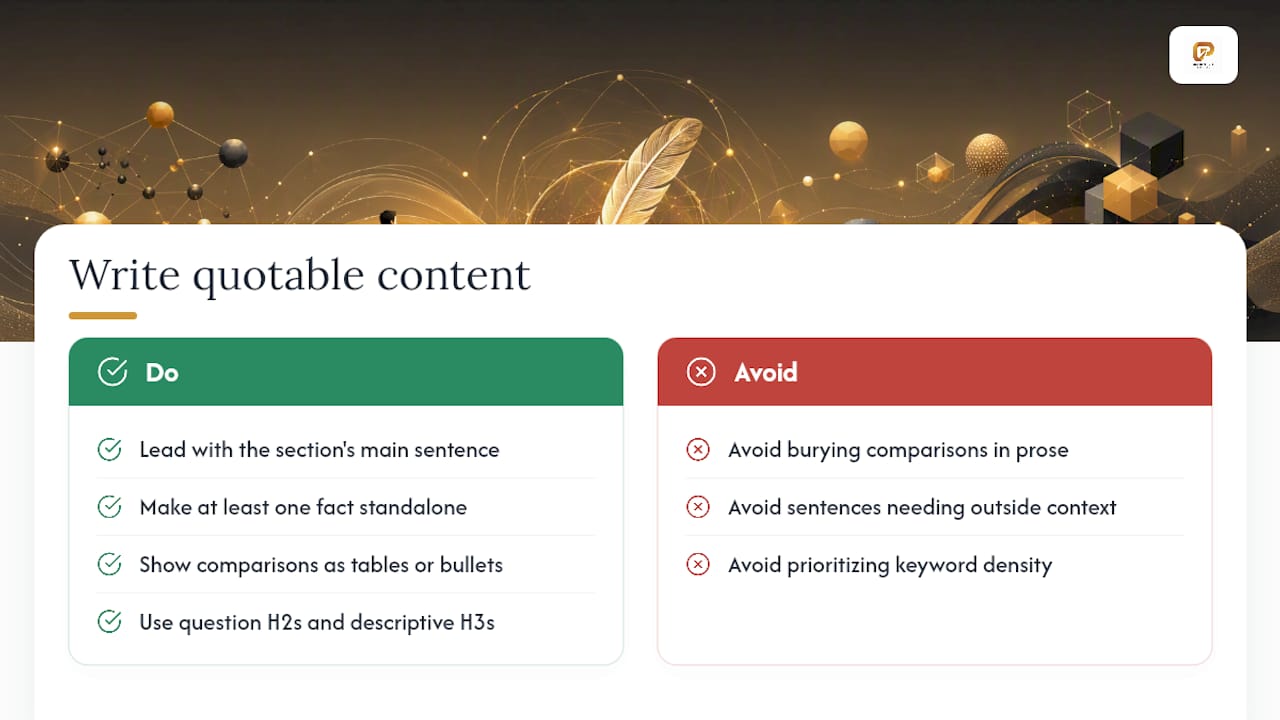
Heading structure does real work here too. Use question-based H2s where a real user would type that question, keep H3s descriptive, and break comparative information into lists or tables rather than burying it in paragraph prose. A model scanning your page for a fact about pricing tiers or feature differences will find a table row faster and more reliably than it will parse the same information from a sentence in the middle of a paragraph.
Here’s a compact FAQ-style passage suitable for FAQPage schema, the kind of self-contained Q&A block models reliably extract and quote:
What causes duplicate invoice payments?
Duplicate payments happen most often when an invoice is entered manually more than once, or when a vendor resubmits an invoice that was already processed under a different reference number. Automated matching systems catch this by cross-checking invoice numbers and amounts against payment history before approval.
Before publishing a rewrite, run this mini-checklist: does the first sentence of each section state its main point, does at least one key fact stand as a sentence that makes sense on its own, and is at least one comparison or list of facts presented as a table or bulleted list rather than prose. For teams optimizing specifically for ChatGPT and Gemini visibility, this same discipline applies, just tuned to how each engine’s retrieval layer weights structure.
How Do You Measure GEO Readiness and Results?
Measuring GEO requires three layers, and most teams only build the first one before giving up. That’s a mistake, because the readiness score alone tells you nothing about business outcomes.

Layer one is a readiness audit score, the GeoReady-style scorecard that grades your access, understanding, and quotability signals across categories like schema completeness, robots.txt configuration, and content structure. Layer two is prompt-level visibility and citation tracking, running a consistent set of prompts against ChatGPT, Perplexity, and other engines to see whether and how often your brand or pages get cited. Layer three is business outcome tracking, branded search lift and conversions that arrive via AI referral traffic, which you can isolate with dedicated UTM parameters on any links you control in your own content and profiles.
For the reports and logs that actually feed this model, Google Search Console’s generative AI features data is your first stop, alongside raw server logs to confirm crawler activity, dedicated prompt-visibility tools for tracking citations across engines, and UTM tagging discipline so AI-referred sessions don’t get lost in your analytics as generic direct traffic. Some teams also build out dashboard tracking specifically for LLM visibility to keep all three layers in one place instead of stitching together five separate tools.
A basic scorecard for a quarterly review might track the following:
| Metric | What It Tells You |
|---|---|
| Readiness score (access/understanding/quotability) | Whether your technical and structural foundation is sound before you chase citations |
| Prompt-level citation rate | How often your brand or pages appear across a fixed set of test prompts, tracked over time |
| Branded search volume | Whether AI-driven exposure is translating into people searching your name directly |
| AI-referral sessions (UTM-tagged) | Actual traffic you can attribute to AI answer engines, not just organic search |
| Conversion rate on AI-referred sessions | Whether that traffic behaves like qualified interest or just curious clicks |
None of these numbers move in a straight line, and that’s worth setting expectations around before your team builds a dashboard around them.
What Are the Limitations and Risks of GEO?
Citations from generative engines are probabilistic, not guaranteed. You can do everything right, access, schema, quotable prose, and still not get cited for a given prompt, because the model’s retrieval and selection process weighs dozens of signals you don’t fully control, and research into retrieval and grounding dynamics shows just how much variability exists at inference time.
A few limitations worth planning around:
- Training-time versus inference-time retrieval differ. Some model knowledge comes baked in from training data with a cutoff date, while other answers pull live from the web at the moment of the query. You can influence the second category through GEO work; the first is largely out of your hands until the next training run.
- Each engine weights signals differently. ChatGPT, Perplexity, and Claude don’t treat the same page the same way, so optimizing exclusively for one engine’s quirks can leave you invisible on another.
- Community surfaces matter more for some engines than others. A strong presence on forums, review sites, or reference publications can shift citation odds meaningfully on engines that weight third-party mentions heavily, and barely move the needle on others.
Watch for these red flags in particular: accidentally blocking AI crawlers while trying to block scrapers, fragile canonical setups that flip inconsistently across page templates, and teams over-indexing on per-engine hacks instead of the fundamentals that carry weight everywhere.
On the policy side, be deliberate about what you publish. Don’t feed user data into public-facing content without proper consent, watch for copyright exposure when quoting or summarizing third-party material, and never manufacture inauthentic mentions or fake citations to game a model’s trust signals. That kind of manipulation tends to surface eventually, and it damages the entity-level trust you’re trying to build in the first place.
What Does a 90-Day GEO Rollout Look Like?
A realistic rollout runs in three phases, each with a distinct owner and a deliverable that unblocks the next phase.
- Days 1 to 30 (owner: technical/engineering lead). Complete the access audit, fix robots.txt and crawler blocking issues, confirm server-side rendering on priority pages, and resolve canonical inconsistencies. Deliverable: a clean technical baseline with documented before/after crawl logs.
- Days 31 to 60 (owner: content strategist plus a developer for schema). Roll out or refresh Organization, Person, and Article schema across priority pages. Begin quotability rewrites on your ten highest-value pages, applying BLUF structure and self-contained sentences. Deliverable: schema coverage report and a first batch of rewritten pages.
- Days 61 to 90 (owner: marketing lead). Expand content rewrites to secondary pages, begin brand-surface work on relevant third-party and community platforms, and stand up prompt-level citation tracking against a fixed test set. Deliverable: a baseline citation rate and a repeatable measurement cadence.
Here’s how to weigh those tasks against each other when time is short:
| Task | Impact | Effort | When to do it |
|---|---|---|---|
| Fix crawler blocking / robots.txt | High | Low | Now |
| Server-side rendering fixes | High | Medium | Now |
| Schema rollout (Organization/Article) | Medium | Medium | Weeks 3 to 4 |
| Quotability rewrites (top pages) | High | Medium | Weeks 3 to 4 |
| Brand-surface / community presence work | Medium | High | Weeks 4 to 8 |
| Per-engine prompt tracking setup | Medium | Low | Weeks 4 to 8 |
For governance, keep sign-off simple: technical fixes get approved by whoever owns the site’s infrastructure, content rewrites get approved by whoever owns editorial standards, and the marketing lead owns the measurement cadence and reports short-term wins (crawl log improvements, schema coverage, first citation sightings) back to stakeholders every two weeks rather than waiting for a quarterly review. Enterprise teams juggling this alongside a broader SEO strategy overhaul tend to fold GEO into the same governance cadence rather than running it as a separate initiative.
How Does Golden Path Digital Approach GEO for Clients?
Golden Path Digital treats generative engine optimization the same way it treats legacy codebase work: map the dependencies before you touch anything. That means a governance and technical baseline first, schema and entity work second, content rewrites third, and brand-surface amplification and measurement running throughout, not bolted on at the end.
The methodology in practice:
- Start with a full access audit: crawler permissions, rendering behavior, canonical health, and current schema coverage, documented against a GeoReady-style scorecard.
- Build or repair Organization, Person, and Article schema across priority pages, correcting entity signals that confuse retrieval systems about who a business actually is.
- Rewrite priority content for quotability using BLUF structure, self-contained factual sentences, and comparison tables, the same structural approach used throughout this guide.
- Extend visibility work to relevant third-party and comparison surfaces, since per-engine weighting of community and publisher content materially affects citation odds.
- Track outcomes across readiness score improvement, prompt-level citation signals, and downstream pipeline impact, reported on a cadence clients can actually act on.
Clients who’ve gone through this process have reported meaningful gains in branded search visibility and organic traffic growth after the technical and content layers were addressed together rather than piecemeal.
Pro Tip: If your organization is also mid-modernization on a legacy system, tackle the GEO access audit and your technical debt assessment in the same quarter. The same dependency-mapping discipline that clears a codebase for safe automation also clears a site for reliable AI crawler access.
For teams ready to see where their own site stands, a structured audit conversation is a low-friction next step, not a commitment to a full engagement.
A Practitioner’s Take on Prioritizing GEO Work
The biggest mistake I see marketing teams make with GEO is treating it as a content problem first. It isn’t. It’s an access problem wearing a content costume. Teams spend weeks rewriting pages for quotability while GPTBot has been silently blocked in robots.txt since a security review eighteen months ago. Fix access before you touch a single sentence of copy, or you’re optimizing prose that no crawler will ever see.
The second mistake is expecting citations to behave like rankings. Rankings are stable enough that a page sitting at position three tends to stay near position three for weeks. Citations are not like that. The same prompt run twice in the same week can surface different sources, because these systems reconstruct their answer each time from a retrieval pass that’s sensitive to phrasing, recency, and model updates you don’t control. Chasing a single citation event as proof of success is a trap. Track the readiness signals you control, and treat citation frequency as a lagging indicator that moves over months, not days.
Here’s a thirty-day experiment worth running with your own team: pick ten prompts a real buyer would plausibly type into ChatGPT or Perplexity about your category, run them weekly against two or three engines, and log which domains get cited. Don’t touch your content yet. Just watch the baseline. Most teams are shocked at how often a competitor with mediocre content gets cited simply because their schema is clean and their pages load fast. That baseline data will tell you more about where to spend your next quarter than any generic checklist.
Finally, don’t build a separate GEO team sitting off to the side of your existing content operation. Fold the quotability checklist into your normal editorial review, the same way you folded meta descriptions and internal linking into that process years ago. GEO that lives in a silo gets forgotten the moment the person running it moves to a different project.
How Golden Path Digital Can Help You Get Cited by AI
If you’ve read this far, you already know GEO isn’t a one-time fix. It’s an audit, then implementation, then measurement, repeated on a cadence, and that’s exactly the sequence Golden Path Digital runs for clients: a readiness audit that scores your access, schema, and content structure, followed by prioritized technical and editorial fixes, followed by ongoing citation and traffic tracking so you know what actually moved.

Enterprise teams juggling legacy systems alongside a GEO rollout often find the two problems are more connected than expected. A site with tangled dependencies and inconsistent rendering behavior is hard to make crawlable, which is why Golden Path Digital pairs its managed SEO services with the same dependency-mapping discipline it applies to legacy code modernization work. If your marketing site or app runs on infrastructure that’s harder to update than it should be, that issue is worth solving alongside your GEO audit, not after it. Teams looking for a specialized regional partner in AI search visibility can also review the work being done by Epicware on GEO implementation.
Ready to see where your site stands? Request a GEO readiness audit through Golden Path Digital’s managed SEO services page and get a scored breakdown of your access, understanding, and quotability signals before you spend another hour rewriting content blind.
Sources
- Optimizing your website for generative AI features on Google Search
- Generative Engine Optimization Guide — GEO for AI Search
- What Is Generative Engine Optimization? – Coursera
- arXiv:2311.09735
- From discovery to influence: a guide to AEO and GEO
FAQ
What Does GEO Stand For in Marketing?
GEO stands for generative engine optimization, the practice of structuring content and site signals so AI-powered answer engines like ChatGPT and Perplexity can find, parse, and cite it.
Is GEO Replacing Traditional SEO?
No. GEO builds on SEO fundamentals rather than replacing them, adding a layer focused on structured passages, entity clarity, and per-engine citation behavior.
How Long Does It Take to See GEO Results?
Access fixes can show measurable change in crawl logs within one to two weeks, while schema and quotability improvements typically take four to eight weeks to influence citation behavior.
Does Blocking AI Crawlers Hurt My GEO Efforts?
Yes. Blocking GPTBot or similar crawlers in robots.txt, even accidentally, removes your content from that engine’s retrieval pipeline entirely, regardless of how well-structured your content is.
Can I Guarantee My Content Gets Cited by ChatGPT or Google?
No. Citations are probabilistic, driven by retrieval and scoring dynamics that vary by engine and query, so the realistic goal is improving your readiness signals and citation odds, not guaranteeing a specific outcome. Golden Path Digital’s GEO audits focus on strengthening exactly those controllable signals.