

Consolidate campaigns until each one carries enough conversion volume to teach Smart Bidding something, or has a genuine budget, reporting, or product reason to stand alone. That’s the whole principle. Most accounts we review are over-segmented out of habit, not strategy, and it costs them learning speed and Quality Score alike.
Before restructuring anything, run through this checklist:
- Campaign boundaries follow budget, reporting, or product lines — not internal preference or legacy habit.
- Aim for enough monthly conversions per campaign to keep Smart Bidding out of a permanent learning phase.
- Bring match types together inside themed ad groups instead of splitting exact, phrase, and broad into separate groups.
- Give Performance Max a defined job with clear exclusions so it doesn’t quietly eat your Search budget.
A compact starter layout looks like this: Brand Search | Non-Brand Search | Performance Max / Shopping | Prospecting or Demand Gen, with a small number of tightly themed ad groups inside each Search campaign. That’s the whole skeleton. Everything else in this guide explains why it works and how to get there safely.
Key Takeaways
Concentrating conversion data into fewer, well-bounded campaigns, and organizing ad groups by theme rather than match type, gives Smart Bidding and Performance Max the signal they need to perform.
| Point | Details |
|---|---|
| Consolidate with purpose | Merge campaigns unless a real budget, reporting, or product reason keeps them separate. |
| Watch conversion volume | Aim for a sufficient number of monthly conversions per campaign before expecting Smart Bidding to stabilize. |
| Bring match types together | Themed ad groups with broad match plus Smart Bidding outperform split-by-match-type structures. |
| Set Performance Max boundaries | Use brand exclusions and campaign negatives so Performance Max doesn’t cannibalize Search. |
| Get a professional audit | Golden Path Digital’s PPC service maps conversion volume against structure and builds a staged consolidation plan. |
Table of Contents
- What Are the Levels of a Google Ads Account Structure?
- Why Does Account Structure Matter for Smart Bidding and Automation?
- When Should You Segment vs. Consolidate Campaigns?
- How Should You Structure Ad Groups and Keywords?
- How Do You Avoid Performance Max Cannibalizing Search?
- How Should Conversion Tracking Align With Account Structure?
- How Do You Audit and Restructure an Account Safely?
- How Do You Keep an Account Organized Long-Term?
- What Enterprise Marketers Get Wrong About Consolidation
- Get a Structure Audit From Golden Path Digital
- Sources
- FAQ
What Are the Levels of a Google Ads Account Structure?
A Google Ads account is a hierarchy, and each layer controls something different. Confusing what belongs where is the single most common structural mistake we see.
At the account level, you control billing, user access permissions, account-wide negative keyword lists, time zone, and auto-tagging for tracking. These settings apply everywhere beneath them, so get them right once instead of fixing them campaign by campaign.
At the campaign level, you set budget, bidding strategy, network and location targeting, campaign type (Search, Performance Max, Shopping), and campaign-specific negatives. This is where most structural decisions actually live, because campaigns are the boundary Google’s automation treats as a distinct data pool.
At the ad group and asset group level, and below that the ad and keyword level, you control landing pages, ad copy, responsive search ad assets, and the keyword themes or audience signals feeding Performance Max. Google’s own account organization guidance warns against restructuring casually once an account has accumulated meaningful data, since reorganizing can scatter or reset performance history.
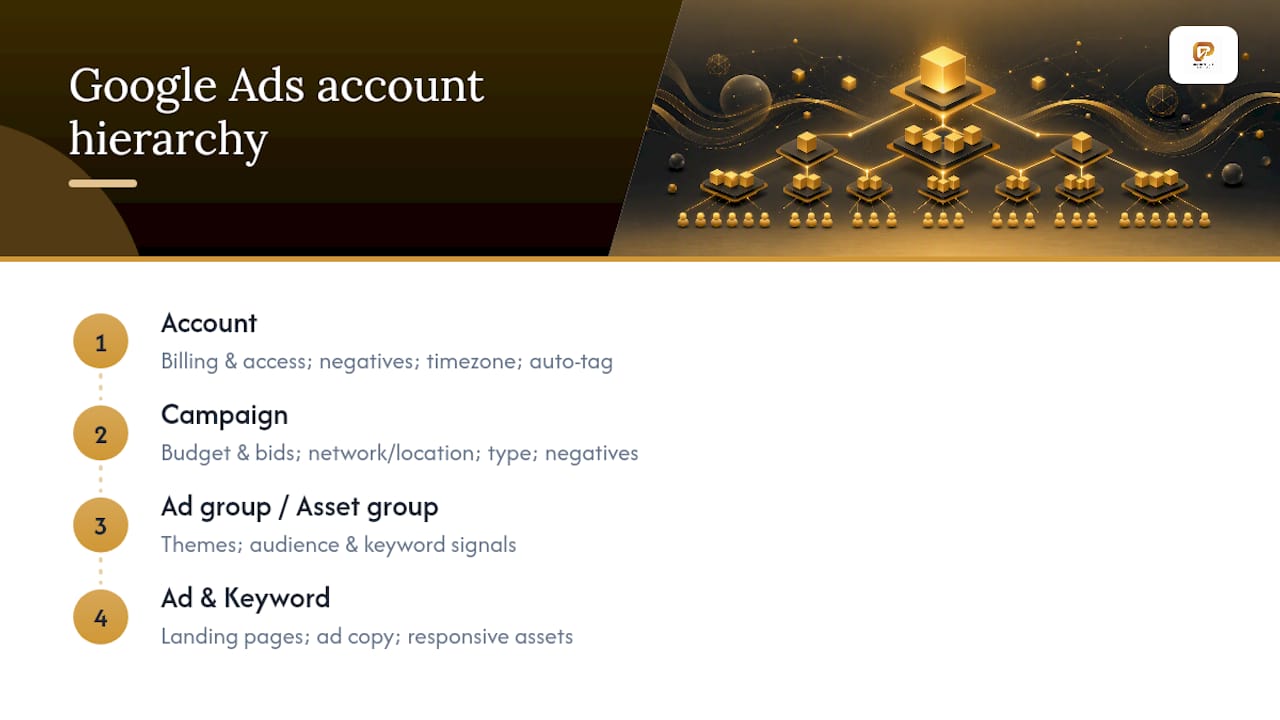
Picture it as a funnel: budget and strategy decisions flow down from the campaign, get filtered through ad group themes, and land as specific ads matched to specific searches. Data flows the other way, rolling up from keyword-level clicks into the campaign-level pool that Smart Bidding actually learns from.
Why Does Account Structure Matter for Smart Bidding and Automation?
Every campaign functions as a separate data container. Split your conversions across ten thin campaigns instead of three well-defined ones, and you’ve divided the fuel Smart Bidding needs into portions too small to learn from efficiently. Search Engine Land’s analysis of campaign structure confirms that Google’s automation performs better when conversions concentrate rather than scatter across many low-volume campaigns.

There’s a practical volume guide worth internalizing: many practitioners treat a minimum conversion volume per campaign each month as a floor before Smart Bidding reliably exits its learning phase, according to the same campaign structure research. Fall well below that and the algorithm keeps testing rather than optimizing, and your cost-per-acquisition stays volatile far longer than it should.
Performance Max adds another wrinkle. Its asset groups behave like mini-campaigns, each expected to carry a distinct theme and audience signal. Mix unrelated products or offers into one asset group, and Google’s creative-matching engine can’t tell what story to tell which searcher.
Pro Tip: Check the “Learning” status on your bid strategy report weekly during a restructure. If a campaign sits in learning for more than two to three weeks without stabilizing, its conversion volume is probably too thin for the strategy you’ve chosen.
When Should You Segment vs. Consolidate Campaigns?
Run every proposed split through a simple test before you build it: does this campaign need its own budget, its own bidding objective, or does a legal or operational requirement force separation? If the honest answer is no, merge it.
Valid reasons to split campaigns:
- Brand versus non-brand traffic, since intent and cost-per-click often differ.
- Different margins or product economics that may justify separate bidding targets.
- Geographic budgets that require regional spend management.
- Conversion values that may influence bidding behavior and strategy.
Weak reasons that usually cause harm:
- Legacy single-keyword ad groups (SKAGs), a technique that predates modern Smart Bidding.
- Splitting by match type, which Google’s own account structure guidance specifically recommends against.
- Splitting by device, which automated bid adjustments now handle far better than manual campaign duplication.
Google’s product leadership has been explicit that consolidation isn’t the goal in itself — structure should exist only where it reflects a real business distinction, not a preference for tidiness or an old playbook.
How Should You Structure Ad Groups and Keywords?
Ad group design is where most accounts bleed efficiency, one micro-segment at a time.
- Cap ad groups at three to five per campaign, each built around one tight theme rather than one keyword.
- Group ten to twenty closely related keywords per ad group, not one keyword per ad group.
- Merge SKAGs and micro-segmented groups whenever they share a landing page and search intent.
- Bring match types together inside the merged group instead of maintaining parallel exact and phrase versions.
Why does consolidating match types matter so much? Broad match paired with Smart Bidding now draws on far more signals, including landing page content, other keywords in the account, and real-time auction context, according to Google’s ABCs of Account Structure. Splitting match types into separate ad groups starves that system of the very signal diversity it depends on.
Before merging older SKAGs, check:
- Do the candidate groups share a landing page and comparable conversion intent?
- Will merged search terms reports still let you spot new negative keyword candidates?
- Has each group logged enough impressions to trust its historical Quality Score?
WordStream’s account structure research backs a three-to-five ad group approach per campaign as the sweet spot for responsive search ad learning.
Pro Tip: Give each responsive search ad multiple headline variations and avoid excessive asset pinning to allow effective testing. Over-pinning collapses the ad back into something close to a manually written static ad, which defeats the point of testing.
How Do You Avoid Performance Max Cannibalizing Search?
Performance Max pulls inventory from Search, Display, YouTube, Gmail, Discover, and Maps simultaneously, which means it can and does serve branded and non-branded queries your Search campaigns already cover. Left unchecked, it competes with your own account rather than expanding reach, a dynamic detailed in Google’s campaign type documentation.
Set boundaries deliberately:
- Add brand exclusions to Performance Max if brand Search already converts efficiently on its own.
- Use campaign-level negative keywords to keep Performance Max out of terms your Search campaigns own.
- Assign distinct conversion goals so each campaign type gets credit for a different part of the funnel.
- Feed Performance Max clear audience signals rather than leaving it to guess who your customer is.
Define Performance Max’s job explicitly, whether that’s cold prospecting or lower-funnel Shopping conversions, and monitor budget allocation regularly so it doesn’t quietly absorb spend meant for Search.
How Should Conversion Tracking Align With Account Structure?
Conversion configuration is a structural decision, not an afterthought bolted on later. Map primary and secondary conversions deliberately, because poor alignment sends Smart Bidding chasing the wrong outcome entirely.
- Set your primary conversion to the action that actually drives revenue, like a qualified lead or purchase, not a proxy metric like a page view.
- Feed accurate conversion values into value-based bidding; Performance Max in particular responds to whatever value signal you give it, garbage or gold.
- Map roles clearly: non-brand Search optimizes toward the primary lead conversion, while Performance Max might optimize toward an assisted or upper-funnel capture goal.
Get this mapping wrong and every other structural decision in this guide loses its footing.
How Do You Audit and Restructure an Account Safely?
Restructuring an account with years of accumulated data carries real risk if you rush it. Move in stages, not all at once.
- Audit first. Pull conversions per campaign and ad group, flag duplicate match types across groups, and identify ad groups running below meaningful volume.
- Test merges in a holdout. Restructure one product line or region before touching the whole account, so you can compare against an untouched control.
- Use shared budgets or portfolio bidding to pool signal across newly merged campaigns without losing individual reporting visibility.
- Watch the two to four week window. Learning-phase volatility is normal; judge results against that window, not against day three.
- Set rollback triggers in advance. Decide beforehand what performance drop, over what timeframe, would trigger pausing the change.
Teams comfortable with the Google Ads API’s hierarchical structure can script this audit across dozens of campaigns at once rather than reviewing each one manually, which matters enormously at enterprise scale.
How Do You Keep an Account Organized Long-Term?
Structure decays without maintenance, so build in guardrails from day one.
Use a naming format like [Brand/NonBrand]_[Product]_[Geo]_[CampaignType] so any stakeholder can parse a campaign’s purpose without opening it. Centralize shared negative keyword lists and shared budgets in the shared library rather than duplicating them campaign by campaign, and use labels to track experiments across a rollout.
A short weekly routine, roughly 45 minutes according to industry guidance, covering search terms, disapprovals, pacing, and learning states catches most drift before it compounds.
What Enterprise Marketers Get Wrong About Consolidation
Consolidation helps automation, but it should follow business logic, not platform trends. I’ve seen enterprise accounts merge campaigns purely to chase a “best practice” headline, only to lose the budget isolation finance actually needed for reporting.
The pitfall isn’t consolidating too much. It’s consolidating without asking whether the business still needs that boundary. Structure decisions are reversible with proper measurement, so test deliberately rather than guessing.
Get a Structure Audit From Golden Path Digital
If your account has grown into a patchwork of legacy SKAGs, duplicate match-type campaigns, and Performance Max groups nobody fully owns, an outside audit finds the fragmentation faster than another internal review cycle. Golden Path Digital’s PPC campaign management service maps your current campaign and ad group hierarchy against real conversion volume, then builds a consolidation plan sized to your budget instead of a generic template.

The output isn’t a vague recommendation. You get a structure checklist specific to your account, a staged rollout plan with holdout testing built in, and an estimate of how long the learning-phase impact should last before performance stabilizes. Request an audit through Golden Path Digital and get a clear picture of what’s holding your Smart Bidding back before you touch a single campaign.
Sources
- How campaign structure shapes Google Ads performance
- How To Structure Your Google Ads Account For 2026 Growth: A 6-Step Framework
- Google clarifies its stance on campaign consolidation
- Understanding Your Google Ads Account Structure — WordStream
FAQ
What Are the Levels of a Google Ads Account?
A Google Ads account has five layers: the account itself, campaigns, ad groups (or asset groups for Performance Max), ads, and keywords or assets. Each layer controls a different set of settings, from billing at the account level down to specific ad copy at the ad level.
What Is the Right Ad Account Structure?
The right structure consolidates campaigns until each one has enough conversion volume to support Smart Bidding, splitting only where budget, reporting, product, or legal boundaries genuinely require it. For many accounts under $50,000 per month, that means somewhere between three and ten campaigns rather than dozens of narrow ones.
What Is the Format of a Google Ads Account ID?
A Google Ads account ID, often called a customer ID, is a ten-digit number typically displayed in the format XXX-XXX-XXXX. It identifies the account across the platform and the Google Ads API.
What Is the Data Structure of Google Ads?
Google Ads organizes data as a hierarchy of resources: a customer (account) contains campaigns, which contain ad groups, which contain ads and keywords. This hierarchy, documented in the Google Ads API, is also how conversion data pools for Smart Bidding, which is why campaign boundaries directly affect automated bidding performance.
How Many Ad Groups Should Each Campaign Have?
Most well-structured Search campaigns work best with three to five tightly themed ad groups, each covering ten to twenty closely related keywords rather than one keyword per group.