

Privacy by Design means embedding privacy protections directly into system architecture and business processes from the first design decision, rather than retrofitting compliance after launch. The concept rests on seven foundational principles formalized by Dr. Ann Cavoukian, and it now has legal teeth through GDPR Article 25’s requirement for data protection by design and by default.
If you’re kicking off a new system or refactoring a legacy one, your first move is simple: add a privacy requirements artifact to your design kickoff meeting and map at least one data flow end to end before writing code. That single habit catches more privacy defects than any late-stage audit ever will.
Here’s what to anchor your work to as you build out a program:
- Ann Cavoukian’s 7 principles — the conceptual foundation every framework since has built on
- GDPR Article 25 — the legal requirement for controllers processing EU personal data
- EDPB guidance on DPbDD — the regulator’s interpretation of what “by design” actually requires
- OASIS PbD-SE specification — the engineering standard for documenting conformance
Key Takeaways
Privacy by Design succeeds when the seven principles are mapped to concrete engineering controls and documented through artifacts that satisfy both GDPR Article 25 and OASIS PbD-SE conformance expectations.
| Point | Details |
|---|---|
| Start with a data flow | Map at least one data flow end to end during design kickoff, before writing code. |
| Treat the 7 principles as engineering specs | Assign each principle a concrete control, such as pseudonymization or default opt-in settings. |
| Know the legal line | GDPR Article 25 is binding for EU processing; treat it as a best-practice benchmark otherwise. |
| Automate enforcement | Use policy-as-code and CI checks to catch privacy violations before merge, not after audit. |
| Document for traceability | Link privacy use templates, data-flow diagrams, and test reports to specific requirements. |
| Map dependencies before refactoring legacy code | Golden Path Digital’s assessment approach traces data flows first to avoid privacy regressions during modernization, following Security & Data Privacy design patterns that embed privacy into system processes. |
Table of Contents
- What Are the 7 Principles of Privacy by Design?
- How Does GDPR Article 25 Differ From Privacy by Design?
- What Engineering Patterns Actually Implement Privacy by Design?
- What Documentation Do Auditors Expect From Privacy by Design?
- What Happens When Teams Get Privacy by Design Wrong?
- What Legacy Modernization Teaches About Privacy by Design
- How Golden Path Digital Helps You Operationalize Privacy by Design
- Sources
- FAQ
What Are the 7 Principles of Privacy by Design?
Cavoukian’s seven principles were never meant to be an abstract ethics statement. Each one maps to a concrete engineering decision, and treating them that way is what separates a real privacy program from a compliance checklist nobody reads. Here’s how each principle translates into something you can actually build.
- Proactive, not reactive. Identify privacy risks before code is written, not after a breach. Engineering mapping: threat modeling and a privacy impact assessment at the design kickoff, not during the pre-launch security review.
- Privacy as the default setting. Users get maximum privacy protection without lifting a finger. Engineering mapping: new accounts default to minimal data sharing and opt-in analytics, not opt-out.
- Privacy embedded into design. Privacy isn’t a bolt-on feature or a separate module. Engineering mapping: access control and field-level encryption live in the data schema itself, not in a middleware layer added later.
- Full functionality — positive-sum, not zero-sum. Privacy and functionality aren’t a trade-off; well-designed systems deliver both. This principle gets misunderstood constantly. Teams assume that protecting data means degrading the product, but positive-sum design proves otherwise: a recommendation engine can run on pseudonymized identifiers instead of raw user profiles and lose no accuracy that matters to the business.
- End-to-end security. Data is protected across its entire lifecycle, from collection to deletion. Engineering mapping: encryption at rest and in transit, plus a documented retention and secure-deletion schedule tied to actual business need.
- Visibility and transparency. Stakeholders can verify that stated privacy practices match actual system behavior. Engineering mapping: audit logs that are queryable, not just written, and a data map that matches what the privacy policy claims.
- Respect for user privacy. The individual’s interests come first, expressed through granular consent and easy access to their own data. Engineering mapping: a self-service data export and deletion endpoint, not a support ticket queue.
Pro Tip: Treat principle four as your tie-breaker whenever a design review stalls on “privacy versus features.” If a proposal frames the two as opposites, the design hasn’t been finished yet.
How Does GDPR Article 25 Differ From Privacy by Design?
Privacy by Design is a design philosophy. Data protection by design and by default (DPbDD) under GDPR Article 25 is a legal obligation built on that philosophy, and the distinction matters for how you scope your work.
Article 25 requires controllers to implement appropriate technical and organizational measures, taking into account the state of the art, implementation cost, and the nature, scope, context, and purpose of processing. That’s a risk-based standard, not a fixed checklist. The European Data Protection Board’s guidelines spell out expected technical measures: pseudonymization, data minimization, and storage limitation, applied through a documented risk assessment rather than blanket rules.
One misconception worth killing early: “by default” doesn’t mean every feature ships turned off. Supervisory guidance treats it as a risk-based judgment where each default setting must be justified as necessary for the stated purpose, not maximally restrictive by rule.
For engineering teams, the practical breakdown looks like this:
- PbD = the design philosophy and the seven principles guiding architecture decisions
- DPbDD = the specific legal obligation to document and justify those decisions under Article 25
- EDPB guidance = the regulator’s interpretation of what counts as “appropriate” measures
If your organization operates in the United States without EU data subjects, Article 25 isn’t binding on you. Treat it as the most rigorously documented best-practice benchmark available. Organizations that build to this standard voluntarily tend to sail through customer security questionnaires and enterprise procurement reviews that increasingly reference GDPR-grade controls as the baseline, regardless of jurisdiction.
What Engineering Patterns Actually Implement Privacy by Design?
Principles and legal text tell you what to achieve. They don’t tell you how to write the code. These are the patterns that turn PbD from a policy document into working software.
Data minimization starts at the schema level, not the API response. If a field isn’t required for the stated purpose, don’t collect it, and if you already collect it, run a deprecation pass. Purpose-limited schemas take this further by tagging each field with its allowed processing purpose, so a billing service physically cannot query a field tagged “marketing only.”
Pseudonymization and tokenization replace direct identifiers with reversible tokens wherever raw identity isn’t operationally necessary. A support dashboard rarely needs a customer’s actual email address to resolve a ticket. It needs a stable reference ID that support staff can use consistently.
Consent gating enforces permission state at the point of data use, not just at collection. A common failure mode: consent is captured correctly at signup, then ignored by three downstream services that never check it before firing an event to an analytics pipeline.
Retention automation removes the human decision from data deletion. If your retention policy says 90 days, a scheduled job should enforce that, because manual deletion processes get deprioritized the moment there’s a production fire.
On the mechanization side, model-driven enforcement of privacy policies consistently outperforms manual code review at catching violations. Translating your privacy rules into policy-as-code, then running automated data-flow analysis in CI, catches a schema change that violates purpose limitation before it merges, not three months later during a customer audit. A tool like Golden Path Digital’s AI privacy compliance playbook can help teams structure that automated verification layer for AI and CRM pipelines specifically.
Legacy systems need a different starting point entirely. Before you refactor a single line of a decades-old codebase, map every dependency first. Skipping this step is how privacy regressions get introduced during modernization: a field that was masked in the legacy application gets exposed unmasked in the new service because nobody traced where it flowed. Once the dependency map exists, prioritize the highest-risk data flows for targeted refactoring rather than attempting a full rewrite.
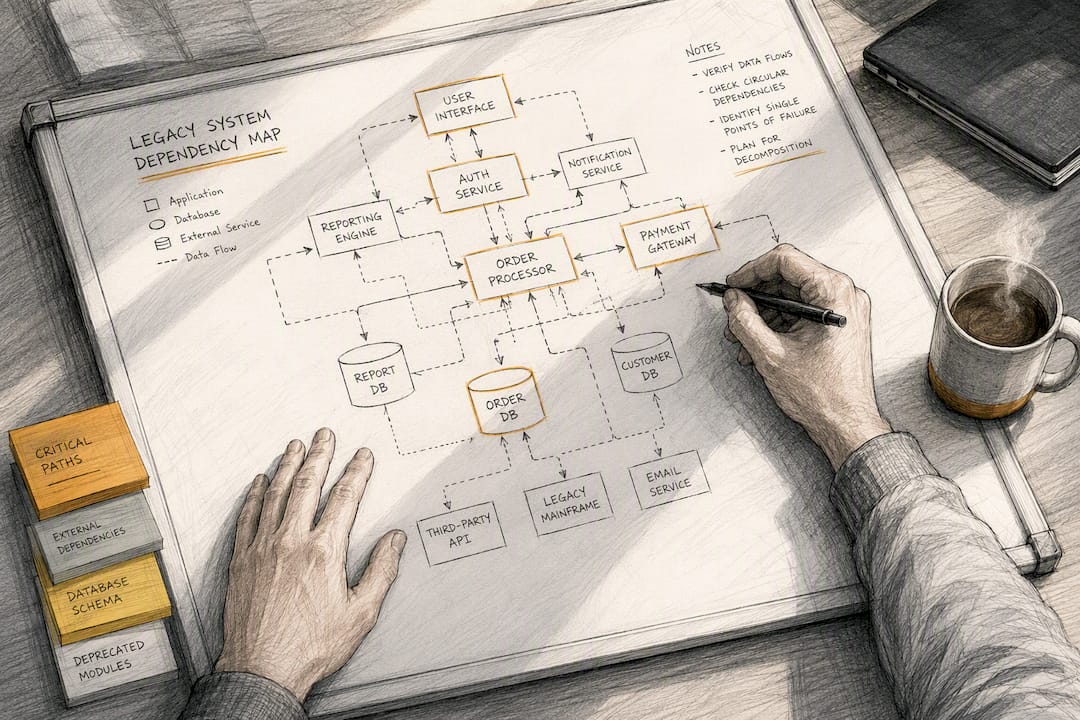
For teams enforcing this discipline in CI/CD, add a privacy gate to your pull request template: any schema change touching personal data fields requires a linked data-flow diagram update before merge. It’s a small friction cost that prevents a much larger one later.
Pro Tip: Pair every automated retention job with an audit log entry confirming deletion actually occurred. A scheduled job that silently fails is worse than no automation at all, because it creates false confidence.
Role-based access control does the heavy lifting for minimizing exposure once data exists in your system. Structuring RBAC properly means privacy enforcement doesn’t depend on every engineer remembering to check permissions manually.
What Documentation Do Auditors Expect From Privacy by Design?
Auditors and supervisory authorities don’t take your word for it. They want artifacts that prove privacy was designed in, not bolted on. The OASIS PbD-SE specification exists precisely to standardize what that evidence looks like.
- Privacy use template — documents the purpose, data categories, and legal basis for each processing activity
- Data-flow diagrams — trace personal data from collection through storage, processing, and deletion
- Architecture diagrams — show where privacy controls (encryption, access control, pseudonymization) sit in the system
- Privacy test reports — evidence that privacy requirements were verified, not just designed
- Design sign-offs — a documented decision trail showing who approved the privacy posture and when
PbD-SE’s conformance requirements function well as a checklist: for every processing activity, can you produce a use template, a matching DFD, and a test report that references both? If any of the three is missing, that’s your gap.
| Artifact | What it proves to an auditor |
|---|---|
| Privacy use template | The purpose and legal basis were defined before processing began |
| Data-flow diagram | Personal data movement matches the documented purpose |
| Privacy test report | Controls were verified, not just designed on paper |
| Design sign-off | Accountability for the privacy posture is traceable to a named decision-maker |
Link every artifact to a specific requirement ID, then to the test case that verifies it, then to the release note where it shipped. That traceability chain is what turns a folder of documents into an actual audit trail an EDPS reviewer or internal compliance officer can follow without asking you to reconstruct history from memory.
What Happens When Teams Get Privacy by Design Wrong?
A greenfield fintech team built consent gating correctly from day one but skipped retention automation, assuming they’d “get to it later.” Eighteen months in, they had no reliable way to purge stale records, and a routine audit flagged it as their single largest gap.
A legacy modernization project mapped dependencies thoroughly, but a data field masked in the old RPG application shipped unmasked in the new microservice because the mapping stopped at the database layer and never traced the API response.
A mobile app implemented strong encryption at rest, then logged full user objects, tokens and all, to a third-party crash reporting service by default.
Common anti-patterns and fixes:
- Privacy as a launch-week checklist — fix by requiring a privacy artifact at design kickoff, not QA
- Masking data in storage but not in transit or logs — fix by auditing every downstream consumer of a data flow, not just its origin
- Treating consent as a one-time database flag — fix by checking consent state at the point of each data use, not just at signup
If you’re facing a legacy modernization scenario, start with dependency mapping before touching code. If you’re greenfield, build the artifact trail from the first sprint.
What Legacy Modernization Teaches About Privacy by Design
Applying PbD to a decades-old IBM i or Laravel codebase looks nothing like applying it to a greenfield app. Dependency mapping has to come first, because you can’t embed privacy controls into data flows you haven’t fully traced yet. Automated artifact generation, pulling data-flow diagrams and schema documentation directly from the codebase, makes that mapping realistic at scale instead of a six-month manual exercise.
Automation gets you the map fast. It doesn’t replace the judgment call on which flows carry the highest risk. That reasoning still needs a human who understands the business context.
How Golden Path Digital Helps You Operationalize Privacy by Design
Reading the principles is one thing. Tracing every data flow through a 30-year-old RPG codebase to actually apply them is another problem entirely, and it’s the one most teams underestimate. Golden Path Digital built its modernization tools around exactly that gap: dependency mapping before any AI-assisted refactoring touches your code, so privacy controls get embedded based on what your system actually does, not a guess.

Our services map directly onto the PbD tasks covered in this guide. Dependency mapping identifies every data flow before you refactor, artifact generation produces the data-flow diagrams and privacy use templates auditors expect, and our HIPAA-capable deployment paths handle regulated data without slowing down your release schedule. The engagement flow is straightforward: assessment first, then mapping, then prioritized remediation ranked by actual risk instead of guesswork about where problems might be.
If you’re staring down a legacy IBM i or Laravel system that needs both modernization and a defensible privacy posture, start with an IBM i modernization assessment to see exactly what you’re working with before committing to a rebuild.
Sources
- CES Privacy / Privacy by Design (foundational principles)
- European Commission — What does data protection ‘by design’ and ‘by default’ mean?
- EDPS — Preliminary opinion on privacy by design
- OASIS — Privacy by Design Documentation for Software Engineers (PbD-SE)
FAQ
What are the 7 principles of Privacy by Design?
They are proactive not reactive, privacy as the default, privacy embedded into design, full functionality (positive-sum), end-to-end security, visibility and transparency, and respect for user privacy, formalized by Dr. Ann Cavoukian.
Can you give an example of Privacy by Design in practice?
A signup form that collects only the email address needed to create an account, defaults analytics tracking to off, and stores that email pseudonymized rather than in plain text demonstrates several principles at once: minimization, default privacy, and embedded design.
What does the difference between Privacy by Design and privacy by default mean?
Privacy by Design is the overall philosophy guiding architecture decisions across the whole system. Privacy by default is one specific principle within it, requiring that the most privacy-protective settings apply automatically without user action.
Is Privacy by Design a legal requirement?
It becomes a legal requirement, called data protection by design and by default, under GDPR Article 25 for organizations processing EU personal data; outside that scope, it functions as a best-practice standard.
How do I document Privacy by Design for an audit?
Produce a privacy use template, data-flow diagrams, architecture diagrams, and privacy test reports for each processing activity, following the artifact structure the OASIS PbD-SE specification lays out.