

What is release management software, and why does it matter?
Release management software is the control layer that sits between your CI/CD pipeline and your end users. It coordinates the human and technical steps that turn a tested build into a live change, handling deployment orchestration, environment management, approval gates, and governance evidence along the way. Without it, teams rely on manual handoffs, tribal knowledge, and hope.
The discipline matters because enterprise releases now span multiple projects, systems, teams, and environments simultaneously. A single missed dependency or skipped approval can cascade into an outage or a compliance finding. Release management software replaces that fragility with a governed, repeatable process.
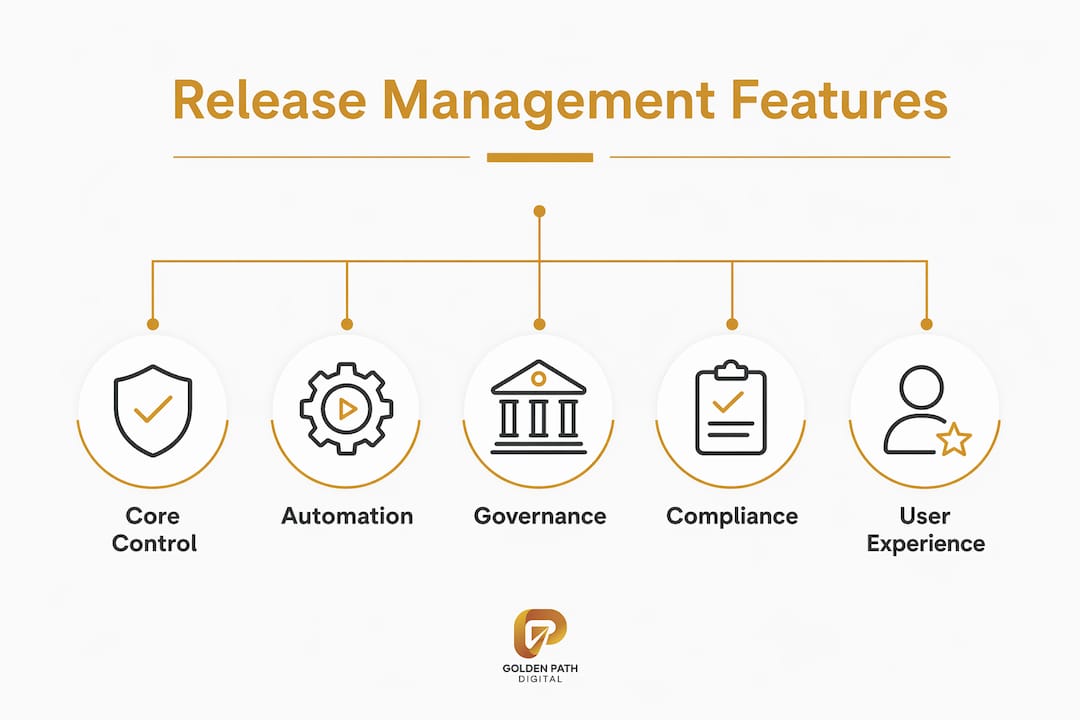
Core functions your team should expect:
- Deployment orchestration: sequences multi-service, multi-environment deployments in the correct order
- Approval gates: enforces sign-off at defined checkpoints before promotion to production
- Audit trails: captures who approved what, when, and why, for compliance and post-incident review
- Environment tracking: monitors readiness, version state, and data availability across environments
- Rollback capabilities: reverses a bad change quickly, ideally without a full redeploy
- Stakeholder visibility: provides a shared release status view for engineering, SRE, and business teams
In ITIL-governed organizations, release and deployment management is a formal process under Service Transition, with change enablement tightly coupled to it. Agile and DevOps teams face the same governance needs, just at higher frequency.
Key features that separate good release management tools from great ones
The baseline capabilities above are table stakes. What separates a genuinely useful tool is how well it integrates and how far its automation reaches.
- Deep CI/CD integration: a tool that requires manual data entry between pipeline stages introduces the exact errors it is supposed to prevent; direct integrations with your existing toolchain are non-negotiable
- Observability connections: native hooks to Datadog, New Relic, or similar platforms let the tool watch deployment health in real time and trigger automated rollback when metrics degrade
- Feature flags and progressive delivery: separating deploy from release, shipping code dark and exposing it to canary groups first, limits blast radius on every rollout
- Searchable, exportable audit evidence: audit trails must capture approvals and manual actions, not just logs, and the evidence must be exportable for auditor review
- Change management alignment: in regulated or ITIL environments, the tool needs to create and close change tickets automatically, not as an afterthought
Pro Tip: Start with the simplest workflows that meet your risk and compliance requirements. Adding governance layers incrementally, as your team matures, avoids process bloat and keeps adoption rates high.
Why your development team needs release management software
Coordination is the hidden cost of software delivery. As release frequency climbs, the manual effort of aligning teams, confirming environment readiness, and chasing approvals grows faster than headcount can absorb.

Release management acts as a control plane that gives engineering, SRE, and business stakeholders a unified view of release status without requiring manual status meetings or email chains. That shared visibility alone reduces the coordination overhead that slows most enterprise teams.
Compliance is the other driver. Regulated industries need documented evidence that each release followed an approved process. A tool that captures that evidence automatically, in a searchable and exportable format, turns a painful audit preparation exercise into a routine export. The most common implementation mistake is deploying a release management tool before the underlying process is defined. Tools enforce policies; they cannot fix a culture or process that does not yet exist.
Top release management software tools in 2026: U.S. providers compared
Five tools represent the meaningful range of approaches available to U.S. teams today. The right choice depends on where your pain sits: deployment complexity, feature exposure control, enterprise governance, legacy modernization, or open-source flexibility.
| Tool | Best For | Primary Focus | AI-Powered Features | Deployment Automation | CI/CD and Change Management | Security and Compliance | Pricing | Rating |
|---|---|---|---|---|---|---|---|---|
| LaunchDarkly | Enterprises needing AI-powered release control | Feature flagging and progressive delivery | Runtime AI control, self-healing systems | Feature flag-based rollout and rollback | Integrates with CI/CD; separates deploy from release | Audit trails, targeting rules | Developer free; Enterprise custom | 4.8★ (16 Google reviews) |
| Statsig | Teams prioritizing product metrics and experimentation | Product analytics and feature management | No-code editor, experimentation analytics | Gradual rollouts, canary exposure | CI/CD integration; product analytics pipeline | Feature-level access controls | Usage-based; details on site | 5★ (7 Google reviews) |
| CloudBees Inc. | Organizations needing compliant DevOps at scale | Enterprise DevOps orchestration | AI-driven governance and security automation | Pipeline orchestration with gated promotion | Jenkins modernization; change management integration | Policy enforcement, compliance automation | Free; Team; Enterprise custom | 5★ (3 Google reviews) |
| Golden Path Digital | Companies modernizing IBM i and Laravel for automated releases | Legacy modernization and AI automation | Dependency mapping before AI application; QuantaPath AI CRM | Automated Laravel upgrades (v6-v11); RPG codebase parsing | Integrates modernization output into release workflows | HIPAA-compliant workflow automation | Contact for pricing | 5★ (1 Google review) |
| Jenkins | Teams needing flexible CI/CD with external governance | Open-source automation server | None native; plugin-dependent | Pipeline as Code via Jenkinsfile | Extensive plugin ecosystem; no native change management | No native enterprise compliance | Free (open source) |
LaunchDarkly approaches release control from the exposure side rather than the deployment side. You ship code dark and turn features on for specific user segments, percentages, or canary groups via feature flags. Its runtime AI control layer can detect degraded metrics and self-heal a release without human intervention. For product teams that want to decouple deploy cadence from feature launch decisions, this is the clearest fit.
Statsig sits at the intersection of feature management and product analytics. Its no-code editor lets non-engineers configure experiments and rollouts, while the analytics layer tracks how each release affects product metrics. Teams that run continuous experimentation alongside their deployments get the most from it.
CloudBees Inc. is built for the governance problem at scale. Hundreds of developers, dozens of pipelines, and a compliance requirement that every release follows the same rules: that is the environment CloudBees was designed for. Its Jenkins modernization path also gives organizations a route to enterprise-grade governance without abandoning existing pipeline investments.

Jenkins remains the most widely deployed automation server in DevOps, but it is a CI/CD foundation, not a release management platform. It lacks native approval gates, change management integration, and compliance reporting. Teams that use Jenkins typically layer a dedicated release governance tool on top, or accept the gap.
Golden Path Digital occupies a distinct position. Where the other tools govern releases of already-modern applications, Golden Path Digital addresses the modernization step that must happen first. Its AS/Forward product parses IBM i RPG codebases and maps dependencies before any automation is applied. Laravel Ascend automates framework upgrades from version 6 through 11. For organizations whose release management problem starts with legacy code that cannot be safely automated yet, that sequencing matters. You can explore the automated Laravel upgrade approach to see how that fits a release workflow.
How to choose the right release management software for your team
Selection comes down to matching the tool’s center of gravity to your team’s primary pain point. Work through these questions before you evaluate vendors:
- Where does your release process break today? Deployment complexity points to orchestration tools; exposure risk points to feature flag platforms; compliance gaps point to governance-first solutions.
- How deep are your existing integrations? A tool that connects indirectly to your CI/CD, observability, and incident systems increases failure risk compared to one with native connectors.
- What does your compliance posture require? ITIL-governed or regulated environments need change ticket automation and exportable audit evidence, not just logs.
- What is your total cost of ownership? License cost is the visible line item. Factor in integration effort, training time, and the overhead of maintaining custom plugins.
- Have you defined your release process first? Tooling enforces process. If your process is unclear, the tool will amplify the confusion, not resolve it.
Pro Tip: Pilot-test with a real release before committing. A live trial surfaces integration overhead and complexity that a demo never will, and lets you add features incrementally as your team’s maturity grows.
For teams evaluating workflow automation tools alongside release management platforms, the overlap in orchestration and approval logic is worth mapping before you buy two tools that duplicate each other.
Golden Path Digital’s approach to legacy modernization and release readiness
Most release management tools assume the codebase is already in a state that supports automated deployment. Golden Path Digital starts one step earlier, with the question of whether the code can be safely automated at all.
Its AS/Forward product performs deep parsing and analysis of IBM i RPG codebases, producing a dependency map that shows exactly what calls what, what data flows where, and what the risk profile of any change looks like. That map becomes the foundation for safe release automation, not an afterthought. Laravel Ascend then handles the upgrade path from Laravel 6 through 11 automatically, removing the manual effort that typically stalls framework modernization projects.
QuantaPath AI extends this into CRM and workflow automation with HIPAA-compliant integration, which matters for healthcare and financial services organizations that cannot afford compliance gaps in their release pipeline. The private AI deployment model keeps sensitive data within controlled boundaries throughout the process. For teams whose release management challenge is rooted in legacy architecture rather than pipeline tooling, this sequenced approach, map first, automate second, is how you ship on a schedule instead of on a prayer.
Golden Path Digital for teams modernizing before they automate
If your release management challenge starts with legacy IBM i or Laravel applications that were never designed for automated deployment, the tools compared above solve the wrong problem first.
Golden Path Digital offers a different entry point: structured legacy code modernization that creates the foundation automated release pipelines require. Rather than layering governance on top of fragile code, the AS/Forward and Laravel Ascend products map dependencies and automate upgrades so your team arrives at the release management conversation with code that is actually ready for it. For organizations carrying decades of IBM i RPG or aging Laravel applications, the legacy code modernization framework is the practical starting point. Reach out to Golden Path Digital to discuss where your codebase stands before committing to a release automation platform.
FAQ
What is release management software?
Release management software coordinates and automates the process of moving software builds through environments to production, adding governance, approval gates, and audit trails that CI/CD pipelines alone do not provide.
How does release management software differ from a CI/CD tool?
CI/CD tools automate building, testing, and deploying code. Release management software adds the coordination and governance layer on top, handling approvals, scheduling, progressive delivery, rollback, and stakeholder communication.
Which release management tool is best for enterprise compliance?
CloudBees Inc. is purpose-built for enterprise-scale governance, with policy enforcement, compliance automation, and Jenkins modernization. For organizations in regulated industries with legacy systems, Golden Path Digital’s HIPAA-compliant automation addresses the modernization step that precedes compliant release automation.
What is the biggest mistake teams make when adopting release management tools?
Implementing a tool before defining the underlying release process. Tools enforce policies but cannot fix process gaps; the result is added friction rather than improved control.
How do feature flags relate to release management?
Feature flags separate code deployment from feature release, letting teams ship code dark and expose it to canary groups or specific user segments first. This limits blast radius and enables instant rollback via a toggle without a full redeploy.
Key Takeaways
The most effective release management approach combines a well-defined process, direct CI/CD integration, and a tool matched to your team’s primary risk: deployment complexity, exposure control, governance, or legacy modernization.
| Point | Details |
|---|---|
| Process before tooling | Define your release process first; tools enforce policies but cannot substitute for a missing process. |
| Integration depth matters | Direct connections to CI/CD, observability, and incident systems reduce failure risk compared to indirect integrations. |
| Audit evidence must be exportable | Compliance audits require searchable, exportable approval records, not just deployment logs. |
| Match tool to pain point | Feature flag platforms, orchestration tools, and governance platforms solve different problems; choose by where your releases break. |
| Golden Path Digital | For teams with IBM i RPG or aging Laravel codebases, dependency mapping and automated upgrades create the foundation release automation requires. |
Recommended
- Workflow Automation Tools: Top 10 Picks for 2026
- Top 6 Best Automation Workflow Tools Alternatives 2026
- Custom Software Development | Golden Path Digital
- Laravel Ascend vs Laravel Shift: Upgrade Tools Compared
After choosing your release management tools, read our developer guide on as400 api integration software to connect your legacy IBM systems.
As you evaluate software deployment tools, you must also prepare your team for the %laravel release security september 2026 deadline.