

A content operations framework is the documented system of people, process, and platform that governs how content moves from idea to published asset to retirement. Its purpose is singular: predictable, governed, scalable content production instead of ad hoc scrambling. Built well, it gives you gate-based quality control at every stage and a way to prove the return on the whole operation, not just a single campaign.
TL;DR:
- Enforcing strict intake criteria prevents wasted effort on content that lacks clear audience, purpose, or strategic priority, optimizing downstream resource use.
- Mapping ownership and approval chains before automation reduces risks and prepares for compliance needs, much like dependency maps for legacy codebases.
- Using a small, integrated tech stack supports fewer than 20 pieces per month at low cost, but larger organizations need dedicated tools with stage-specific functions.
- Tracking cycle time, throughput, first-pass edit rate, and refresh ratio offers real-time insights into content pipeline health and areas needing process optimization.
- Starting with a pilot in high-volume content types and measuring ROI in terms of hours saved and capacity gained accelerates the transition from ad hoc to optimized content operations.
Table of Contents
- Content Operations Framework Basics: People, Process, Platform
- Mapping the Content Lifecycle and Stage Gates
- Building Governance and Content Standards That Actually Get Followed
- Designing Workflows and Choosing the Right Tools
- Metrics and the Content Operations Maturity Model
- How to Build a Content Operations Framework, Step by Step
- What Enterprise Modernization Teaches About Content Operations
- Where Content Operations Meets Marketing and Product
- Centralized or Decentralized Content Ops? It Depends on Your Risk Profile
- Sources
- FAQ
Content Operations Framework Basics: People, Process, Platform
Every functioning content operations model rests on three pillars, and weakness in any one of them shows up as bottlenecks somewhere else.
People means named ownership, not a general sense that “content” belongs to marketing. Assign roles for strategy, production, editing, design, distribution, and analytics, then map who is accountable, responsible, consulted, and informed (RACI) for each content type. One name per verb, per asset type. Vague ownership is the single most common reason approvals stall for days instead of hours.
Process is the set of artifacts that make work repeatable: content briefs with required fields, service-level agreements for turnaround time, style guides, and templates for recurring formats like blog posts, product pages, or release notes. Documenting who is involved in each asset and keeping it visible is what actually smooths handoffs between writers, editors, and legal.
Platform covers the tools that store, route, and measure the work: a project tracker, a digital asset manager, a content management system, and analytics tied to business outcomes. Integration matters more than feature count. A tool stack that does not talk to your CRM or analytics platform just relocates the bottleneck instead of removing it.
- Strategy: sets goals, personas, and journey maps
- Production: writers, designers, editors
- Governance: legal, brand, accessibility review
- Distribution: SEO, social, email, partner channels
- Analytics: performance tracking and refresh triggers
Mapping the Content Lifecycle and Stage Gates
A formal framework documents intake, analysis, create, manage, distribute, repurpose, and measure stages so quality control happens at defined checkpoints instead of at the very end, when fixing a problem costs the most.
- Intake. A request enters through a brief form with required fields: audience, goal, keyword or topic, format, and deadline. Exit criteria: brief is complete and scored against strategic priority.
- Analysis. The team checks the request against existing content, SEO opportunity, and audience data. Exit criteria: a documented rationale for why this asset should exist now.
- Create. A writer or designer produces the draft against the brief. Exit criteria: draft matches brief scope and format.
- Edit. Editorial review checks accuracy, voice, and structure. Exit criteria: edits resolved, no open comments.
- Build and publish. Technical formatting, metadata, and QA happen before the asset goes live. Exit criteria: passes a pre-publish checklist.
- Distribute. The asset reaches its intended channels on schedule. Exit criteria: distribution tasks marked complete in the tracker.
- Repurpose. High-performing assets get adapted into new formats. Exit criteria: a repurposing decision is logged, even if the decision is “not now.”
- Measure. Performance data feeds back into planning. Exit criteria: metrics reviewed against goals set at intake.
The intake stage carries the most leverage of the eight. Enforcing evidence-based intake criteria prevents the downstream waste of writers producing content nobody asked for, editors reworking pieces with no clear audience, and analytics teams measuring assets that never had a defined goal.
Building Governance and Content Standards That Actually Get Followed
Governance covers the rules that keep content consistent, accessible, legally sound, and easy to retire when it goes stale. It should touch voice and tone standards, accessibility requirements, legal and compliance checks, and clear archival rules for outdated pages. For regulated industries, governance functions as risk management: formalized review chains help prevent inaccurate or non-compliant information from reaching an audience.
The practical way to stand this up is an editorial advisory group, small, cross-functional, and empowered to set service-level agreements for review turnaround. Two days for standard edits, five for legal or compliance review, is a reasonable starting point for most midmarket teams.
- Voice and tone guide with real examples, not abstract adjectives
- Accessibility checklist (alt text, heading structure, color contrast)
- Legal and compliance sign-off criteria by content type
- Archival policy: when to update, redirect, or remove
- Definition-of-done checklist attached to every brief
Pro Tip: Frame governance to leadership as risk reduction, not editorial gatekeeping. “This prevents a compliance incident” wins budget faster than “this keeps our voice consistent.”
Teams handling sensitive data or regulated review chains should treat governance the same way enterprise IT teams treat third-party risk management: document the approval chain before you need it, not after an incident forces the question.
Designing Workflows and Choosing the Right Tools
Your tech stack should match your scale, not your ambitions. A small, pragmatic stack, something like Notion or Airtable plus a calendar view, a brief form, a shared asset store, and GA4 or Search Console, can support roughly 20 pieces a month for under $100 in monthly tooling cost. Enterprise platforms earn their cost only once you are managing multiple regulated review chains or dozens of contributors across departments.
Map every tool to a lifecycle stage before you buy it. A common failure mode is tool sprawl: three overlapping project trackers, a content calendar nobody updates, and an asset library that duplicates what already lives in the CMS. Each tool should own one job.
- Intake and briefing: a form that feeds directly into your tracker
- Production and editing: a shared workspace with version history
- Publishing: CMS with metadata fields enforced, not optional
- Distribution: automation that triggers on publish status change
- Measurement: analytics tied back to the original brief’s goal
Automation earns its keep at the handoff points. A brief submitted through a form can automatically create a task in your project tracker with the deadline and owner pre-filled. A status change to “published” can trigger a distribution checklist. Tools that automate these transitions, like the workflow platforms covered in this roundup of automation tools, reduce the manual coordination that eats a content ops manager’s week. The anti-pattern is automating a broken process: automation makes a badly designed workflow break faster, not better.
Metrics and the Content Operations Maturity Model
Four metrics reveal pipeline health faster than any qualitative check-in. Cycle time, throughput versus plan, first-pass edit rate, and refresh ratio function as your operational dashboard.
Cycle time measures days from intake to publish. Throughput versus plan compares assets completed against the number committed for the period. First-pass edit rate tracks how many drafts pass editorial review without major rework, a strong proxy for brief quality. Refresh ratio measures the share of published content updated versus newly created, which tells you whether the team is maintaining its library or just adding to it.
Review cycle time and throughput weekly. Review first-pass edit rate and refresh ratio monthly, since they move slower and reflect systemic issues rather than a single bad week.
A useful maturity model has three stages. Ad hoc teams have no documented process and rely on individual heroics. Defined teams have briefs, stage gates, and at least one shared tracker, but standards still vary by team. Optimized teams run centralized journey maps, shared personas, and consistent content standards across departments, and that integration is where the largest efficiency gains show up. Most midmarket organizations sit between ad hoc and defined; the jump to optimized usually requires an executive sponsor.
How to Build a Content Operations Framework, Step by Step
Start with an audit, not a tool purchase. Inventory every content asset you currently maintain, every tool in active use, and where work actually stalls. Baseline your current cycle time and throughput before you change anything, or you will have no way to prove improvement later.
- Audit. Catalog assets, tools, and bottlenecks. Interview the three or four people most involved in production to find where handoffs break down.
- Define mission and OKRs. Set a small number of measurable objectives, such as cutting average cycle time by 20% or raising first-pass edit rate by a set margin. Teams that set clear OKRs for content operations report stronger alignment and an easier time proving ROI to leadership.
- Assign governance owners. Name who approves what, and put the RACI chart somewhere everyone can find it.
- Pick one pilot content line. Choose a single content type, blog posts or product pages work well, and build the full brief, stage gates, and metrics around it before rolling out to everything else.
- Instrument and measure. Track your four core metrics from day one of the pilot so you have real data within a month.
- Iterate and expand. Fix what broke in the pilot, then extend the framework to additional content lines.
Pro Tip: Run the pilot on your highest-volume content type, not your most strategic one. You will hit every process flaw faster with volume, and you will have more data points to justify the rollout.
The business case follows a straightforward formula: hours saved multiplied by hourly rate, plus the value of additional content produced, minus implementation cost. Present that number alongside your baseline cycle time to stakeholders, and frame the ask as risk reduction and capacity gain rather than a process overhaul for its own sake.
What Enterprise Modernization Teaches About Content Operations
Some enterprises spend their days untangling decades of undocumented dependencies in enterprise codebases, and the parallel to content operations is closer than it looks. Before touching a single line of legacy RPG code, the practical move is mapping every dependency so nobody breaks something they cannot see. Content operations needs the same discipline: map ownership and approval chains before you touch the workflow, not after a compliance gap surfaces.
- Structured dependency mapping before applying any automation
- Reduced consulting costs and improved operational visibility
- Compliance-first system integration, including privacy-standard adherence for regulated data
The lesson transfers directly: an ownership map for your content assets, who owns which page, who approved it last, when it needs review, functions exactly like a dependency map for legacy code. Skip it, and both systems accumulate risk nobody can see until something fails publicly.
Where Content Operations Meets Marketing and Product
Content operations rarely functions as a standalone department. It sits at the intersection of marketing, product, sales enablement, and often legal, and the framework only works if those functions share the same intake process instead of routing requests around it.
Marketing typically drives the volume: campaigns, SEO content, and demand generation assets that follow predictable seasonal or launch-driven cycles. Product management brings a different rhythm, release notes, documentation updates, and in-app messaging tied to ship dates that rarely move. A content operations framework has to accommodate both cadences within the same intake and stage-gate structure, or one function ends up bypassing the process entirely because “our deadlines are different.”
The practical fix is a shared intake form with a field for source function and priority tier, feeding into the same tracker regardless of whether the request came from a product manager or a demand generation lead. SEO-driven content is a useful test case: aligning buyer personas and journey maps to search intent only works if the content operations team and the SEO team are looking at the same persona documentation, not two separate versions built six months apart.
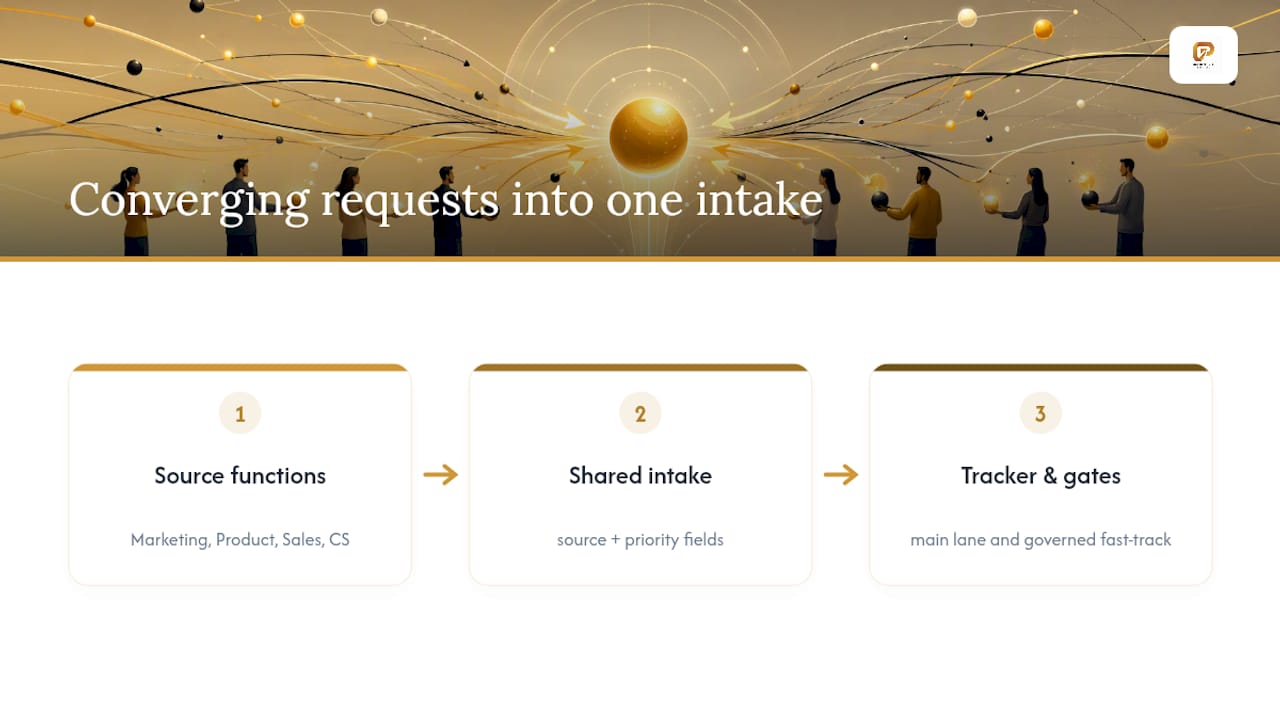
Sales enablement and customer success often get left out of the framework entirely, then flood the intake queue with urgent one-off requests that skip every gate. Building a lightweight fast-track lane, still governed, still logged, but with a shorter SLA, keeps those requests visible without letting them break the standard process for everyone else.
Centralized or Decentralized Content Ops? It Depends on Your Risk Profile
Centralization earns its overhead when regulatory exposure is high or brand consistency errors carry real cost. A financial services company or a healthcare provider needs the control that centralized governance provides. A fast-growing startup with low compliance risk usually loses more from added bureaucracy than it gains from a heavier structure.
The trade-off is speed against control. Lightweight, decentralized operations move faster but drift on standards over time. My recommendation: start decentralized, add centralized governance only where regulatory or brand risk actually justifies the friction.
— Ty
Sources
- Master content operations and keep your team moving forward — Content Marketing Institute
- Content operations and management — Trailhead (Salesforce)
- The business case for content operations: ROI data to convince your CFO — Easy Content
- Content Operations: Stages, Gates & the Minimal Stack — Gatilab
FAQ
What Are Content Operations?
Content operations, or ContentOps, is the framework of people, process, and platform that governs how content is planned, produced, published, and retired across an organization. It replaces ad hoc production with documented stages, gates, and measurable outcomes.
What Are the Three Pillars of a Content Operations Framework?
The three pillars are people (roles and ownership), process (briefs, SLAs, standards), and platform (the tools that store, route, and measure content). Weakness in any one pillar creates bottlenecks that show up in the other two.
What Are the Stages in a Content Lifecycle?
A standard content lifecycle includes intake, analysis, create, edit, build and publish, distribute, repurpose, and measure. Each stage has its own exit criteria that must be met before work moves forward.
How Do You Measure Content Operations Success?
Track cycle time, throughput versus plan, first-pass edit rate, and refresh ratio as your core operational metrics. Review the faster-moving metrics like cycle time weekly, and slower systemic ones like refresh ratio monthly.
What Are the Content Operations Maturity Levels?
Most models describe three stages: ad hoc (no documented process), defined (briefs and gates exist but vary by team), and optimized (centralized standards, personas, and journey maps shared across departments). Moving from defined to optimized typically requires executive sponsorship.