Migrating a mainframe to the cloud means moving legacy IBM z/OS applications, COBOL batch jobs, VSAM databases, and associated workloads onto modern cloud infrastructure, whether AWS, Azure, GCP, or Oracle Cloud. Enterprises pursue this for three converging reasons: mainframe hardware and MIPS-based licensing costs are rising, the COBOL talent pool is shrinking fast, and cloud platforms now offer capabilities, including AI, real-time APIs, and elastic compute, that mainframes simply cannot match. The migration itself is not a single event. It spans a spectrum from rehosting existing binaries on cloud emulators, to refactoring COBOL into Java or C#, to fully replacing applications with cloud-native microservices.
Key components of any mainframe migration program include:
- Application inventory: Cataloging all COBOL, PL/I, and JCL programs, CICS transactions, and IMS or DB2 databases
- Data migration: Moving VSAM files and proprietary data stores to relational databases like PostgreSQL or Aurora
- Integration layer: Building API facades or middleware to connect remaining mainframe components with cloud services
- Compliance mapping: Identifying HIPAA, PCI DSS, and GDPR obligations before data leaves the protected mainframe environment
What are the real benefits of moving mainframe workloads to the cloud?
The financial case is concrete. According to a Kyndryl survey, mainframe modernization projects typically represent 3.9% of an organization’s IT budget yet deliver average annualized cost savings of $23.3 million. Organizations also report becoming 9% more profitable by modernizing on the mainframe and 11% more profitable when integrating with or moving off it entirely.
Beyond cost, cloud platforms give your team access to AI, machine learning, and DevOps pipelines that legacy systems were never designed to support. Disaster recovery improves because cloud environments offer geographic redundancy without the capital expense of a secondary data center. Security posture can also improve, provided compliance obligations under PCI DSS, GDPR, and HIPAA are secured early in architecture before data leaves the mainframe environment.
Which migration strategy fits your mainframe program?
Four primary patterns exist, and most enterprises combine more than one.
| Strategy | Typical cost | Timeline | Best for |
|---|---|---|---|
| Rehosting (emulation) | $600K | 6–12 months | Fast exit, MIPS cost reduction |
| Refactoring (COBOL to Java/C#) | $2.2M | 12–24 months | Long-term modernization |
| Rearchitecting (microservices) | ~$4M | 24–48 months | Strategic transformation |
| Hybrid (mainframe + cloud) | — | Ongoing | Core banking, insurance, government |
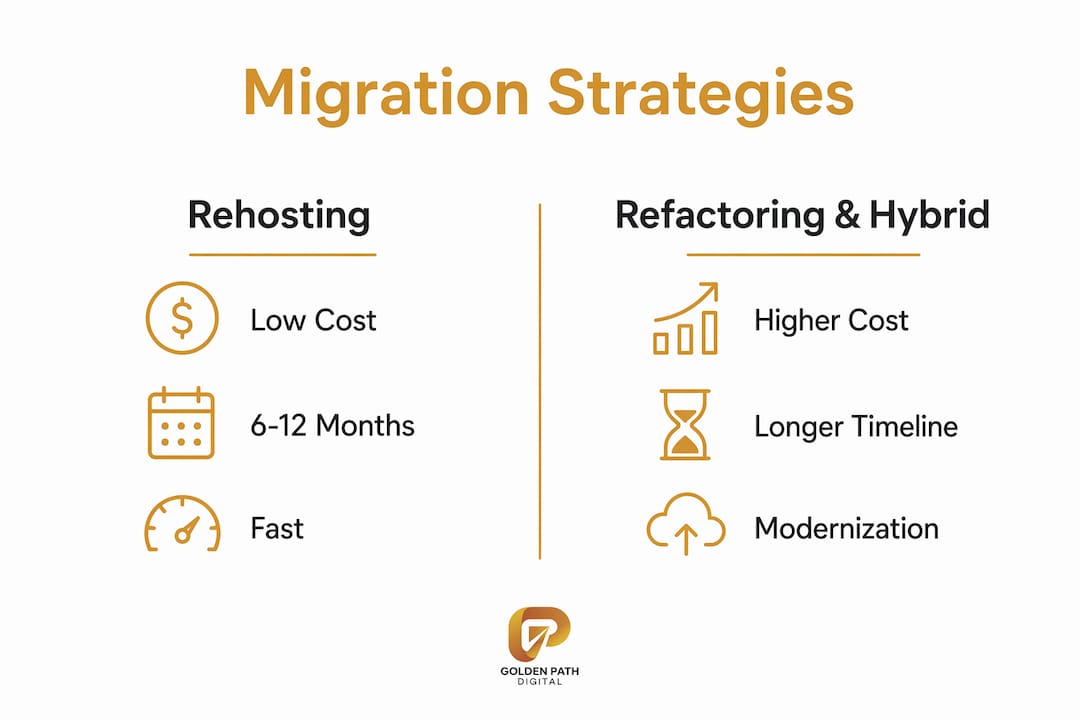
Rehosting runs existing COBOL binaries inside an AWS-hosted emulator with no code changes. It is the fastest path out of a mainframe contract but locks in higher steady-state cloud costs because the emulated environment carries inherent inefficiency.
Refactoring converts COBOL source code to Java or .NET using automated tools. The upfront investment is higher, but the resulting codebase is portable and the long-term operating cost is materially lower. Refactoring pays back over a 5–7 year horizon; emulation pays back in 2–4 years.

Hybrid approaches are a very common choice among enterprises. The mainframe stays as the system of record and settlement engine, while all new customer-facing applications run on cloud. An API gateway or middleware layer, such as IBM z/OS Connect or MuleSoft, bridges the two environments.
When migration may not be the right move: if your mainframe runs fewer than 500K lines of well-structured COBOL and the business case does not close within 36 months, a MIPS reduction program on the existing estate may deliver faster savings while you build the migration case properly.
What challenges and risks should you plan for before you start?
Architectural complexity is the first obstacle most teams underestimate. Mainframe applications accumulate decades of undocumented business logic, tightly coupled CICS transactions, and batch jobs that assume overnight processing windows. Cloud architectures assume 24/7 operation, so eliminating batch windows requires business process changes, not just technical ones.
VSAM to relational database migration is consistently the hardest part of any mainframe program. Organizations that treat it as a standard DBA task routinely spend 2–3 times their data migration budget. It requires domain experts who understand the business logic embedded in KSDS and ESDS file structures, not just database administrators.
Big-bang cutovers without a parallel run period are the leading cause of failed migrations. Best practice is a minimum 6-month parallel run where both environments process the same transactions, with automated reconciliation to catch discrepancies. Parallel runs that drift past 18 months erode ROI substantially.
Security risk expands the moment data leaves the mainframe. The compliance scope under PCI DSS, GDPR, and HIPAA extends to every downstream system that touches that data. Most security teams are not positioned for this shift without deliberate planning.
Pro Tip: Treat your migration as a business transformation program, not an IT infrastructure project. Stakeholder alignment, governance structure, and defined cutover criteria in your partner SOW matter as much as the technical pattern you choose.
What the 2026 market tells you about talent, automation, and funding
The COBOL talent crisis is no longer a future risk. COBOL contractor rates in North America have risen sharply, and the pipeline of new mainframe developers is essentially empty. Your options are automated refactoring, offshore contractors, or an emergency rewrite at significantly higher cost. Organizations that delay assessment are already paying the crisis premium.
AI-powered automation has changed the economics considerably. Automated COBOL-to-Java conversion reached 70–85% automation in 2026, up from 40% in 2020. The remaining 15–30% requires manual cleanup of unstructured business rules, SORT/MERGE operations, and complex screen maps. This shift cut total migration cost by approximately 35% between 2022 and 2025, turning projects that were previously cost-negative into positive-ROI programs within 18–36 months.
AWS operates a specialized MAP variant for mainframe migrations with funding ratios materially better than standard cloud migration programs. Mainframe workloads classified as “modernization” rather than “migration” routinely qualify for higher funding tiers. Negotiate the partner SOW in parallel with the funding agreement, and lock your EDP tier before finalizing the MAP agreement.
Bridge-skilled professionals who understand both COBOL and cloud-native development are the most valuable resource on any migration team. Internal upskilling programs, paired with AI automation services that handle structured code conversion, give your team the coverage to manage both environments during the transition period.
How to assess and plan your migration before writing a single line of code
Start with a full application inventory: catalog every program, transaction, batch job, and data store. Map dependencies between applications, databases, and external interfaces. This dependency map is your blast radius assessment. It tells you which workloads can move independently and which require coordinated cutovers.
Cost-benefit analysis must model four parallel cost pools: existing mainframe operating costs (MIPS licensing, hardware, facilities, headcount), migration project costs (partner SOW, internal staffing, tooling), new cloud run-rate costs, and post-migration operational costs. Migrations that fail to retire the mainframe inside the planned timeline produce TCO outcomes that look like failure even when the cloud side performed well.
Classify each workload by complexity, business criticality, and migration pattern suitability. Prioritize low-complexity, non-critical workloads for early waves to build team capability before tackling core banking or policy systems.
What does a phased migration timeline look like?
A well-structured program runs in four phases:
- Assessment (months 1–3): Application inventory, dependency mapping, cost-benefit analysis, pattern selection, and compliance scoping
- Pilot (months 4–9): Migrate one low-risk workload end-to-end to validate tooling, test the parallel run process, and calibrate team velocity
- Scaled migration (months 10–30): Apply the Strangler Fig pattern to incrementally extract business domains, domain by domain, while the mainframe remains the system of record
- Cutover and decommission (months 24–48): Execute blue/green deployment, run parallel environments for 6–12 months, validate reconciliation, then decommission the mainframe transaction environment
Define cutover criteria in the SOW before the parallel run begins. Partners paid on time-and-materials during parallel run have no financial incentive to end it.
How do you choose the right cloud platform for mainframe workloads?
Platform selection comes down to five criteria: mainframe-specific tooling availability, compliance certifications, network connectivity options, pricing model fit, and long-term vendor commitment to the modernization pattern you choose.
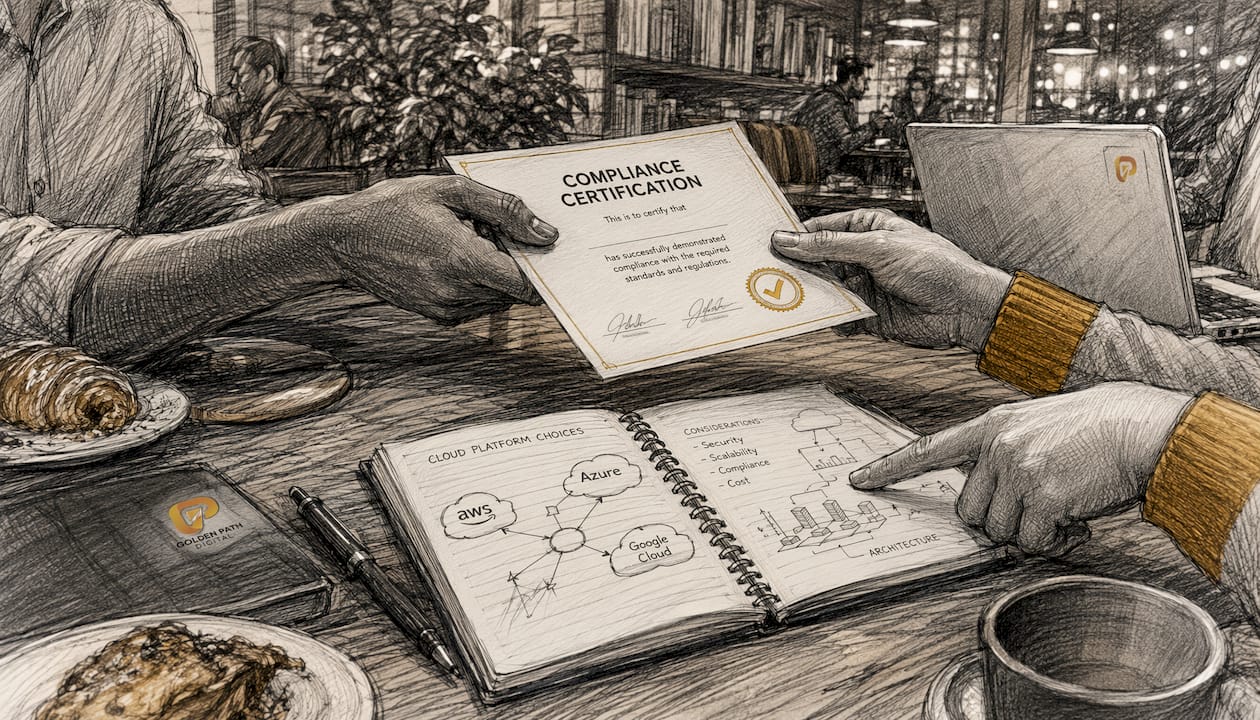
AWS offers the broadest mainframe-specific tooling, including AWS Transform for mainframe (COBOL-to-Java refactoring) and AWS Mainframe Modernization for replatforming. Oracle provides high-performance cloud infrastructure with AI-enabled enterprise applications suited for industries like banking and healthcare; Oracle Cloud@Customer starts at $250,000 per month for organizations requiring private cloud deployment within their own data centers. Azure and GCP offer strong general-purpose infrastructure but fewer mainframe-specific managed services.
For hybrid scenarios, evaluate AWS Direct Connect or equivalent dedicated network links carefully. Moving data out of a cloud environment back to on-premises systems for hybrid workloads can generate significant egress costs that rarely appear in initial TCO models.
Which tools support mainframe to cloud migration?
The tooling landscape covers four functional areas:
- Automated refactoring: AWS Transform for mainframe (COBOL to Java), Raincode, and similar tools handle 70–85% of structured logic conversion automatically
- Replatforming runtimes: AWS Mainframe Modernization with Rocket Software (formerly Micro Focus) recompiles COBOL and PL/I for cloud execution with minimal code changes
- Data migration: Specialized VSAM-to-PostgreSQL tooling combined with domain expert engagement; never treat this as a standard ETL task
- API integration: IBM z/OS Connect, MuleSoft, and custom REST facades over CICS transactions bridge mainframe and cloud during hybrid phases
For legacy code modernization programs that include IBM i RPG alongside COBOL, dependency mapping before applying any automated tool is the step that separates controlled migrations from expensive surprises. Golden Path Digital’s AS/Forward product addresses exactly this gap for RPG codebases. You can also explore migration best practices for additional technical guidance on sequencing workloads.
How do you verify performance and quality after migration?
Post-migration validation runs in three layers. First, functional testing confirms that migrated applications produce identical outputs to the mainframe for the same inputs. Second, performance testing validates that transaction response times and batch processing windows meet or exceed mainframe benchmarks. Third, reconciliation testing compares financial totals, record counts, and data integrity metrics between environments during the parallel run period.
Allocate 40% of your total project budget for user acceptance testing. Projects that budget only 20% for UAT consistently run over schedule and over budget during the parallel run phase.
How do you manage change and train your IT teams through migration?
Organizational resistance is a primary cause of migration failure, not technical complexity. Your mainframe operations team of 5–15 specialists will be replaced by a broader cloud engineering function. That transition requires deliberate planning, not just retraining.
Establish a migration center of excellence early, combining mainframe domain experts with cloud engineers. Run knowledge transfer sessions where COBOL developers document business rules before automated tools process the code. This preserves institutional knowledge that no refactoring tool can extract. For teams managing IBM i modernization alongside mainframe programs, the talent cliff is the same: act on upskilling before the window closes.
Key Takeaways
Migrating a mainframe to the cloud delivers average annualized savings of $23.3 million, but only when the migration pattern, parallel run, and data migration are planned with the same rigor as the technical execution.
| Point | Details |
|---|---|
| Hybrid is the dominant model | 78% of enterprises in 2026 keep the mainframe as system of record while running new apps on cloud. |
| Automation changes the math | AI-powered COBOL conversion reached 70–85% automation in 2026, cutting total migration cost by ~35% since 2022. |
| VSAM migration is the hard part | Organizations that treat VSAM-to-relational migration as a DBA task spend 2–3 times their data migration budget. |
| Parallel run duration controls ROI | A 6–12 month parallel run is best practice; extending past 18 months erodes the migration business case. |
| Compliance must be scoped early | HIPAA, PCI DSS, and GDPR obligations extend to every cloud system that touches migrated data. |
FAQ
Can a mainframe be migrated to the cloud?
Yes. Mainframe applications, data, and workloads can move to cloud platforms using rehosting, refactoring, or hybrid approaches. The right pattern depends on your timeline, codebase size, and long-term modernization goals.
How much does it cost to migrate a mainframe to the cloud?
Enterprise migration costs typically range from $600K for a basic rehosting project to $4M or more for full rearchitecting, with large-scale programs varying depending on MIPS size and codebase volume.
What will replace the mainframe?
Cloud-native microservices, containerized APIs, and managed database services on platforms like AWS, Azure, GCP, and Oracle Cloud are the most common replacements. Most organizations use a hybrid model rather than a full replacement.
Is cloud better than a mainframe?
Cloud platforms offer greater agility, lower infrastructure costs, and access to modern AI and DevOps tooling. Mainframes retain advantages in raw transactional throughput and availability for specific workloads, which is why 78% of enterprises run both in a hybrid configuration rather than eliminating the mainframe outright.