

For most PPC teams, the right starting point is a rule-based multi-touch model, specifically position-based W-shaped attribution, running alongside last-click and first-click as sanity checks. Graduate to data-driven attribution once your account generates enough conversion volume to support it, per Google Ads’ own guidance. This approach answers the question that actually matters to budget owners: which channels deserve credit for starting, nurturing, and closing a deal, not just the one that happened to get the last click.
Here’s why this matters immediately. Last-click attribution, still the default mental model for most paid search managers, systematically undervalues top-of-funnel and awareness channels. That skews budget allocation toward bottom-funnel search terms and starves the campaigns that generate demand in the first place.
Three things to do this week:
- Turn on the Model comparison report inside Google Ads and check how Cost/conv. shifts across models for your top campaigns.
- Audit your conversion definitions. If “conversion” means different things across campaigns, no attribution model will save you.
- Run your current model and a position-based model in parallel for at least 60 days before changing anything in production.
Pro Tip: Before you touch a bid strategy, brief finance and sales on why credit is about to shift. A channel that “used to convert well” isn’t underperforming. The math changed under it, and that conversation goes a lot smoother before the dashboard changes than after.
Key Takeaways
Position-based W-shaped attribution serves most PPC teams best as a starting system of record, with a graduated move to data-driven attribution once conversion volume supports stable model weights.
| Point | Details |
|---|---|
| Start with W-shaped | Assign weight to first touch, lead creation, and opportunity creation for B2B funnels. |
| Watch conversion columns | Switching models changes Conversions, Cost/conv., and any bid strategy reading those columns. |
| Run models in parallel | Test a new model against your current one for 60 to 90 days before switching fully. |
| Fix data foundations first | Standardize UTM naming, CRM timestamps, and identity resolution before trusting any model. |
| Add MMM for coverage gaps | Roughly 20 to 40% of B2B touchpoints go untracked, so pair MTA with MMM for offline and brand channels. |
Table of Contents
- What Are the Main PPC Attribution Models?
- How Attribution Models Change Google Ads and GA4 Reporting
- How Do You Choose the Right Attribution Model?
- What to Set Up Before You Switch Attribution Models
- How Should You Test an Attribution Model Change?
- Where Attribution Models Break Down
- A 90-Day Runbook for Switching Models
- Primary Sources and Further Reading
- PPC Attribution Models for Paid Search Teams: Pick, Test, Act
- Sources
- FAQ
What Are the Main PPC Attribution Models?
Every attribution model answers the same underlying question differently: which touchpoint, or touchpoints, gets credit when a customer converts? Practitioner comparisons generally group the field into seven core models, plus two complementary methodologies worth knowing.
Last-click gives 100% of the credit to the final touchpoint before conversion. It’s simple and still common, but it ignores everything that happened earlier in the funnel. First-click does the opposite, crediting whatever introduced the customer to your brand. Linear splits credit evenly across every touchpoint, which is fair but blind to the fact that not all touches carry equal weight. Time-decay weights recent touches more heavily than distant ones, useful for short sales cycles.
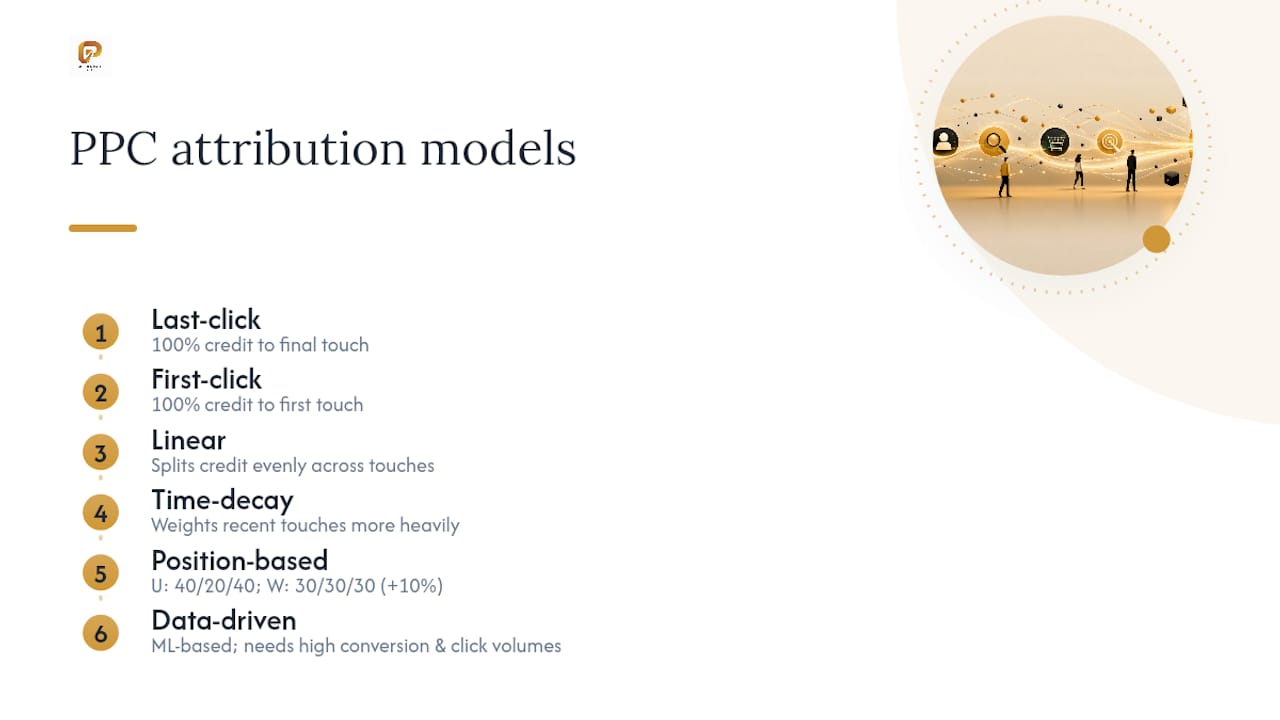
Position-based models split the difference. U-shaped gives 40% to first touch, 40% to last touch, and 20% to the middle. W-shaped extends that logic for B2B: it typically assigns 30% to first touch, 30% to lead creation, and 30% to opportunity creation, splitting the remaining 10% across other touches, according to Search Engine Journal’s breakdown. That model requires clean CRM timestamps to work correctly.
Data-driven attribution uses machine learning to assign credit algorithmically based on actual conversion patterns in your account, but it only produces stable weights when your conversion and click volumes are high enough to train the model reliably, per GetFairView’s analysis. Below that threshold, the weights fluctuate more than they should.
Consider a five-touch path: display ad, branded search, retargeting, a case study download, then a demo request. Last-click hands 100% to the demo request. W-shaped splits credit across the display ad (first touch), the case study download (lead creation), and the demo request (opportunity creation). Data-driven might land somewhere between the two, depending on what patterns it finds across thousands of similar paths.
Pro Tip: Don’t treat account-based aggregation and Marketing Mix Modeling (MMM) as competitors to these seven models. They’re different tools for different jobs. Click-based models optimize in-flight bidding; MMM measures channel effectiveness at the aggregate, budget-allocation level.
How Attribution Models Change Google Ads and GA4 Reporting
Changing your attribution model doesn’t just change a report. It changes what your bid strategies optimize toward. Google Ads confirms that switching models directly alters the numbers in your Conversions and All Conversions columns, and any automated bid strategy, Target CPA, Target ROAS, Enhanced CPC, that reads from those columns will shift its behavior in response, per Google Ads Help.
Here’s how to evaluate the impact before you flip the switch with insights from Selloop:
- Open the Model comparison report in Google Ads and select the conversion actions your bid strategies use.
- Compare Cost/conv. and Conv. value/cost across your current model and the model you’re considering.
- Note which campaigns show the biggest swings. Those are the ones where a full switch carries the most bidding risk.
- Check whether your account already defaults to data-driven attribution. Google Ads Help notes several legacy models, first-click, linear, time-decay, standalone position-based, are deprecated in favor of data-driven for most eligible conversion actions.
Cross-reference this with GA4’s own tracking behavior before drawing conclusions, since GA4 and Google Ads can report different conversion counts for the same account.
Pro Tip: When you do switch, hold Target CPA and Target ROAS targets flat for the first two weeks even if the new model reports different numbers. Give the bid strategy time to relearn under the new data before you touch the targets themselves.
How Do You Choose the Right Attribution Model?
The right model depends on four factors you can assess in an afternoon: sales-cycle length, how complex your buying committee is, monthly conversion volume, and whether your objective is demand generation or bottom-funnel conversion optimization. Pedowitz Group’s guidance is blunt about this: no single model fits every business, and the mistake most teams make is picking a model because it’s the platform default, not because it matches their sales motion.
A simple diagnostic:
- Short sales cycle, single decision-maker, high volume: start with time-decay or last-click, then test data-driven once volume supports it.
- Long B2B sales cycle, multiple stakeholders: start with W-shaped. B2B buyers often touch 7 to 14 surfaces before ever talking to sales, and position-based models capture that reality far better than last-click.
- Heavy offline or field-sales component: don’t rely on click-based models alone; layer in MMM.
Practical sequence for most teams:
- Designate one model as your system of record for bidding decisions.
- Report at least one alternate model in parallel for the first quarter.
- Move to data-driven once your account clears the conversion volume threshold to train stable weights.
- Revisit account-level attribution if you’re B2B and still measuring at the contact level. B2B buying is fundamentally an account-level activity, and contact-level models miss that.
What to Set Up Before You Switch Attribution Models
Attribution models are only as good as the data feeding them. Before touching your primary model, run through this checklist.
- Standardize UTM parameters and campaign naming conventions across every channel, so touchpoints actually stitch together into one journey.
- Validate that your conversion definitions and timestamps match across Google Ads, GA4, and your CRM.
- Map CRM stages (MQL, SQL, opportunity) so W-shaped or account-based models have clean milestones to weight against.
- Set your lookback window using your median and 90th-percentile sales-cycle length, not the platform default, a recommendation echoed in Octane11’s B2B measurement guidance.
- Bring offline conversions into the model wherever your sales team closes deals outside the funnel entirely.
| Dependency | Acceptance criteria |
|---|---|
| Tracking / UTM structure | Every campaign uses a consistent naming pattern across all platforms |
| CRM stage mapping | MQL, SQL, and opportunity stages have timestamped events |
| Identity resolution | Cross-device sessions resolve to a single contact or account record |
| Event / conversion layer | Conversion actions fire once per event with matching timestamps in Ads and CRM |
Pro Tip: Keep your old model’s data visible during the transition. Add a “legacy model” column to your Google Ads exports or run a parallel backfill analysis, so you can explain a reporting discontinuity to stakeholders instead of just apologizing for one.
How Should You Test an Attribution Model Change?
Run the new model and your current model in parallel for 60 to 90 days before making it official.
- Pull the Model comparison report weekly and track Cost/conv. and Conv. value/cost side by side.
- Where possible, set up geographic or campaign-level holdouts to test causality rather than relying on correlation alone.
- Watch for sudden shifts in channel ranking, erratic bid strategy behavior, or unexplained swings in conversion volume.
- Track downstream lead quality and win rate, not just conversion counts, since a model can look better on paper while feeding sales worse leads.
Shifting from last-click to W-shaped commonly reallocates credit toward upper-funnel channels like display and organic social. Frame that shift for finance before it shows up in a quarterly report, or it reads as a budget request instead of a measurement correction.
Where Attribution Models Break Down
Every click-based model shares the same blind spot: it can only credit what it can see. Dark funnel activity, offline conversations, word-of-mouth referrals, and cross-device journeys with no shared identity all disappear from the data.
- Identity loss from iOS privacy changes and cookie deprecation has eroded MTA coverage significantly.
- Multi-device fragmentation splits one buyer’s journey into what looks like several anonymous users.
- CRM gaps mean touches that happen after a handoff to sales often go unrecorded in marketing data entirely.
Roughly 20 to 40% of real B2B buyer touchpoints go untracked in a typical marketing stack, according to GetFairView’s benchmark analysis. That’s the ceiling on how accurate any MTA model can be, no matter how sophisticated the algorithm behind it.
That’s exactly why a hybrid MTA plus MMM architecture has become standard at the enterprise level: use MTA for day-to-day bidding decisions and MMM for strategic, offline-inclusive budget allocation.
A 90-Day Runbook for Switching Models
Days 1 through 30: align on conversion definitions across teams and stand up parallel reporting for your current and candidate models.
Days 31 through 60: run holdout tests where feasible and watch how your bid strategies respond to the new attribution data.
Days 61 through 90: bring finance and sales into the results, update the executive scorecard, and formally designate your new system of record.
A few things practitioners learn the hard way: keep a last-click view alive for channel-level operational reporting even after you switch your primary model, and if you’re adding view-through windows for display, keep them short. A 30-day view-through window inflates credit for channels that were barely involved.
Golden Path Digital’s approach to measurement work starts with data foundation and dependency mapping before any algorithmic model gets applied, the same discipline the firm brings to legacy code parsing. Identity resolution and clean CRM integration aren’t optional prerequisites; they’re the difference between a model that reflects reality and one that just looks sophisticated.

Pro Tip: Get sign-off from finance and sales in writing before the new model goes live, not after the first report lands in their inbox. Checklist: confirm conversion definitions, confirm reporting cadence, confirm who owns the exception list when numbers look strange in month one.
Ready to operationalize this? Golden Path Digital’s PPC campaign management team builds the identity resolution and CRM integration work that makes multi-touch and data-driven attribution trustworthy, instead of just technically installed. For a broader look at how measurement fits into the firm’s enterprise automation work, see the Golden Path Digital overview.
Primary Sources and Further Reading
- Google Ads Help: About attribution models for platform setup and the Model comparison report.
- LatentView’s attribution modeling frameworks for hybrid MTA/MMM architecture.
- Pedowitz Group’s model selection guidance for choosing by sales-cycle and data maturity.
PPC Attribution Models for Paid Search Teams: Pick, Test, Act
The conventional advice on attribution treats model selection like a settings toggle: pick one, apply it, move on. That’s backward. The real work is the data foundation underneath the model, and most teams skip straight past it because CRM cleanup isn’t as exciting as a new attribution dashboard.
Here’s what gets underrated constantly: identity resolution. Every model, from the simplest last-click to the most sophisticated data-driven algorithm, is only as good as its ability to recognize that the person who clicked a display ad on their phone is the same person who converted on a laptop three weeks later. Get that wrong, and W-shaped attribution just distributes credit confidently across the wrong touchpoints.
The other place conventional wisdom fails: treating data-driven attribution as automatically superior because it’s algorithmic. It’s not, below a certain conversion volume, it produces less stable output than a well-reasoned rule-based model. Sophistication isn’t the same as accuracy.
Prioritize the boring infrastructure first. The model you choose second.
Sources
- About attribution models – Google Ads Help
- How to Choose Marketing Attribution Models in 2026
- Marketing Attribution Model Comparison
- A Comprehensive Guide To Marketing Attribution Models
FAQ
What Are the Types of Attribution Models?
The main types are last-click, first-click, linear, time-decay, position-based (U-shaped and W-shaped), and data-driven, plus account-based aggregation and Marketing Mix Modeling as complementary methodologies.
What Are the Four Types of Attribution?
When people say “four types,” they usually mean the single-touch and even-weight basics: last-click, first-click, linear, and time-decay, though most practitioners now work with seven or more models including position-based and data-driven.
Which Attribution Model Is Best?
There’s no universal best model. Position-based W-shaped attribution fits most B2B and longer sales cycles, while data-driven attribution works best once your account has enough conversion volume to train stable weights.
What Does 7-Day Click, 1-Day View Attribution Mean?
This means Google Ads counts a conversion if it happens within seven days of an ad click or within one day of an ad view with no click. Shorter view-through windows help avoid over-crediting channels the customer barely engaged with.