

For IBM i shops, the safest path through an RPG to Java migration is a dependency-first, automated-assisted approach that begins with a focused pilot and behavioral validation before any production cutover. Start by running a full dependency mapping of your codebase, then scope a small proof-of-concept that proves behavioral equivalence on real production data distributions. AS/Forward, Golden Path Digital’s IBM i parsing and analysis platform, accelerates both steps by generating dependency graphs and candidate classifications before your team writes a single line of Java.
The core recommendation, in brief:
- Run dependency mapping and static analysis before selecting a migration approach.
- Validate behavioral equivalence, not just compilation, on every migrated module.
- Start with a pilot of 3–5 low-complexity programs to build confidence and a migration pattern catalog.
- Keep stateful batch and data-intensive logic on IBM i where it belongs; migrate APIs and integration layers to Java first.
- Use AS/Forward to reduce the manual analysis burden and surface hidden dependencies early.
Key Takeaways
A dependency-first, automated-assisted RPG to Java migration with behavioral equivalence validation is the approach that consistently reduces production risk and keeps programs on schedule.
| Point | Details |
|---|---|
| Map dependencies before converting | Build a full dependency graph and complexity matrix before selecting a migration approach or writing Java. |
| Validate behavior, not just compilation | Run parallel validation on production-like data; a module that compiles but ships wrong results is a production defect. |
| Pilot first, then scale | Scope 3–5 low-complexity programs for the pilot to build a migration pattern catalog and prove the approach. |
| Keep IBM i logic where it belongs | Stateful batch and data-intensive workloads often stay on IBM i; migrate APIs and integration layers to Java first. |
| AS/Forward accelerates the assessment | Golden Path Digital’s AS/Forward generates dependency graphs and candidate classifications that reduce manual analysis time. |
Table of Contents
- When does migrating RPG applications to Java make strategic sense?
- What migration strategy fits your RPG codebase?
- How to execute an RPG to Java migration, step by step
- Technical pitfalls that derail most RPG migrations
- How to prove your migrated Java code actually works
- What does RPG to Java migration actually cost, and how long does it take?
- How Golden Path Digital’s structured approach reduces migration risk
- Post-migration optimization and refactoring your Java applications
- How to build Java skills on an RPG team
- Long-term maintenance strategies for your migrated Java applications
- Integrating migrated Java applications with your existing enterprise systems
- Security considerations specific to RPG to Java migration
- The part of migration planning most teams get wrong
- AS/Forward gives your migration a foundation, not a gamble
- Sources
- FAQ
When does migrating RPG applications to Java make strategic sense?
The decision to migrate is a business choice, not a technical reflex. RPG and Java each have genuine strengths: RPG is tightly integrated with Db2 for i and IBM i’s job control for batch and transaction workloads, while Java excels for APIs, web services, and cross-platform integration. Migration makes sense when the gap between what RPG can deliver and what the business needs is widening.
Business drivers that justify migration:
- Talent availability. The RPG talent cliff is real. Experienced RPG developers are retiring faster than they are being replaced, and recruiting Java talent is measurably easier.
- Integration and API needs. Modern integration patterns, REST APIs, microservices, and cloud connectors are native to Java ecosystems. Exposing IBM i logic through Java layers reduces friction significantly.
- Cloud portability. If your roadmap includes moving workloads off IBM i hardware, Java is the portable runtime; RPG is not.
- Strategic rearchitecture. When a business unit needs to replace a legacy ERP module with a modern application, a full rewrite in Java may be the right call.
Migrate vs. wrap vs. keep: a practical decision map:
- Migrate to Java when the module needs to run off-platform, serve a REST API, or be maintained by a Java team.
- Wrap with an API layer when the business logic is stable, well-tested, and the integration surface is the only problem.
- Keep on IBM i when the workload is batch-heavy, data-intensive, and tightly coupled to Db2 for i with no off-platform requirement.
Before committing to any path, define your business “why” first. Migration is a strategic choice, and the approach should match the outcome, not the other way around.
Success metrics to define before you start:
- Time-to-market for new features post-migration
- Defect rate in migrated modules versus baseline
- Cost of ownership per function point after 12 months
- Maintainability score (cyclomatic complexity, test coverage)
- Reduction in IBM i licensing or hardware costs
What migration strategy fits your RPG codebase?
Five approaches exist, and none is universally correct. The right choice depends on your codebase’s complexity, your team’s skills, your timeline, and how much behavioral risk you can absorb.
| Approach | What changes to source | Time to production | Cost drivers | Post-migration maintenance | Risk level | Skills required |
|---|---|---|---|---|---|---|
| Line-by-line conversion (source-to-source) | Syntax translated automatically | Weeks to months | Tooling license, validation, rework | High: Java-flavored RPG is hard to maintain | Medium-high | RPG to validate, Java to maintain |
| Automated-assisted conversion | Parsed, transformed, and validated with tooling | Months | Tooling license, behavioral testing, refactoring | Medium: improves with post-migration refactoring | Medium | RPG domain knowledge, Java for refactoring |
| Selective rewrite | New Java implementation, module by module | Months to years | Developer time, design, testing | Low: idiomatic Java from day one | Low (per module) | Java, RPG domain knowledge |
| Wrap/API exposure | RPG stays; Java or REST layer added | Weeks | Integration development, API design | Low: RPG unchanged | Low | Java/API, minimal RPG |
| Rehost/containers | RPG runs in a container or emulated environment | Days to weeks | Infrastructure, licensing | High: deferred modernization | Very low | Infrastructure |
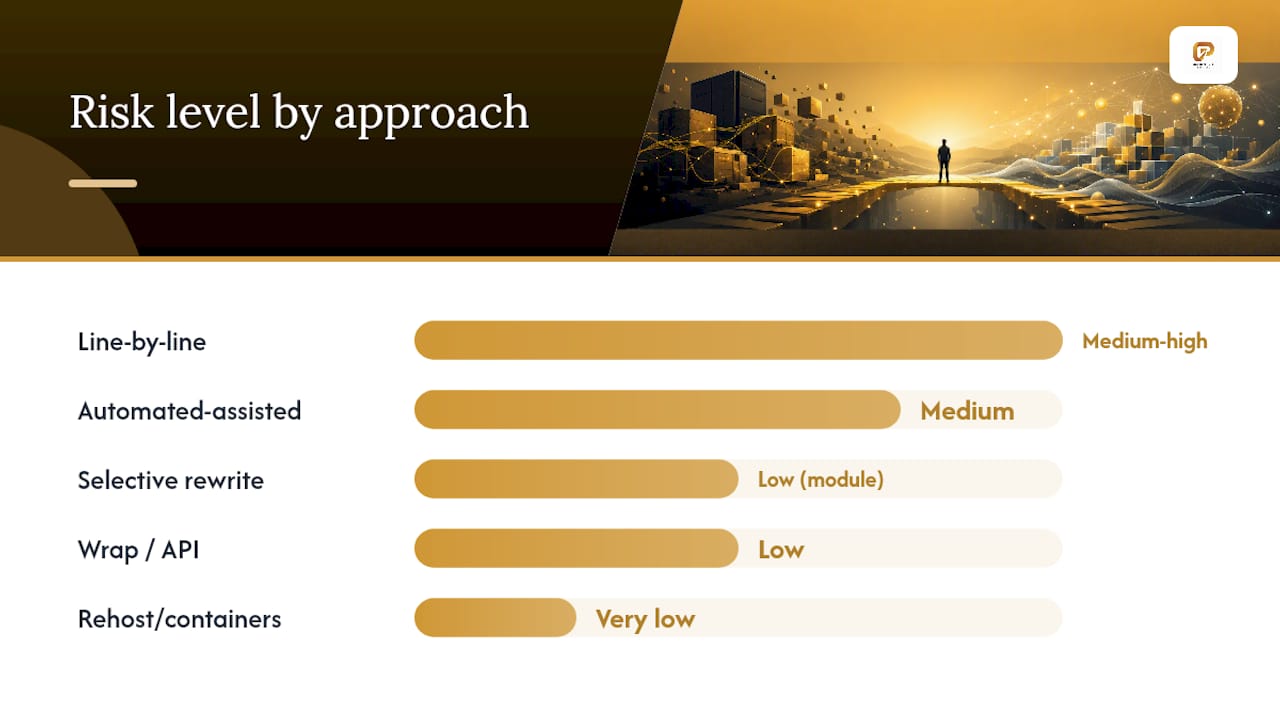
Source-to-source compilers automate syntax translation but do not replicate implicit language or runtime contracts, which means they require careful downstream validation and often significant refactoring. Automated tools can also produce what practitioners call “Java-flavored RPG”: code that mirrors RPG structure in Java syntax, which neither RPG nor Java maintainers find easy to evolve.
When to use each approach:
- Automated-assisted conversion is the right default for mid-size portfolios where speed matters and you have the discipline to run behavioral validation. It is not a shortcut; it is a structured accelerator.
- Selective rewrite fits modules with complex business rules that need to be redesigned anyway, or where the RPG logic is so tangled that translation produces more risk than a clean implementation.
- Wrap/API is the fastest path to integration value and the lowest-risk option for stable, well-tested RPG programs. Pair it with AI-led integration patterns to expose IBM i logic as modern services without touching the core.
- Rehost buys time but does not reduce technical debt. Use it only as a bridge while planning a real migration.
Hybrid approaches, wrapping stable modules while selectively rewriting high-churn ones, are frequently the most practical answer for large portfolios.
How to execute an RPG to Java migration, step by step
A migration that skips the assessment phase is a migration that runs on a prayer instead of a schedule. The steps below apply to a single-application pilot and scale to a full portfolio.
- Discovery and stakeholder alignment. Identify the application scope, business owners, and success criteria. Produce a one-page migration charter that names the “why,” the acceptance criteria, and the rollback conditions.
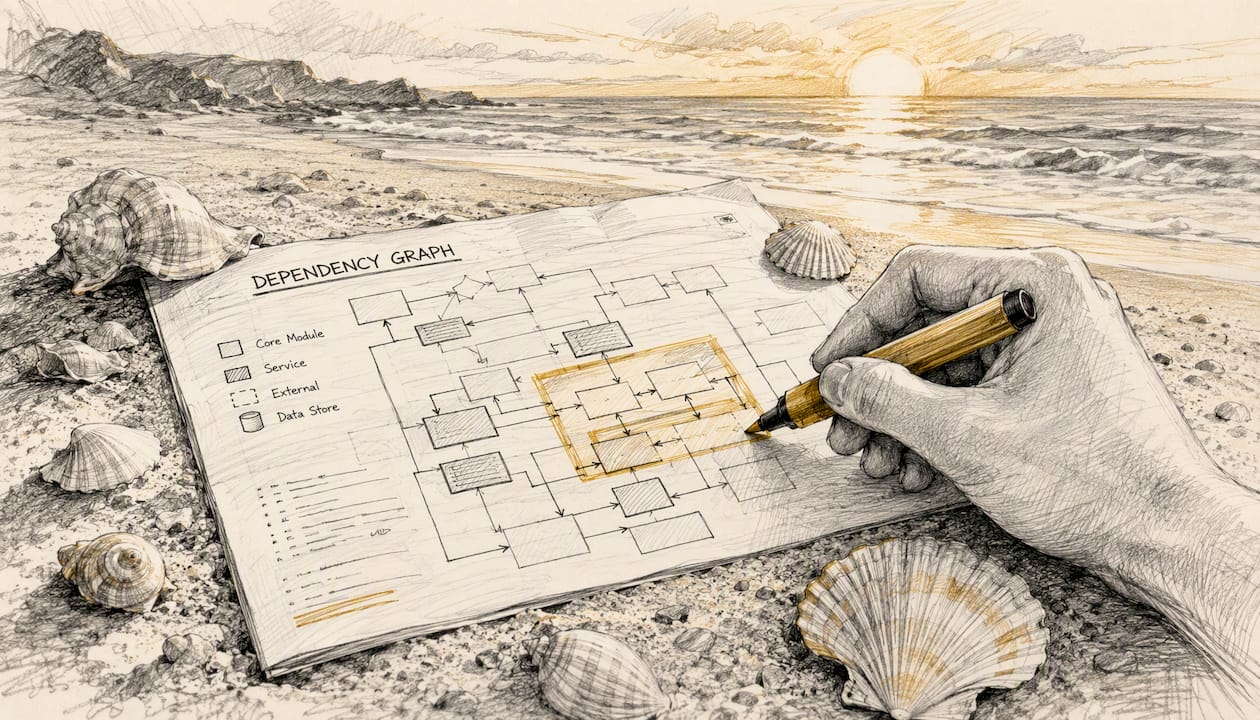
- Dependency mapping and static analysis. Use RPG code analysis tooling to build a dependency graph covering program calls, file references, data structures, and external service calls. This step defines the blast radius of any change.
- Code classification and prioritization. Classify each program by complexity (lines of code, cyclomatic complexity, number of dependencies, presence of fixed-format RPG, embedded SQL). Prioritize low-complexity, low-dependency modules for the pilot.
- Select target architecture and patterns. Decide on Java version, build tooling (Maven or Gradle), JDBC driver for Db2 for i, and the patterns for handling RPG-specific behaviors (packed decimals, activation group state, CHAIN semantics).
- Pilot conversion. Convert 3–5 classified programs using your chosen approach. Capture every behavioral decision as a migration pattern for the catalog.
- Parallel validation. Run the Java output alongside the RPG original on production-like data. Compare outputs field by field. Any divergence is a defect, not a known difference.
- Incremental rollout. Promote validated modules to production one at a time, with a rollback gate at each step. Never cut over an entire application in a single move.
Artifacts each step produces:
| Step | Artifact |
|---|---|
| Discovery | Migration charter, scope boundary document |
| Dependency mapping | Dependency graph, call tree, file reference map |
| Classification | Complexity matrix, prioritized candidate list |
| Architecture selection | Pattern catalog, technology decision record |
| Pilot conversion | Migrated Java modules, behavioral spec |
| Parallel validation | Test corpus, equivalence report, defect log |
| Incremental rollout | Rollout plan, rollback runbook |

Timeline guidance:
A pilot covering 3–5 low-complexity programs typically runs 4–8 weeks, including dependency mapping, conversion, and behavioral validation. A mid-size application of 50–150 programs with moderate complexity generally takes 6–18 months end-to-end, depending on documentation quality and testing depth. A structured modernization assessment at the start of the program is the single most reliable way to tighten that range.
Technical pitfalls that derail most RPG migrations
The code that compiles is not the code that works. Automated and AI-assisted migrations frequently produce output that diverges behaviorally from the original because they miss implicit RPG runtime contracts. These are the traps your team needs to plan for explicitly.
Language and runtime differences:
- Packed decimal truncation vs. rounding. RPG truncates packed decimal arithmetic by default; Java’s
BigDecimalrounds. A single mismatched rounding mode in a financial calculation produces silent, low-frequency errors that only appear at month-end. - CHAIN stale-data behavior. When an RPG CHAIN operation finds no record, the data structure retains its previous values. Java has no equivalent default. Code that relies on this implicit state will produce wrong results silently.
- Activation group persistence. RPG activation groups maintain state across calls within a job. Java does not replicate this model automatically. Stateful programs that depend on activation group scope require explicit state management in the Java equivalent.
- RPG cycle logic. The RPG program cycle (implicit read-process-write loop) has no Java analog. Programs that rely on the cycle need to be rewritten, not translated.
- Fixed-format RPG parsing. Fixed-column RPG is harder to parse and analyze than modern free-form RPG. Older codebases often mix both, which complicates automated analysis.
I/O and database considerations:
- Embedded SQL in RPG uses host variables and cursor semantics that differ from JDBC. Verify isolation levels, commitment control settings, and cursor behavior match exactly.
- File access patterns using native IBM i record-level access (RLA) have no direct JDBC equivalent. Translating RLA to JDBC queries requires careful attention to key positioning, partial-key reads, and locking semantics.
- Journaling and commitment control on Db2 for i behave differently from standard JDBC transaction management. Test rollback and commit boundaries explicitly.
Performance and operational differences:
Batch jobs that run in minutes on IBM i can take significantly longer in Java if the translation produces row-by-row JDBC calls instead of set-based SQL. Practitioner-reported regressions include missing documentation, underestimated complexity, and performance surprises that only appear under production load.
Pro Tip: Build a “semantic gap register” at the start of your pilot: a documented list of every RPG behavior that has no direct Java equivalent. Assign a Java implementation pattern to each one before conversion begins. This register becomes the foundation of your migration pattern catalog.
How to prove your migrated Java code actually works
Compilation is not validation. The goal of testing in an RPG to Java migration is behavioral equivalence: the Java output must produce the same results as the RPG original for every input the business actually sends it.
Unit-level behavioral testing:
- Extract input/output pairs from production logs or test environments before migration begins.
- Write unit tests that assert exact output values, including edge cases: zero quantities, negative balances, end-of-year dates, and not-found conditions.
- Test every CHAIN/READ/READE path, including the no-record-found case, which is where stale-data bugs hide.
Regression corpus construction:
- Sample production transaction data across the full distribution of input values, not just the happy path.
- Include year-end, month-end, and fiscal-period boundary data explicitly.
- Capture outputs from the RPG system before migration as the golden baseline.
- Run the Java equivalent against the same inputs and diff the outputs automatically.
Integration and system testing:
- Test JDBC connections to Db2 for i under the same isolation levels the RPG programs used.
- Validate API contracts if the Java module is exposed as a REST endpoint.
- Run full batch job sequences end-to-end, not just individual programs, because batch dependencies create failure modes that unit tests miss.
- Define rollback gates: if the defect rate in parallel validation exceeds a threshold your team sets in advance, the module does not go to production.
Performance and load testing:
Run performance tests before cutover, not after. Capture production-like data volumes and run the Java batch equivalent against them. A pilot that includes behavioral specification extraction and production-like test corpora substantially reduces the chance of silent failures after cutover.
Key validation principle: A migrated module is not ready for production until it passes parallel validation on production-like data, not just unit tests on synthetic inputs.
What does RPG to Java migration actually cost, and how long does it take?
Budget and timeline vary widely, but the variables that drive them are predictable. Understanding the levers helps you scope a program your organization can actually fund and staff.
Primary cost drivers:
- Analysis and dependency mapping. Skipping this step does not save money; it moves the cost to remediation after cutover, where it costs more.
- Business rule complexity. Undocumented logic, implicit cycle behavior, and packed decimal arithmetic all add analysis and testing time.
- Data migration. If the migration includes restructuring Db2 for i tables or moving data to a new schema, that work is often as large as the code migration itself. See the legacy database migration guide for a structured approach.
- Testing effort. Behavioral equivalence testing is the largest single cost driver in most programs. Cutting it is where migrations go wrong.
- Consultancy and licensing. Tooling licenses, external expertise, and environment costs are real but typically smaller than internal labor.
- Remediation and refactoring. Post-migration cleanup of “Java-flavored RPG” code adds time if the initial conversion was not validated carefully.
Timeline ranges by program size:
| Program size | Approximate timeline | What lengthens it |
|---|---|---|
| Pilot (3–5 programs) | 4–8 weeks | Poor documentation, missing test data |
| Small application | 3–6 months | Embedded SQL complexity, RLA patterns |
| Mid-size application (50–150 programs) | 6–18 months | Undocumented logic, regulatory validation |
| Large portfolio (150+ programs) | 18 months | Data migration, parallel run requirements |
Practical ways to reduce cost and time:
- Scope the pilot tightly: 3–5 programs, fixed deliverables, fixed timeline.
- Keep critical-path IBM i workloads on IBM i during migration; migrate integration and API layers first.
- Use automation for low-complexity, low-dependency modules and reserve manual effort for high-complexity ones.
- Stage the rollout so each module goes to production independently, reducing the blast radius of any single failure.
How Golden Path Digital’s structured approach reduces migration risk
The Golden Path method is built on a principle that most migration programs violate: map dependencies before you touch code. The sequence is inventory, dependency mapping, behavioral specification, automated-assisted conversion, and staged rollout. Each step produces artifacts that the next step depends on, which means there are no surprises at cutover.
AS/Forward is the platform that makes this sequence executable at scale. Its capabilities relevant to your migration program include:
- Deep parsing of both fixed-format and free-form RPG, including mixed codebases.
- Dependency graph generation that maps program calls, file references, data structures, and service calls across the full IBM i codebase.
- Complexity and candidate classification that identifies which programs are suitable for automated-assisted conversion and which require selective rewrite.
- Pilot tooling that supports proof-of-concept scoping and behavioral spec extraction.
A deterministic, dependency-aware migration pipeline that extracts behavioral specs and runs reproducible validation provides stronger guarantees of behavioral equivalence than blind automated translation. That is the architecture AS/Forward is built around.
What a typical AS/Forward-assisted pilot produces:
- A full dependency graph of the scoped application.
- A complexity matrix with candidate classifications.
- A behavioral specification for each pilot program.
- A migration pattern catalog capturing RPG-to-Java decisions.
- An equivalence report from parallel validation.
Vendor or internal team checklist when evaluating migration partners:
- Does the vendor perform dependency mapping before proposing a conversion approach?
- Can they demonstrate behavioral equivalence testing on production-like data, not just compilation?
- Do they have documented experience with IBM i–specific behaviors (activation groups, CHAIN semantics, packed decimals)?
- Is the pilot scoped with fixed deliverables and acceptance criteria, not open-ended time and materials?
- Can they show a vendor evaluation framework that separates analysis from conversion from validation?
Post-migration optimization and refactoring your Java applications
The first version of migrated Java code is rarely the best version. Even with careful conversion, the output often reflects RPG’s procedural structure rather than Java’s object-oriented and functional idioms. Post-migration refactoring is where the long-term maintainability gains are realized.
Practical refactoring priorities:
- Replace procedural loops that mirror RPG’s record-by-record processing with JDBC batch operations or set-based SQL queries. This is the single highest-impact performance change in most migrations.
- Introduce proper Java exception handling to replace RPG’s indicator-based error signaling. Indicators translated literally into boolean flags produce code that is nearly impossible to maintain.
- Refactor data structure handling to use Java POJOs or records rather than flat arrays that mirror RPG data structures.
- Apply standard Java profiling tools (JProfiler, VisualVM, or Java Flight Recorder) to identify hotspots before optimizing. Profile first, then refactor.
- Introduce dependency injection (Spring Framework is the most common choice) to decouple modules that were tightly coupled in the original RPG codebase.
Post-migration is also the right time to introduce unit test coverage using JUnit and to integrate the codebase into a CI/CD pipeline. Code that was never tested in RPG needs tests before it can be safely evolved in Java.
How to build Java skills on an RPG team
The skill gap between RPG and Java is real, but it is not as wide as it looks from the outside. RPG developers understand business logic, data structures, and IBM i deeply. What they need is Java syntax, object-oriented design patterns, and modern tooling.
A practical skill development path:
- Start with Java fundamentals: syntax, types, collections, and exception handling. Oracle’s Java SE documentation and the IBM i modernization framework are both useful references.
- Move to JDBC and Db2 for i connectivity early, since this is where RPG developers will spend most of their initial Java time.
- Introduce Maven or Gradle for build management, then Git for version control if the team is not already using it.
- Pair RPG developers with Java developers during the pilot phase. The RPG developer knows what the code is supposed to do; the Java developer knows how to express it idiomatically.
- Use the migration pattern catalog from the pilot as a training resource. Real examples from your own codebase are more effective than generic tutorials.
Avoid the temptation to send the whole team to a Java bootcamp before the pilot starts. Learning on real migration work, with a pattern catalog and a pairing model, produces faster and more durable skill transfer than classroom training alone.
Long-term maintenance strategies for your migrated Java applications
A migrated application that is not maintained will accumulate technical debt faster than the original RPG code did, because Java ecosystems move quickly. Plan for maintenance from day one.
Key maintenance strategies:
- Establish a Java LTS (Long-Term Support) version policy. Migrate to each new LTS release on a defined schedule rather than letting the runtime fall behind. Java 21 is the current LTS as of 2026.
- Maintain the migration pattern catalog as a living document. When a new RPG-to-Java decision is made during the rollout, add it to the catalog so future maintainers understand why the code is structured the way it is.
- Keep the behavioral test corpus active and run it as part of the CI/CD pipeline. This is your regression safety net for every future change.
- Document the IBM i–specific behaviors that were translated into Java patterns. This knowledge lives in the heads of the original migration team and must be written down before those team members move on.
- Plan for dependency updates: Java libraries, JDBC drivers, and frameworks require regular updates. A dependency management tool like Dependabot or Renovate integrated into your pipeline reduces the manual burden.
Integrating migrated Java applications with your existing enterprise systems
Java’s integration ecosystem is one of the primary reasons organizations migrate from RPG in the first place. But integration work carries its own risks if not planned carefully.
The most common integration patterns for migrated IBM i applications are REST APIs, message queues (IBM MQ or Apache Kafka), and JDBC connections back to Db2 for i for data that remains on IBM i. Legacy IBM i systems can be exposed as modern services through API layers without requiring a full migration of every program, which is the wrap/API approach in practice.
Integration planning priorities:
- Define the integration surface before migration begins. Which programs will be called by external systems? Which will call external systems? These are your highest-priority migration candidates.
- Use a service registry or API gateway (IBM API Connect, Kong, or AWS API Gateway) to manage the integration surface as programs migrate incrementally.
- Validate that JDBC transaction boundaries in the Java layer match the commitment control boundaries the RPG programs used. Mismatched transaction semantics are a common source of data integrity issues post-migration.
- Test integration points under realistic concurrency. RPG jobs on IBM i are single-threaded by design; Java services can be called concurrently, which exposes race conditions that never existed in the original system.
Security considerations specific to RPG to Java migration
Security posture often changes during migration in ways teams do not anticipate. RPG programs running on IBM i inherit the platform’s object-level security model, which is mature and well-understood. Java applications running on a JVM do not inherit that model automatically.
Security areas to address explicitly:
- Authentication and authorization. RPG programs rely on IBM i user profiles and object authority. Java applications need explicit authentication (OAuth 2.0, LDAP, or SAML) and role-based access control. Map every IBM i authority check to an equivalent Java security control before cutover.
- Data in transit. IBM i internal communications are often unencrypted because they run on a trusted internal network. Java services exposed as APIs must use TLS. Verify that JDBC connections to Db2 for i use SSL.
- Input validation. RPG programs often receive fixed-format input with implicit type constraints. Java services receiving JSON or XML input need explicit input validation to prevent injection attacks.
- Secrets management. Database credentials, API keys, and service account passwords that were embedded in RPG source or data areas need to move to a secrets management system (HashiCorp Vault, AWS Secrets Manager, or equivalent) in the Java environment.
- Audit logging. IBM i journals provide a detailed audit trail. Java applications need explicit audit logging to match the compliance posture the RPG system provided.
The part of migration planning most teams get wrong
The single most important planning priority in an RPG to Java migration is protecting business behavior, not modernizing architecture. Architecture can be improved after the migration. Business behavior that breaks in production cannot be recovered without an emergency rollback, and rollbacks at scale are expensive and damaging to organizational confidence.
The teams that succeed treat behavioral equivalence as a non-negotiable gate, not a nice-to-have. They build the test corpus before they write a line of Java. They run parallel validation on production-like data before any module goes live. And they scope their pilots tightly enough that a failure is a learning experience, not a crisis.
What belongs in a steering committee checkpoint or pilot review: the equivalence report (pass/fail by module), the defect log with root cause classifications, the migration pattern catalog with any new patterns added during the pilot, and a go/no-go recommendation with explicit rollback criteria. If your pilot review does not include all four of those artifacts, the pilot is not finished.
AS/Forward gives your migration a foundation, not a gamble
Golden Path Digital built AS/Forward specifically for the problem your team is facing: an IBM i codebase with decades of accumulated logic, limited documentation, and a migration program that cannot afford to ship wrong results. AS/Forward parses your RPG codebase deeply, generates the dependency graphs your team needs to scope the work accurately, and classifies candidates for automated-assisted conversion before a single line of Java is written.

The result is a migration that runs on evidence rather than estimates. Your team knows the blast radius before they start. Your pilot has fixed deliverables and acceptance criteria. Your behavioral test corpus is built from production data, not synthetic inputs. Golden Path Digital’s IBM i modernization framework covers the full program from assessment through staged rollout, and the RPG modernization bridging guide helps you decide which modules to migrate, which to wrap, and which to leave on IBM i. Request a scoped pilot assessment at Goldenpathdigital and get a dependency graph and candidate classification for your first target application.
Sources
- Migrating RPG code to modern languages – Strumenta
- Migrating from RPG to Java in ERP system: Benefits, challenges, and best practices – VM.pl
- Source-to-source compiler — Wikipedia
FAQ
What is the biggest risk in an RPG to Java migration?
The biggest risk is behavioral divergence: migrated Java code that compiles and passes basic tests but produces wrong results on edge-case inputs. Implicit RPG runtime contracts, such as CHAIN stale-data behavior and packed decimal truncation, are the most common sources of silent production defects.
How long does an RPG to Java migration pilot take?
A well-scoped pilot covering 3–5 low-complexity programs typically takes 4–8 weeks, including dependency mapping, conversion, and parallel behavioral validation.
Should all RPG programs be migrated to Java?
No. RPG and Java have different strengths, and stateful batch workloads tightly coupled to Db2 for i often perform better staying on IBM i. Migrate APIs, integration layers, and off-platform workloads first.
What does AS/Forward do in a migration program?
AS/Forward parses IBM i RPG codebases, generates dependency graphs, and classifies programs by complexity and migration candidacy. It gives your team the analysis foundation needed to scope a pilot accurately and select the right conversion approach for each module.
How do you test behavioral equivalence after migration?
Run the Java output in parallel with the RPG original against production-like data, compare outputs field by field, and treat any divergence as a defect. Build the test corpus from real production data distributions before migration begins, not after.